Three Cloud Foundry Stories
Given at Cloud Foundry Day Europe 2025 (Frankfurt, Germany) on .
Recording
Abstract
A talk about telling Cloud Foundry stories - "I'm from marketing, and I'm here to help." Coté walks through four customer case studies (a major bank, Rabobank, Charles Schwab, and DATEV) using a simple runbook for what makes a good one. The setup: Cloud Foundry is in a great moment thanks to private-cloud and sovereign-cloud demand, but not enough people know about it. The fix is more stories, told well.
Slides
Further Resources
- TryTanzu.ai - 90-day trial
- "Enterprise Grade Platform Engineering at Charles Schwab," Coté, September 2024
- Cloud Foundry Weekly
- "Platform Engineering for Private Cloud," Coté, NDC Oslo 2025
Transcript
I'm from marketing, and I'm here to help
Hello, I'm from marketing, and I'm here to help. If you remember one of our former movie actors from the 50s. Thanks for having me, and thanks for being here. What I want to go over is three - actually four - stories, or if you'll pardon the word, case studies of people who use Cloud Foundry. Unlike my usual introverted cocoony self - staying at the hotel, running off to my room between sessions, looking down at the ground so I don't have to talk with people - I actually talked with people here. So I got an extra one, which was delightful. The numbers might be a little wrong on the new one, but I can point the finger at the person who gave it to me if you want the corrected ones.
The perfect time for Cloud Foundry
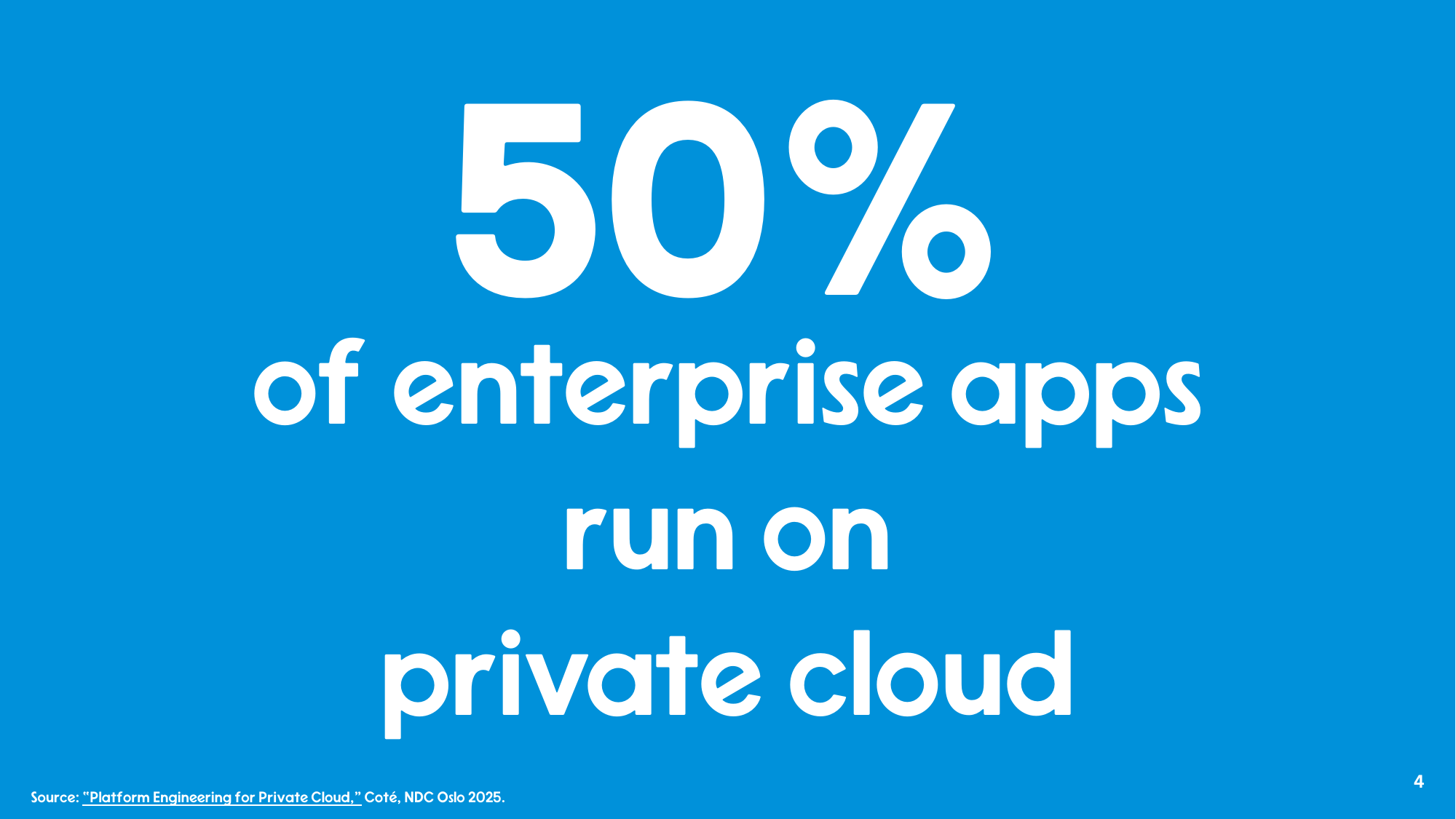
This has been said many times, but it really is a great time for Cloud Foundry, for any PaaS to be around. There's the sentiment of wanting a platform around to do more rapid application development - I don't know if you've heard of that concept. Let the developers focus on what they're doing. There are a few other things supporting it too. By my reckoning, each year about 40 to 50% of applications run on what you want to call dedicated cloud, or private cloud, or on-premises, or "I manage my own stack of stuff" cloud. That doesn't initialize very well. But the number has stuck for many years if you look at the analyst reports. There's a whole presentation I have going over that, with charts. If you really get into charts, I'd love to talk to you - there aren't that many of us around.
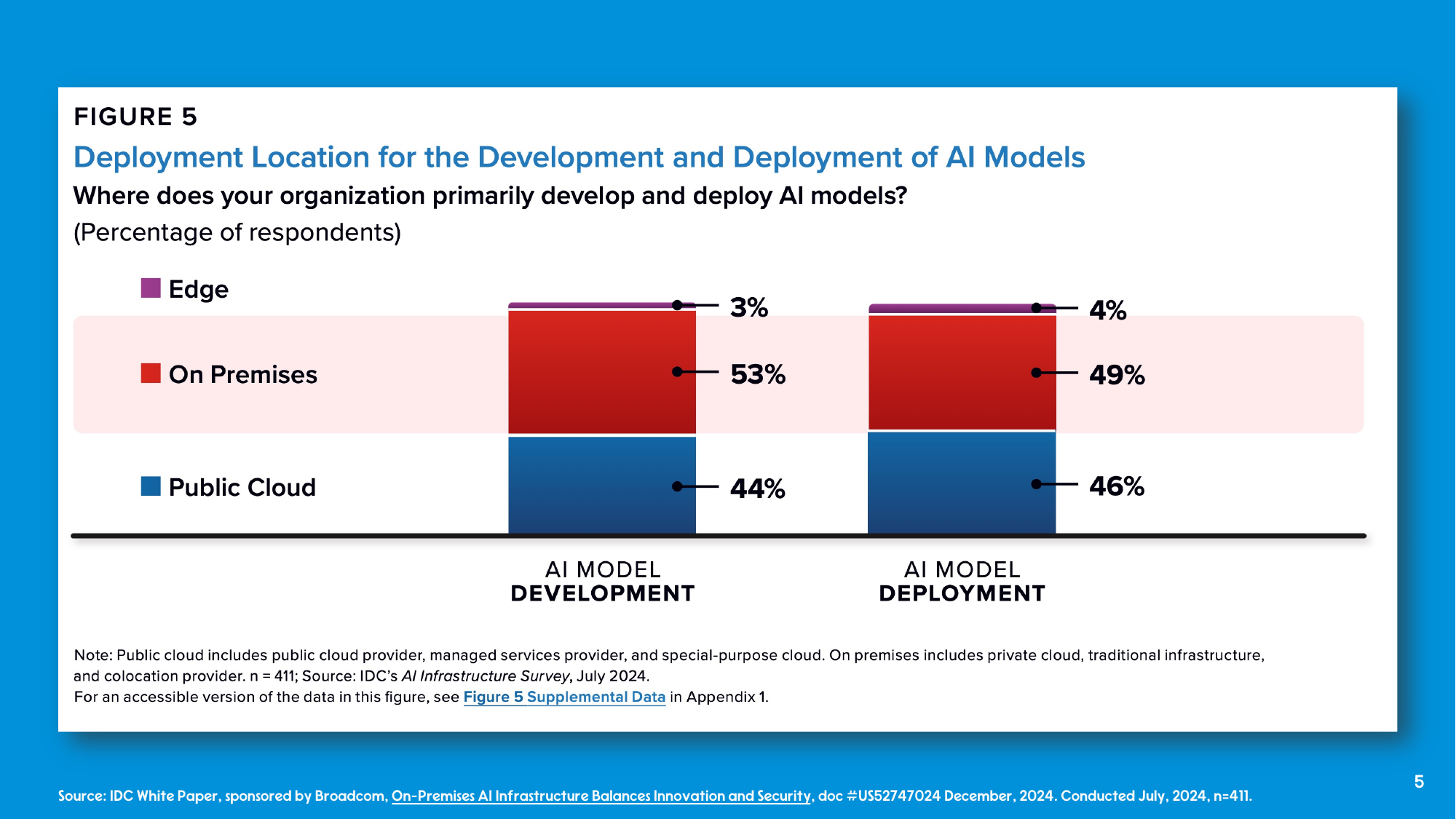
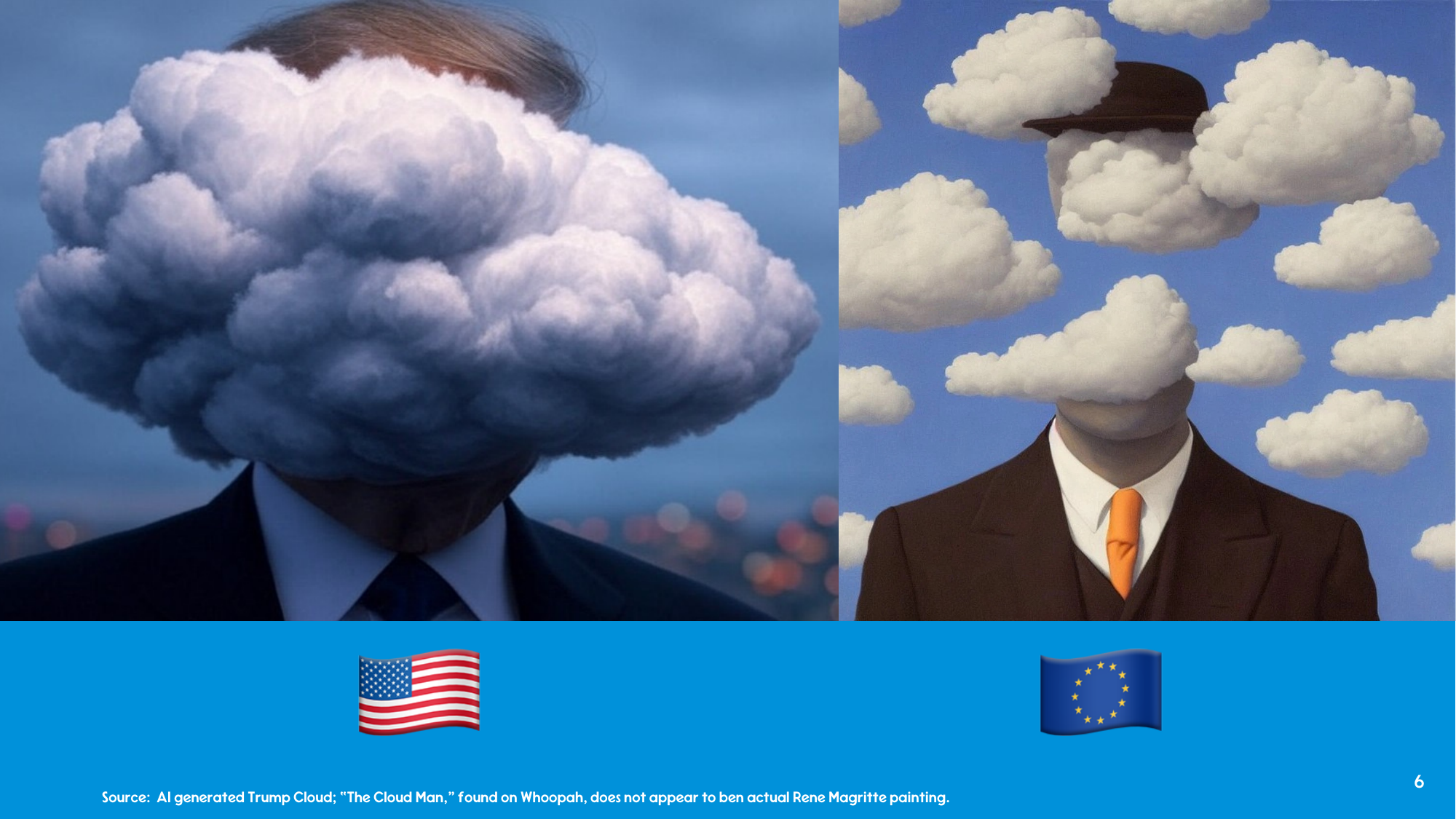
Speaking of charts, when you ask people where they want to do their AI stuff, a lot of them want to do it in - I lump edge in here, it seems extreme to care about something called edge, but I know it's important - in their own environments. Which again is a perfect situation for a platform. And then thanks to my friends back home, lots of discussion about sovereign cloud, or as an American I like to think about it, the not-American cloud. The rest of the world instead of just the US-based ones. Again, a great opportunity for a PaaS, for Cloud Foundry, to be around. As long as you don't call it PaaS. We can't say that anymore. It's got bad memories and connotations - "where did the three-layer stack touch you, make you feel bad?" Just say platform.
Not enough people know about Cloud Foundry
The issue is, not enough people know about Cloud Foundry. They know of it distantly, in the past, as sort of a thing. We don't really get the story out that much, which is what I want to go over. I'll give a quick intro to myself, because I enjoy it when people engage with my brand, as one of my old friends used to say. I've been in this area for about 10 years - at Pivotal, then VMware, then VMware Tanzu, then VMware Tanzu by Broadcom, and I think now we're Tanzu by Broadcom. I just put "Tanzu" because it's a lot faster than all of that other stuff. I don't know if I successfully showed you how much brand training I've been through. Kind of a bad student.
The case-study runbook
Part of what I want to do for this community is a little bit of, if you'll forgive it, pedantry. We should be putting together a lot more of these stories, or case studies - I'm going to go between those two words. This is kind of a template for what you want to do with a case study. The point is to show people who are interested, or people who need to be told this, that what you have is worth their time, that it works, and that it fits their problems. If you go look at the Cloud Foundry site, there are actually a lot of case studies. We just don't have a lot of new updated ones. That's something I think could be pretty easy for us to do as a community.
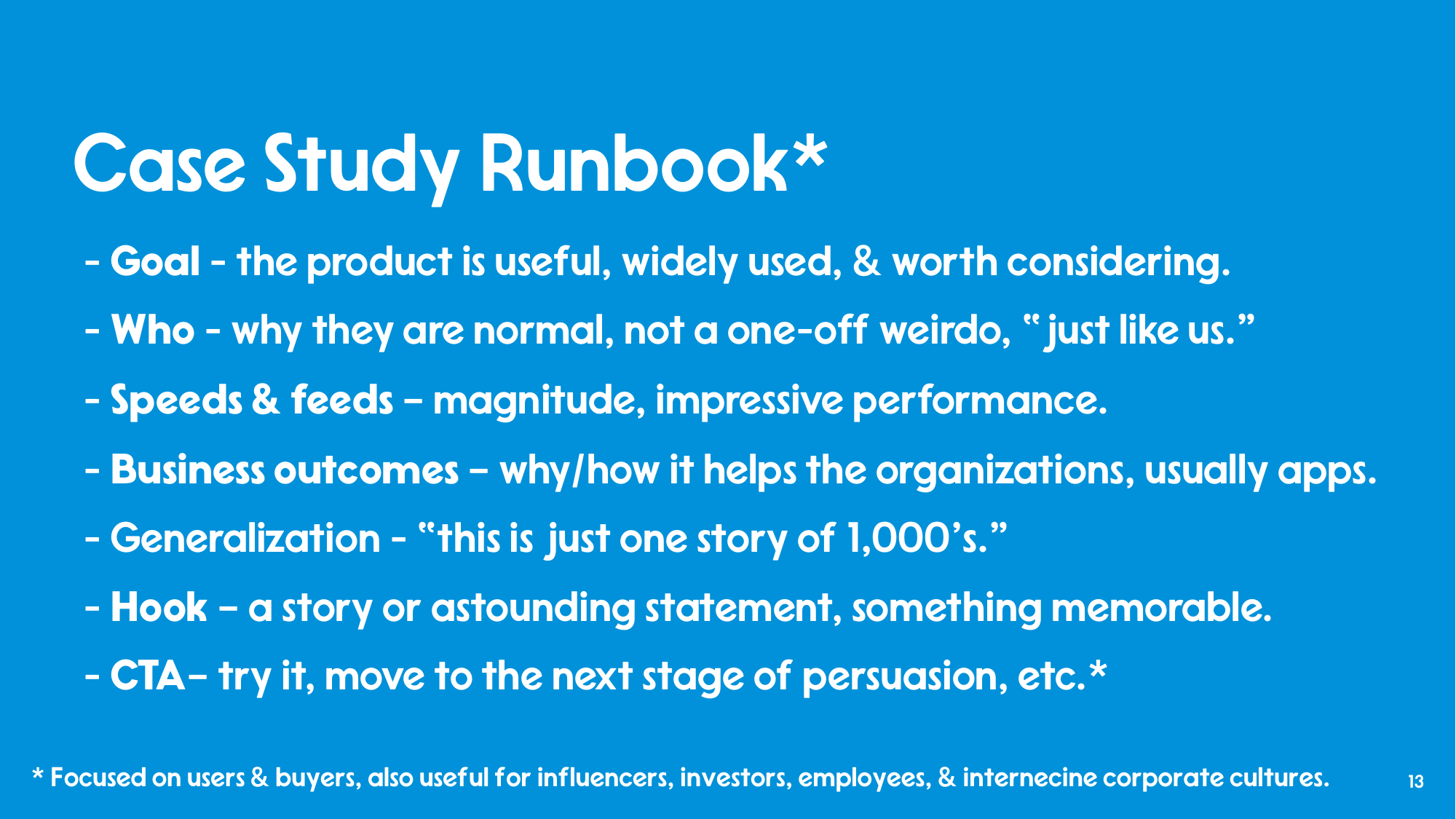
I'm going to go over four. These aren't the technical terms from a textbook - I just made them up. The first one we'll call "It just works."
Story 1: "It just works" - one bank since 2018
What you do with this kind of story is show that this isn't some wacky crazy science-fiction stuff. There was a time when everyone was like "we want to be like Google" and you'd be like, "I don't think you know what you're talking about. You probably don't want to be like that, and you don't need to be like that." This is the opposite. This is "we'd like to go home at 4:30 every day and not have to do some crazy exotic stuff. Be stable, be running in a normal way, be good." Not in a moral way, in an effective way.
This one is anonymized. Here's a bank - I assume most all banks are beloved, a nice beloved bank of the world. You can see what their Cloud Foundry foundations are supporting. The number I like the most, the most tangible to my mind, isn't the application instances or the containers - if you tell that to someone outside this community they're like, "I have no idea what you're talking about. Is a container an AI?" I focus on the number of applications they're supporting, and what they're actually doing with the platform. Because that's why this is a good "it just works" example: this is a regular organization, in a good way. Something people depend on every day, if not multiple times a day. They're running their retail banking, payments, open-banking integrations, and the Gen AI stuff Oren and Josh were going over earlier.
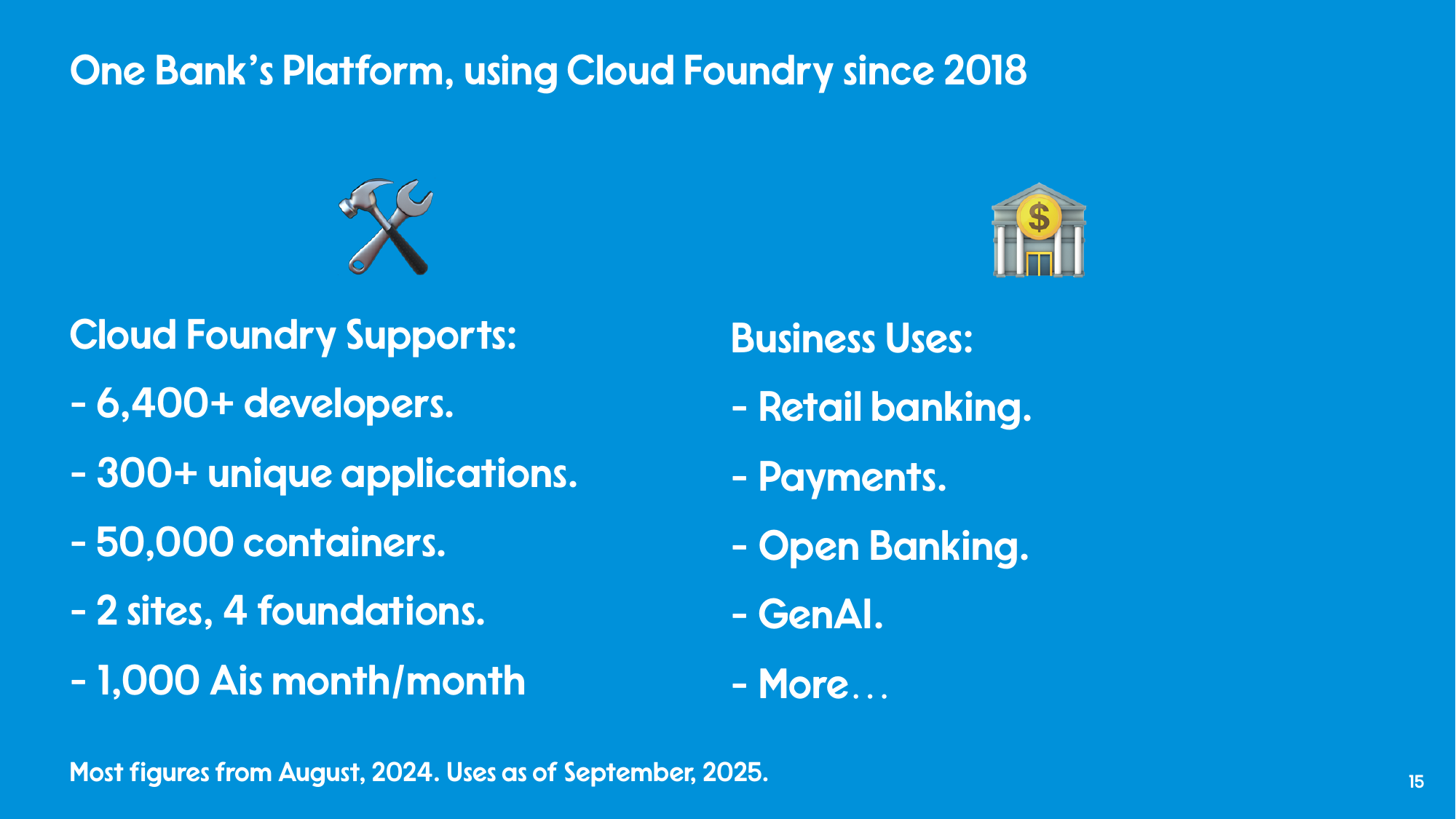
The other side of the case study is outcomes - business outcomes, if you want the marketing term. Why do I care, other than a bunch of big numbers? These are sometimes harder to quantify but equally important. This bank can deploy during working days, and I had to learn this technical term, "heightened awareness periods," which sounds like whenever my kids are home for me. Faster setup time, faster patching, and equally important - we don't talk about this as much as we used to - happy developers. What's good about the "it just works" story is we're not generating images of kangaroos riding horses here. We don't have exotic needs. We just want to make sure you get paid, or that you pay your bills. The things that run not entire, but huge parts, of our lives.
Story 2: "The Open Sourcer" - Rabobank since 2017
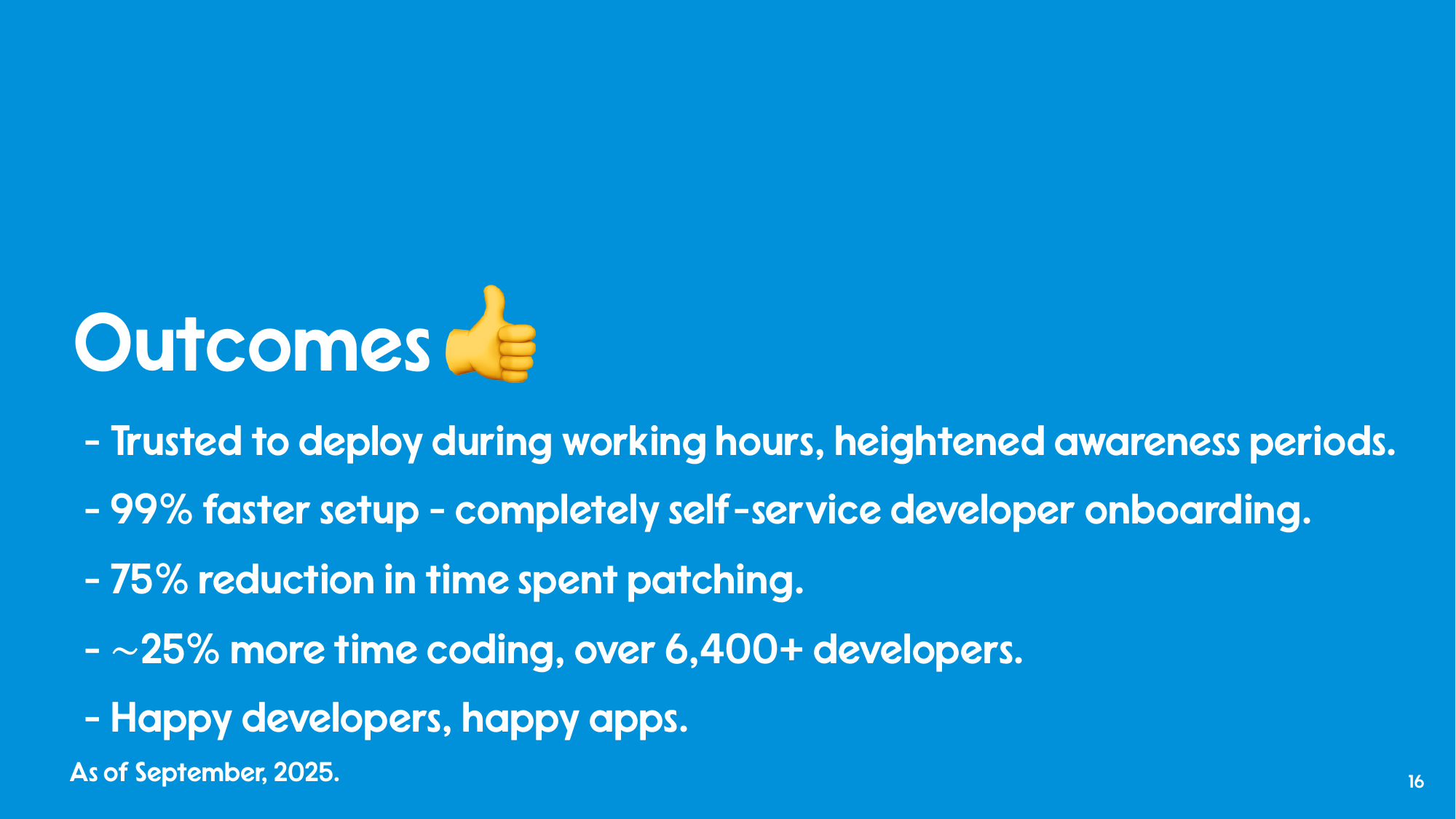
If you're one of my coworkers, close your ears and your eyes for this next part. If you're watching the film, definitely if you're in my upper management chain, just pretend this didn't happen. Here's an example of the open sourcer. Any community like this needs to be more - despite my compensation - than just one person selling the stuff. To put it one way, all of our Cloud Foundry stories are all of our Cloud Foundry stories. This is Rabobank. They first started using Cloud Foundry, probably PCF Pivotal, back in 2017, and four years ago they migrated to open source. Great to see them in the community. I live in Amsterdam, so unfortunately I'm not a Rabo customer. But I encounter them all the time. When I first moved there they were the first ones with Apple Pay, on the bus stops everywhere. I'm going to assume they're the most technologically advanced bank available, just because I could pay with my phone in 2018.
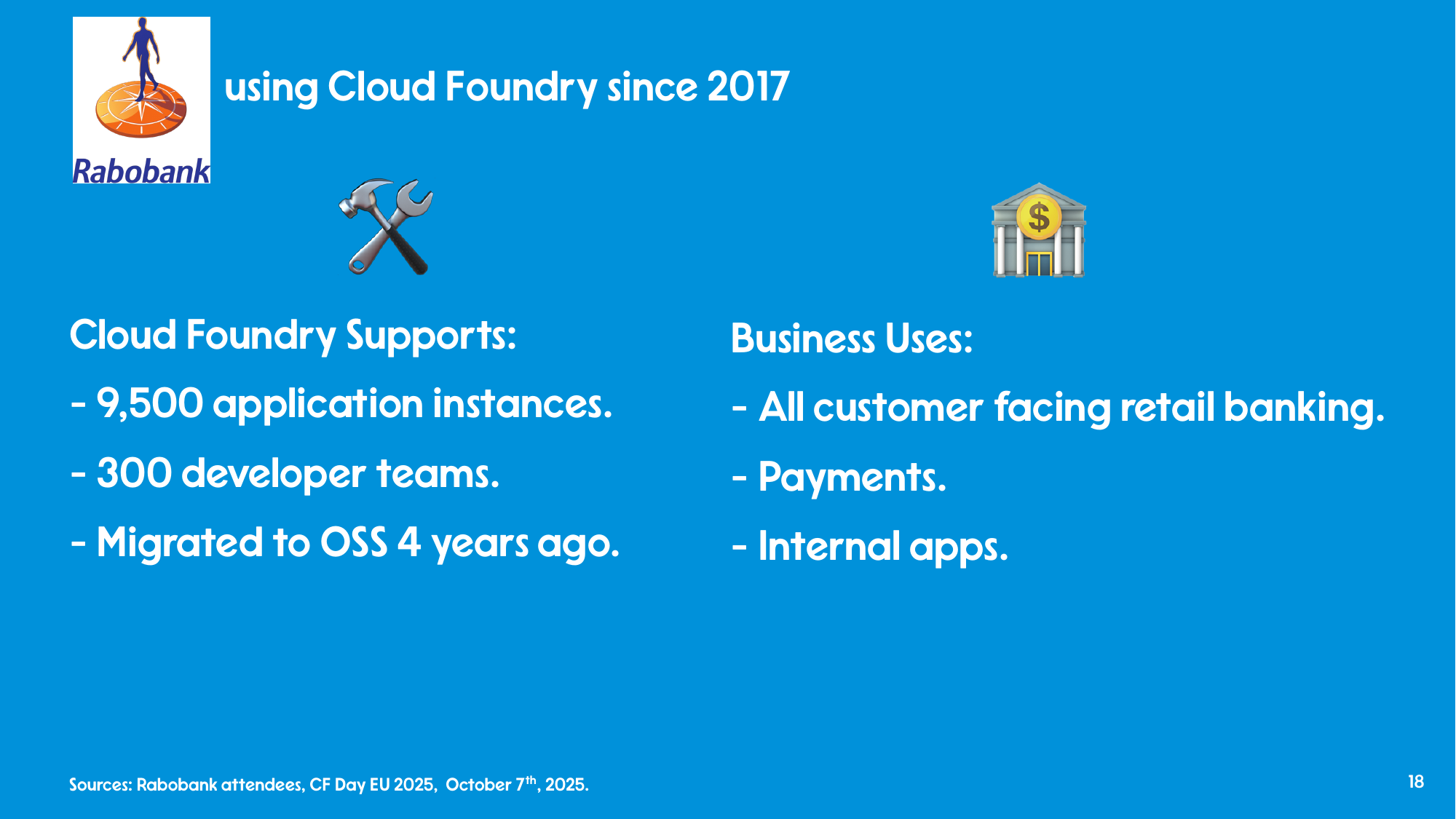
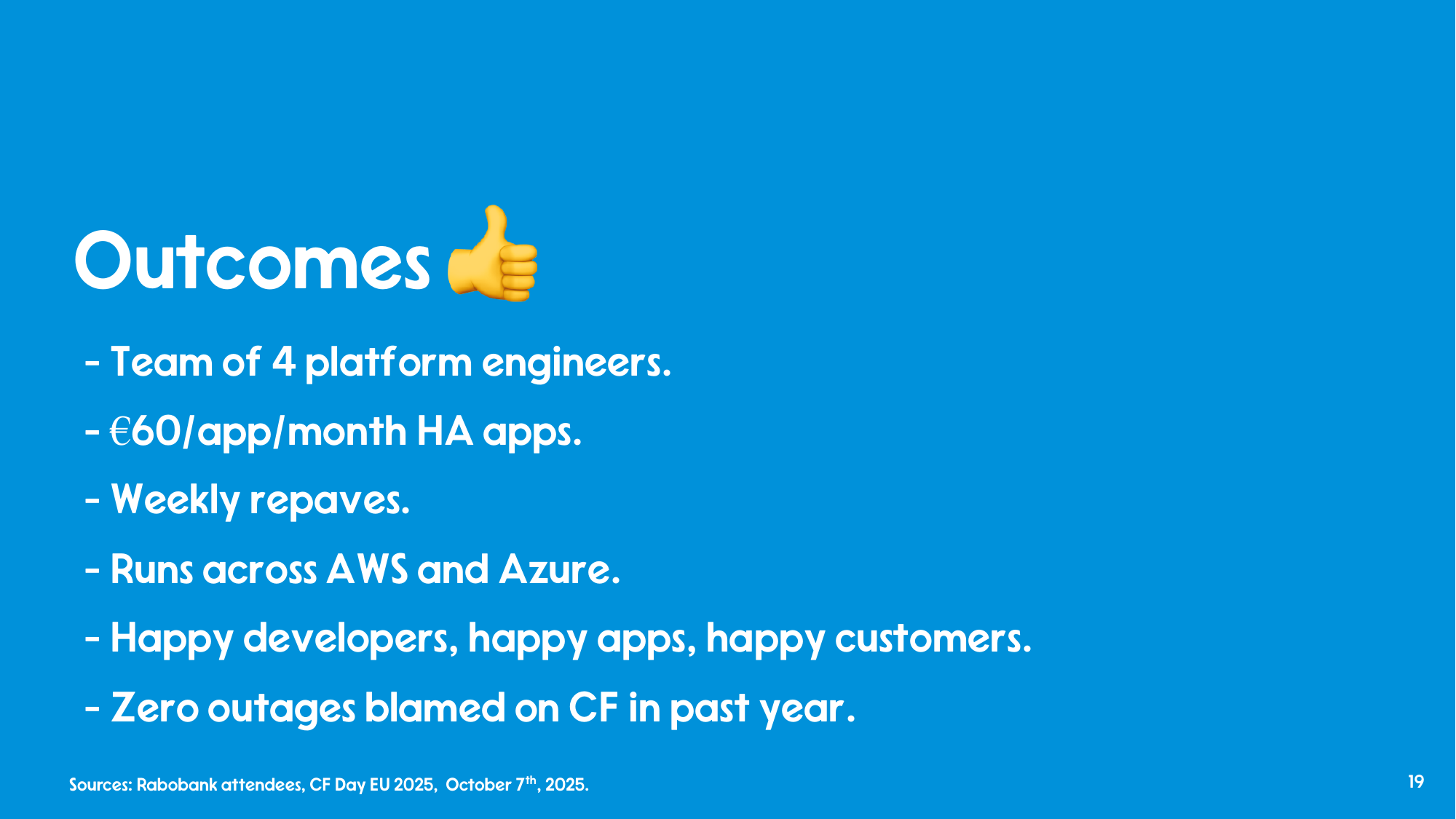
You can see their numbers - a Netherlands bank with reach outside the Netherlands, a bit smaller, which is fine. Supporting 300 developer teams. All their retail banking runs on Cloud Foundry, payments too, and lots of internal applications. One figure we in the community like to quote all the time is the developer-to-operator ratio - 300 developer teams supported by a four-person platform team. Astounds people. The last outcome is my favorite: zero outages blamed on Cloud Foundry in the past year. Which reminds me of another case I'll anonymize - pretty much all of their stuff went down, and the executive team was like, "What's that over there in the corner that didn't go down?" And it was their Cloud Foundry platform. Which reminded me that in marketing you often have to tell people you exist. If something is stable and just running well, it's worth telling people about over and over.
Story 3: "Impressive Performance / CompliantAF" - Schwab since 2014
Next one we'll call the impressive performer. This is the one where you say, "oh, they're operating at Google scale," or whatever scale. Another financial institution. This is also a great example of why the cameras at the back are a fantastic marketing asset, because all of this is from a recorded talk the Schwab people gave at a conference. Once you have something on YouTube, it's a multiplier. Speaking to you in this room is very nice - I love it, pleasant, good to see you - but YouTube reaches the people we haven't talked to yet, the ones hanging out finding videos. That's who we want to reach most.
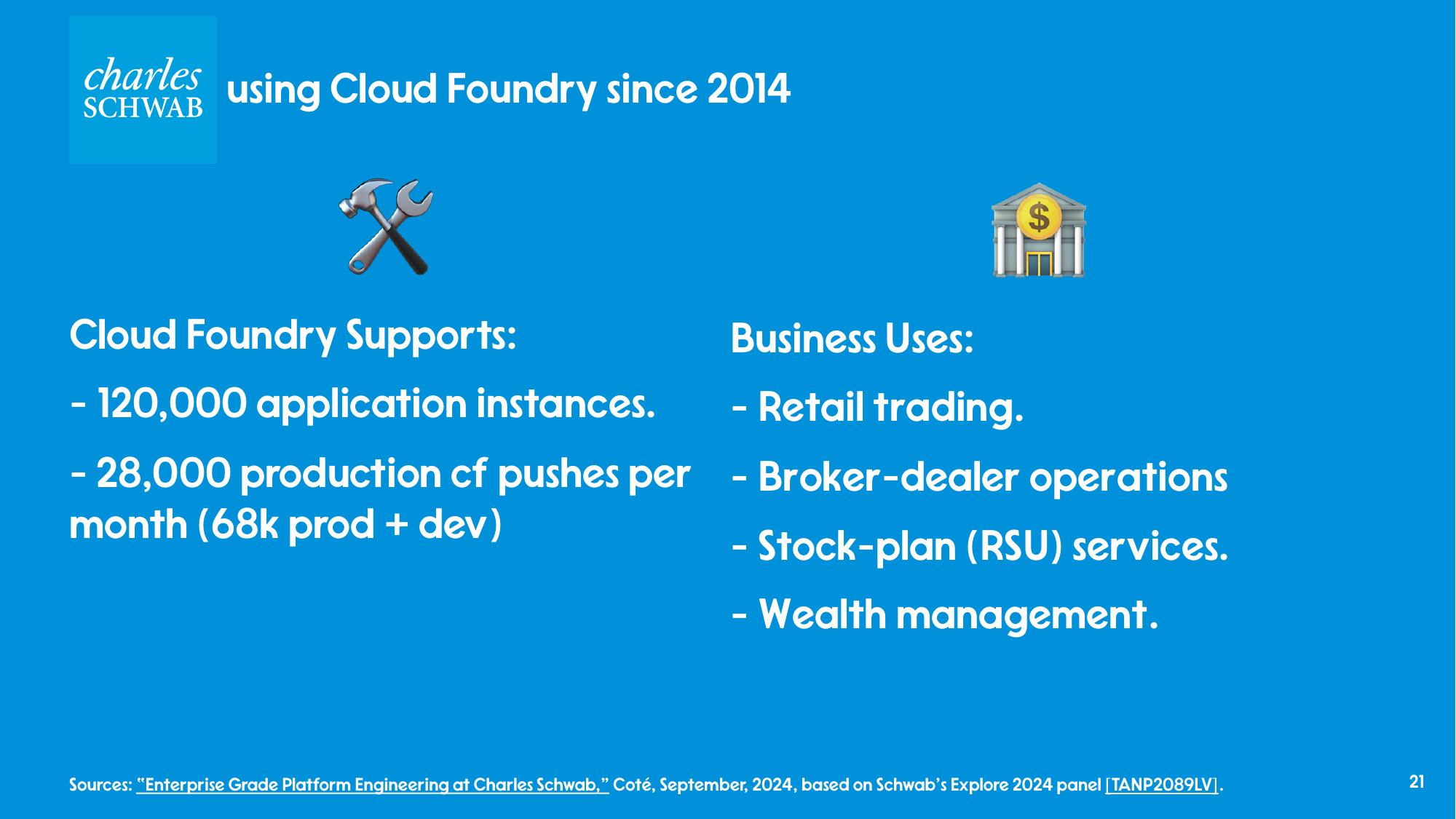
I was showing this to one of the people whose stories I'm telling here, and they took a pause and said, "whoa, that's huge." I use Schwab. They're great. Or Charles Schwab - us insiders just call them Schwab. Retail trading, my retirement account basically, all those RSUs I love are there, wealth management. If you watch their panel, I think they do something like 5.4 million trades a day, and on average they manage around $9.4 trillion in assets. So in the financial world, it's Google scale, whatever that means.
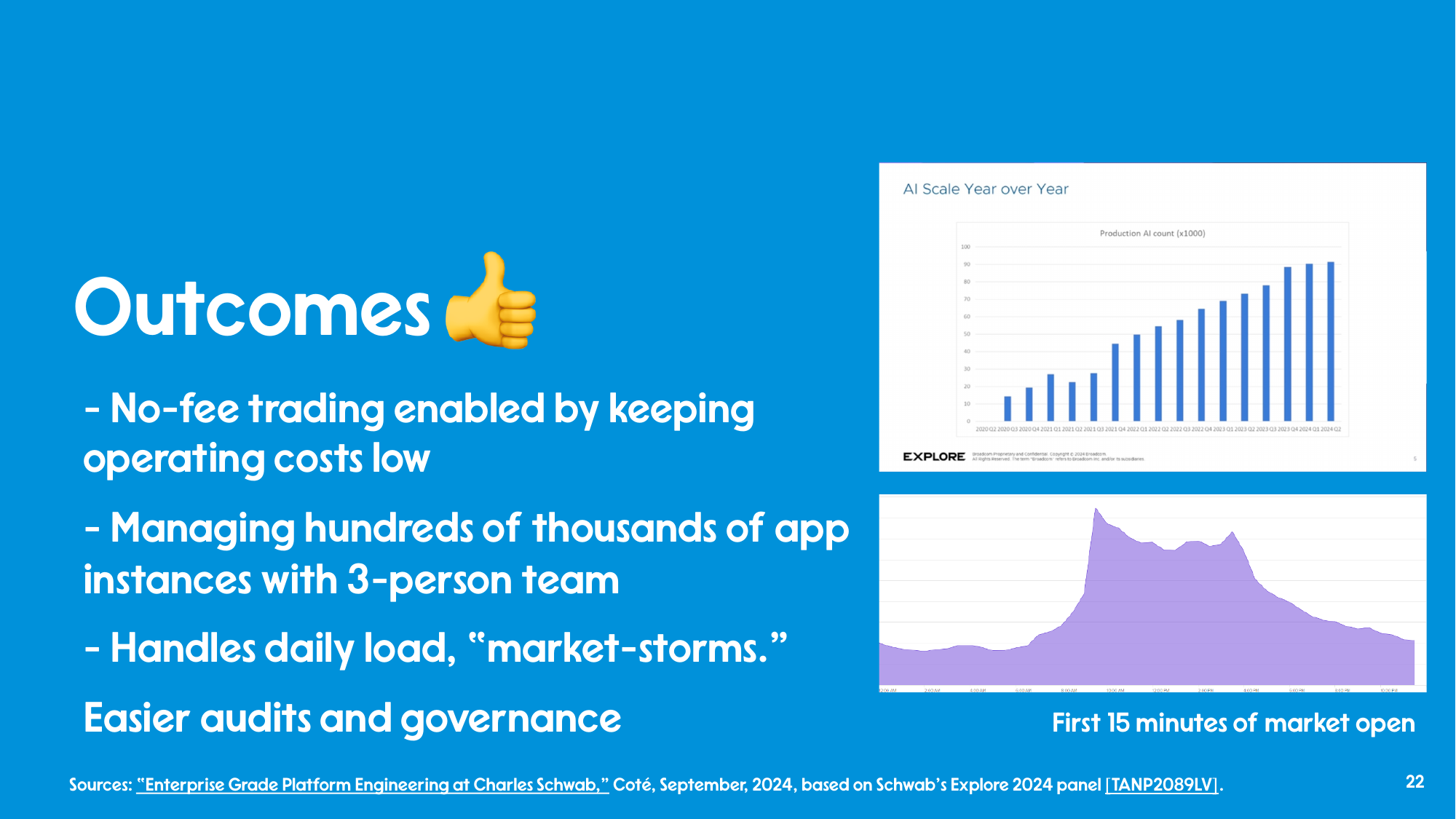
The importance to me is what they do with it. The chart on the outcomes slide is what they call a "market storm." When Wall Street opens, the first 15 minutes are bonkers. Everything is nice and calm, you're getting your coffee, maybe your third cup of coffee, and then craziness. Handling that load, being reliable, five days a week - that's supported by Cloud Foundry. Showing a chart like that draws people in: it's real, it's mature, it works at any scale they care about. Even if they want to operate at Schwab scale. Maybe we should start saying that. That'd be thrilling.
Story 4: "The Transformer" - DATEV
Since we're in Germany, I thought I'd go over a German company. The transformer. There's a lot of computers and software in the world that we'd like to be better - whether we want to change the infrastructure or make the applications better. Most people are interested in transforming how they go about things. That's the journey DATEV has been on. They're an accounting firm that helps out accountants in Germany. I've been told German accounting is even more complicated than American accounting, which sounds really complicated. Now that I live in the Netherlands, taxes are basically three boxes - you put a number in each and everything else is preloaded. It's so crazy this doesn't happen everywhere - the government taxing you knows what you have, why don't they just send you a bill?
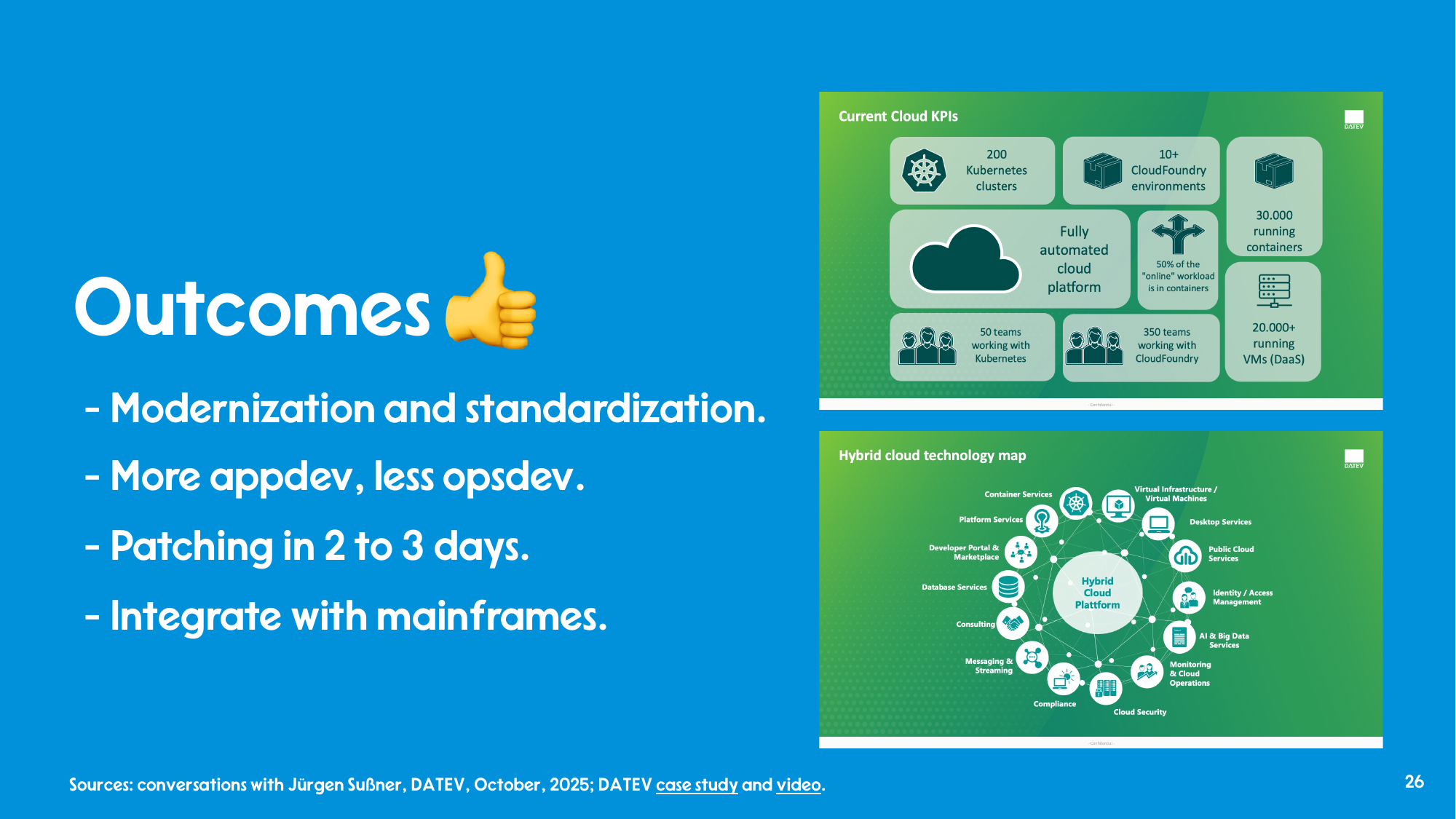
They've been modernizing the mainframe and the Windows-based applications they use to support their co-op of accountants. You can see the magnitude scaled to what they're doing. Showing how many teams you're supporting on Cloud Foundry is very valuable - it gives people outside this room an impression of how much is being done. Not just some strange exotic thing from times past, actually running things people depend on every day, or at least during tax season, but also payroll, office management.
It's great that Jürgen shared all of this with me and corrected some errors I had. Always good to be truthful in most marketing. They've been using Cloud Foundry not just for the runtime - I'm sure they have crazy market windows when some fun tax day occurs - but as a standard way to do things. A standardized way of running applications, even architecting them, so as they take their legacy apps forward they have a standard place to go. They have a plan, instead of the very enterprisey "whatever you might want to do" way of thinking about things. And, by the way, they have very beautiful slides. Worth zooming into when you grab the original.
More: Mercedes-Benz, JPMorgan Chase, SB Payment Service, Comcast, militaries
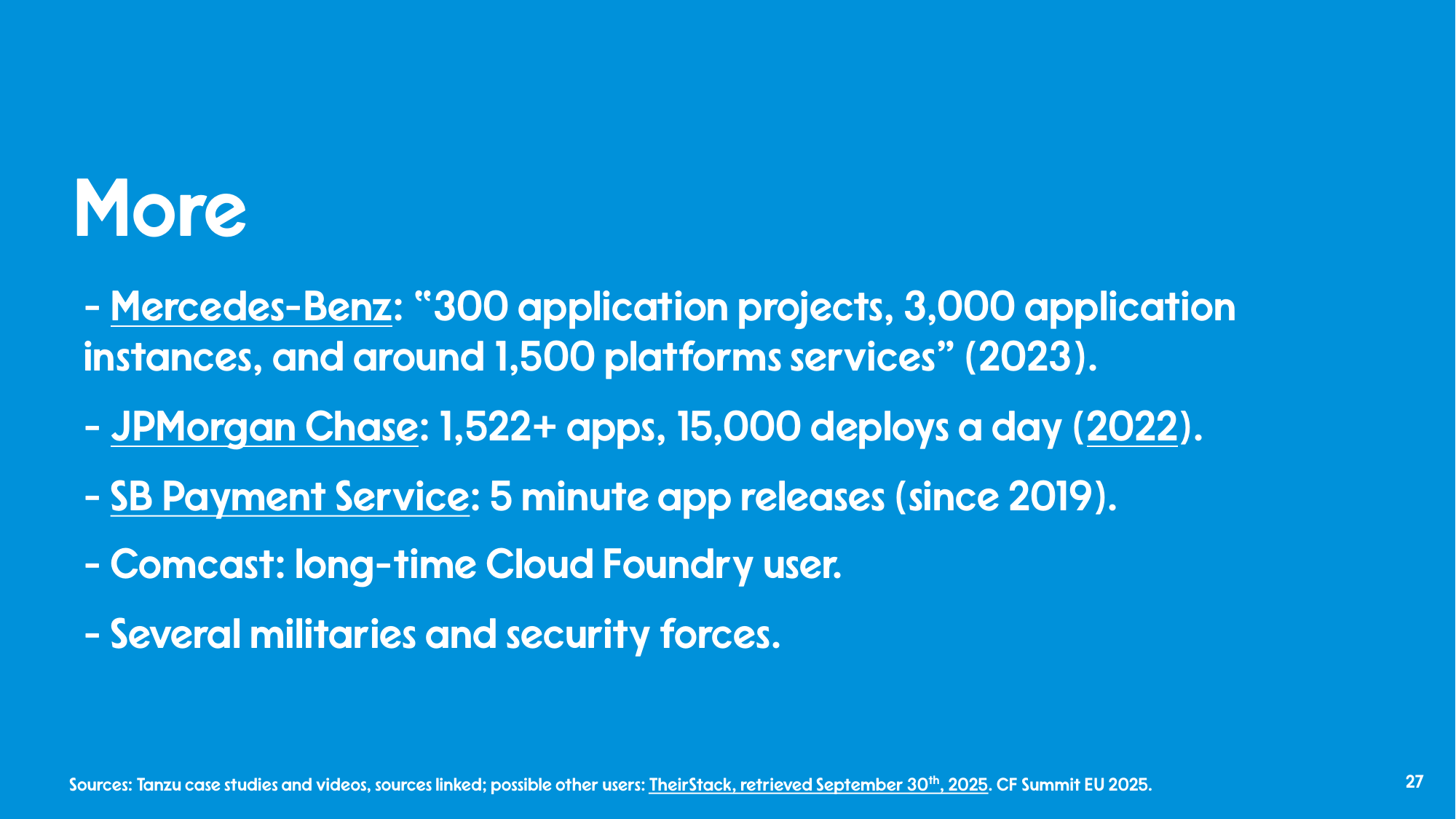
There are many other cases. I caught up with some Mercedes-Benz people. Always lots of banks. Another open sourcer down there, Comcast - similar story to Rabobank, much different industry and scale, but there are all sorts of things. And every time someone mentions a military or security force, they're always like, "but I can't tell you who it is, it's very, very secret." It's great when people talk out loud about it - very helpful for the community.
Call to action: tell your stories
Someone mentioned this term today, so I won't be teaching you it - call to action, which sounds militaristic now that I think of it. If you're a user, figure out how to tell your story. The angle here is: sure, you've got paperwork and comms people, but if you say, "this is about open-source software in a community, for Cloud Foundry stuff," they'll probably be like, "oh right, that's great, because we're in this contract negotiation with this vendor and we don't want you to talk about them." If you talk about how you're using an open-source thing - which you will be, however it's bundled together for you - that generally is a lot easier. Especially over the next 12, maybe even 24 months, get the story out there. Talk about how many people are doing it and what you're doing with it. Hopefully I've given you a sense of the bullet points, the raw ingredients you can stick in a blender and make a delicious smoothie. There's always a little bit left over - have some kids and feed it to them.
Speaking of things you can do right now: there's Cloud Foundry Weekly, and I mean that in a good way - Nick and Nikki, the two Nicks, are always interested in guests. There's cfgmgmtcamp in Ghent in February, very low-level and technical - if you fancy yourself a BOSH aficionado, the last BOSH talk there was when I first joined Pivotal in 2015, when Andrew Clay Shafer went and gave one. KubeCon EU in Amsterdam in March has a platform engineering track Paula was talking about earlier. And The New Stack - if you ever want to put an article in, we have basically unlimited access to help you publish. Wherever there's a button that says "publish," try to click on it. Thanks again - the more we get stories out there, whether updates on existing ones or new ones, the more it'll help us all.