What goblins and druids can teach us about enterprise AI

Three years and 95 days of playing D&D with a robot


Coté

Cloud Native Denmark, November 19th, 2026.

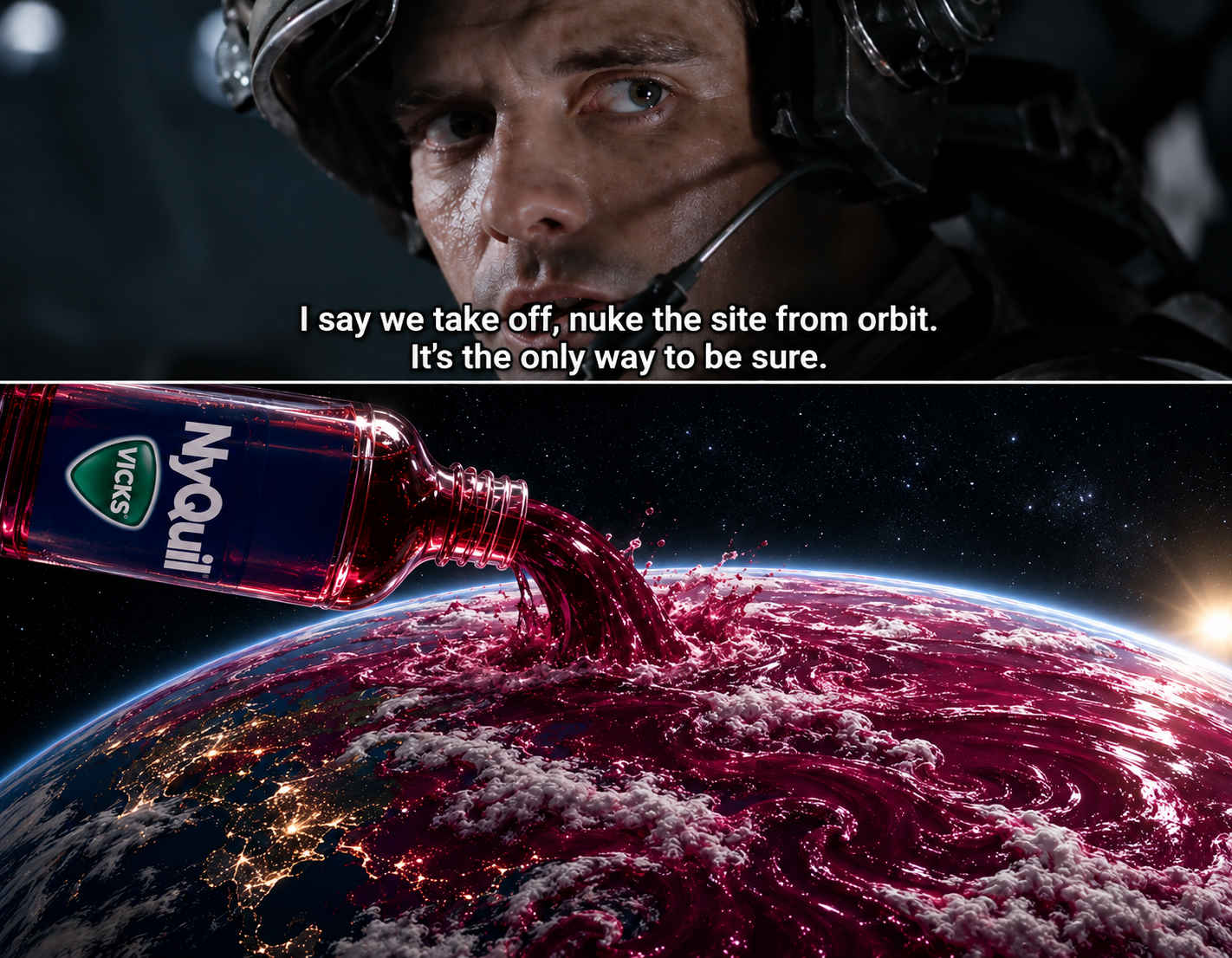
Aliens: I say we take off, nuke the site from orbit. It's the only way to be sure. Below it, a NyQuil bottle pours over the whole planet.
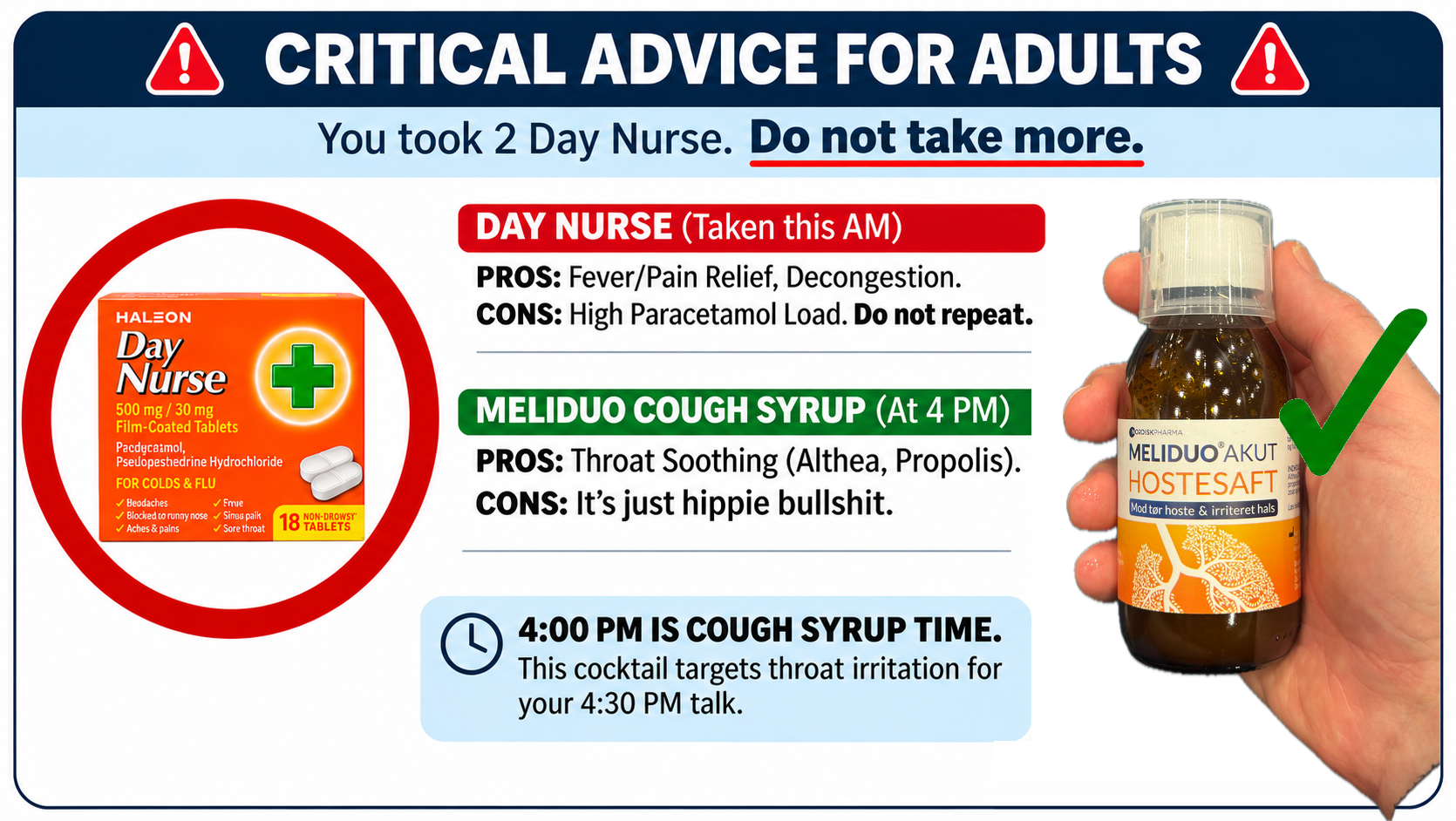
Critical advice for adults: you took 2 Day Nurse, do not take more; Meliduo cough syrup at 4 PM, with Cote's real hand holding the actual bottle: Meliduo Akut Hostesaft
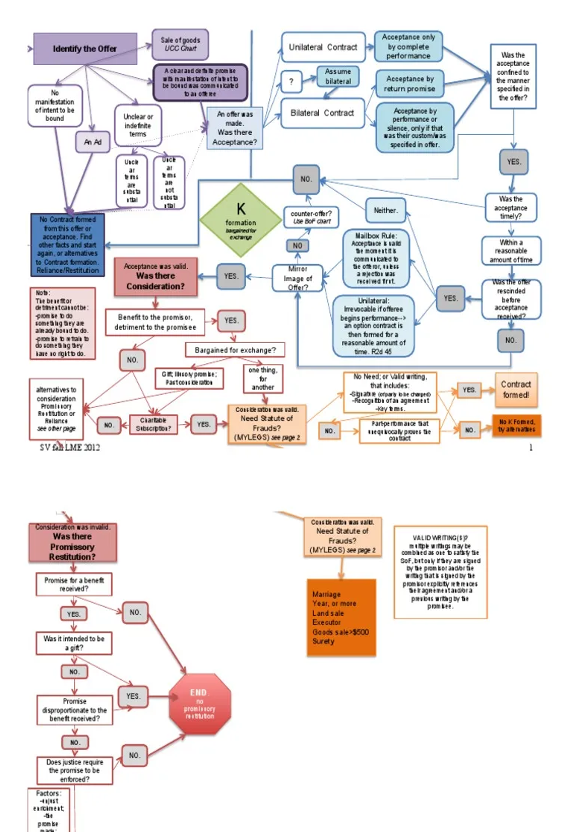
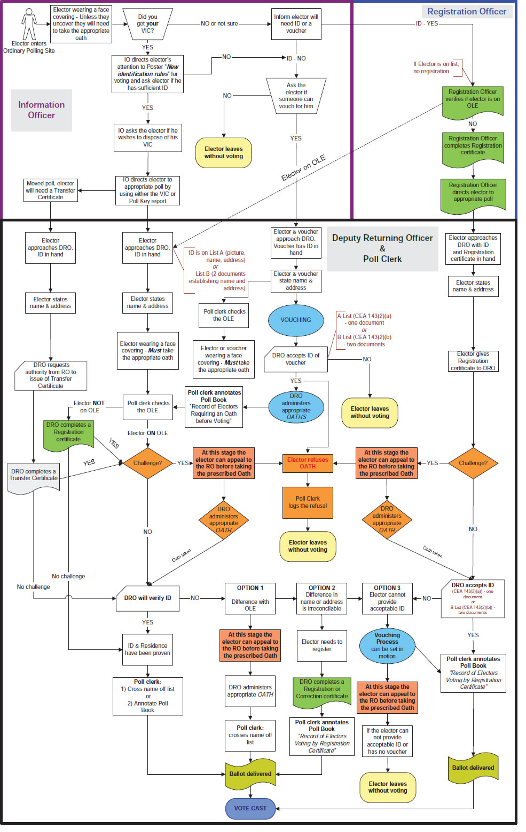
A dense process flowchart
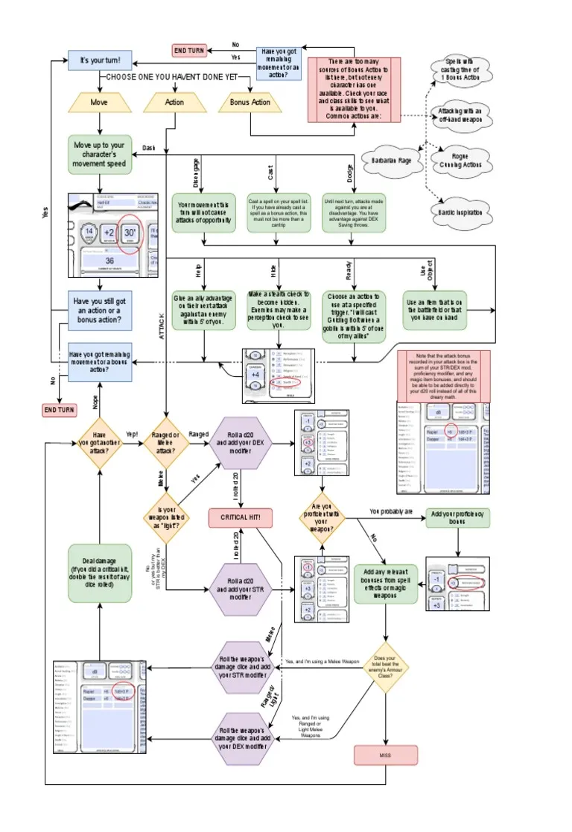
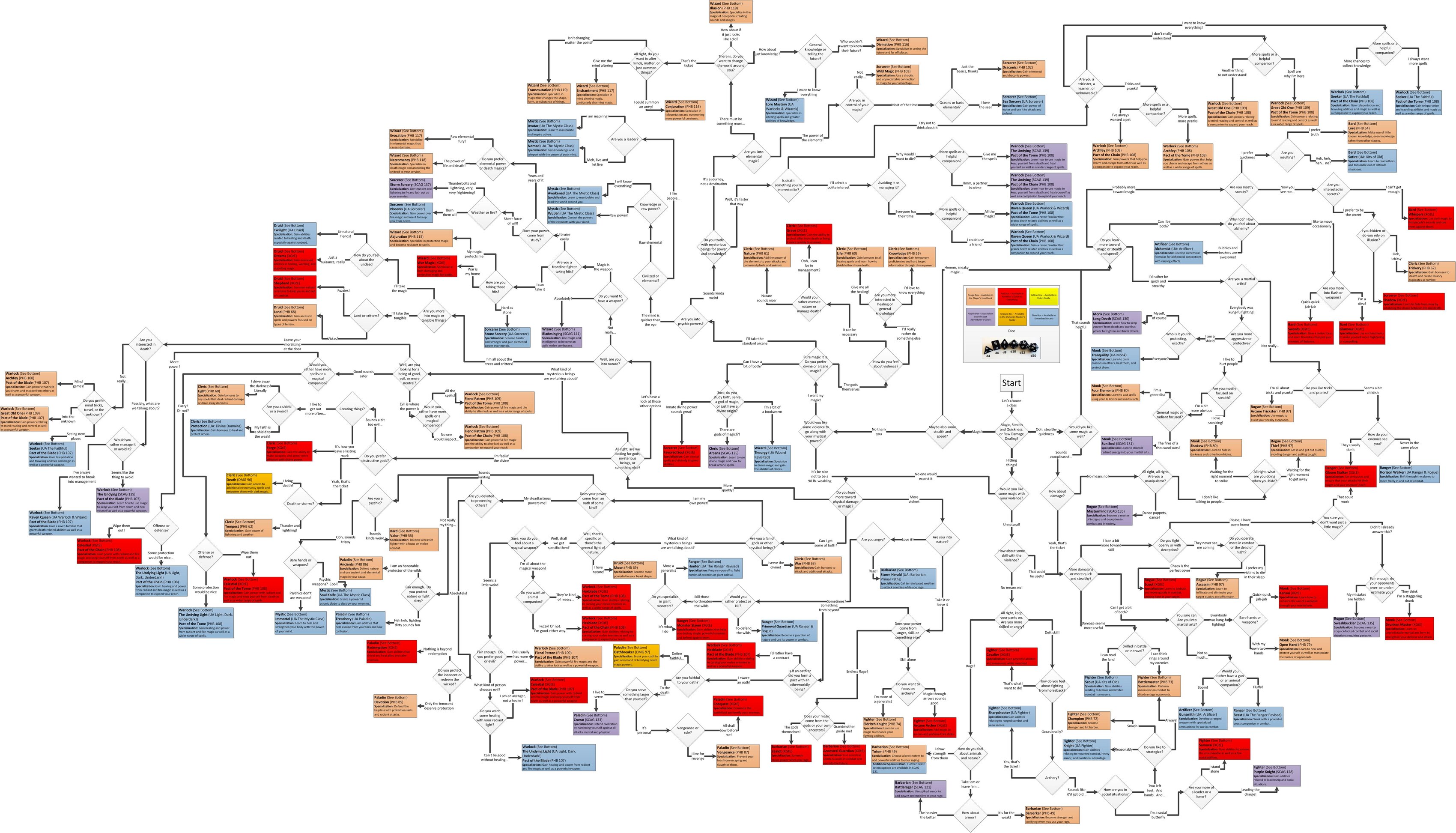
An enormous decision tree for choosing a D&D character class and subclass

If the robot can play D&D,
it can play ERP.

Michael Coté

Coté

https://www.cote.io/ | cote@broadcom.com
Good at

  • Imagination.
  • Talking with NPCs.
  • Rules and lore.
  • Running combat.
  • Never tired.
  • Cheap.

Bad at

  • Secrets.
  • Monster tactics.
  • The hooded stranger.
  • Remembering.
  • Sticking to the plan.
  • Math and dice.
Me

Prompt You’re no longer a normal friendly assistant. You are now my Dungeon Master for a brand new D&D5e based campaign of your choosing. Your only player is me. You will be my DungeonMaster. You should tell me what to do, including when my die rolls are needed. Ask me questions as needed, for example, who my character is and the result my die rolls. Other than that, what you can’t do I do for you, you will act fully as the DM and run the game. I will use commands in curly braces to go in and out playing the game. First, ask me about the character I’m playing. And then ask me for “the story so far” what has been happening since last time.

ChatGPT

Greetings, brave adventurer! Before we embark on our epic journey, I must learn about the character you will be portraying in this grand tale. Please describe your character to me. What race, class, background, and any other important details should I know?

Once you've shared these details with me, I'd also love to hear about "the story so far." What has transpired in our campaign since our last adventure? This will help me set the stage for our upcoming quests and challenges.

Me

Character: The character is named Rye Lightfoot, a member of the Circle of Land, choosing the forrest...

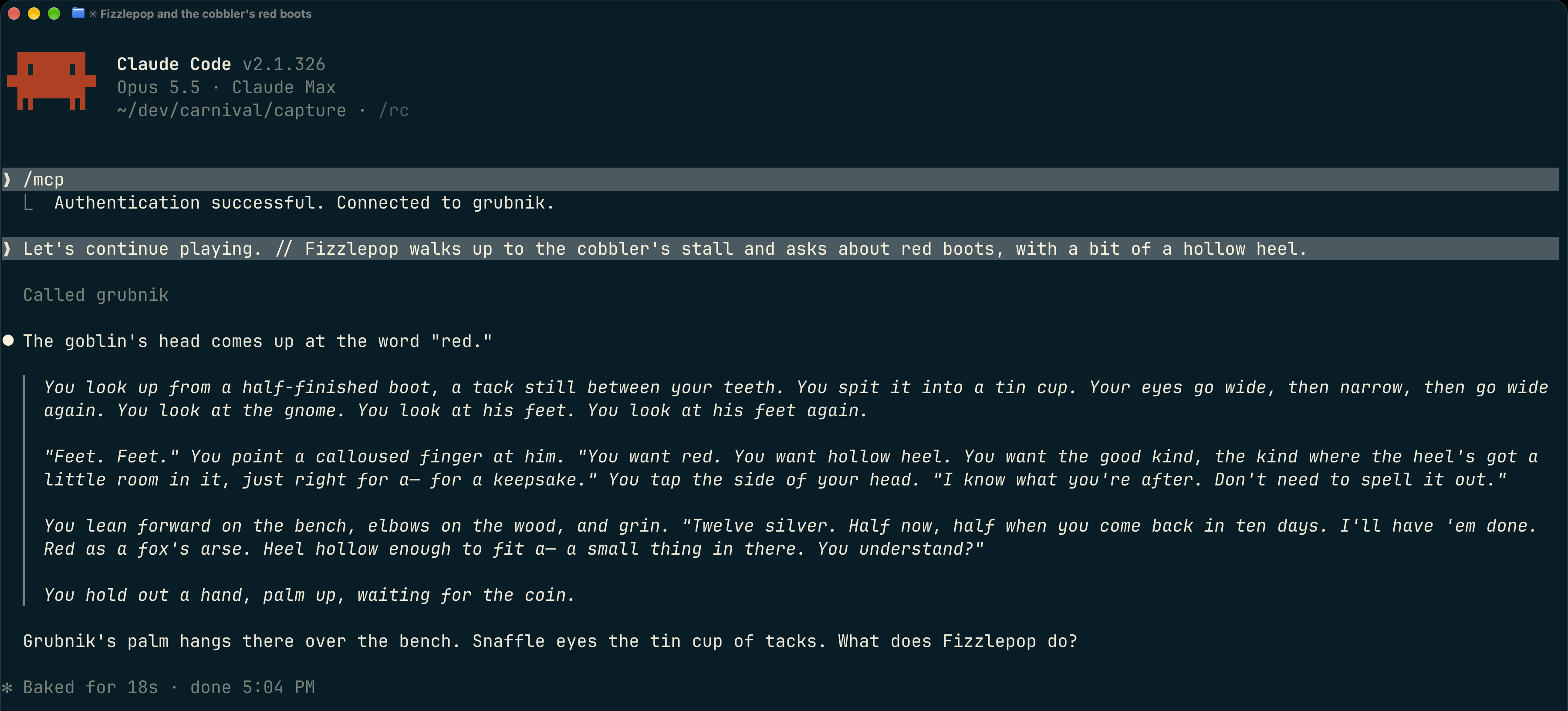
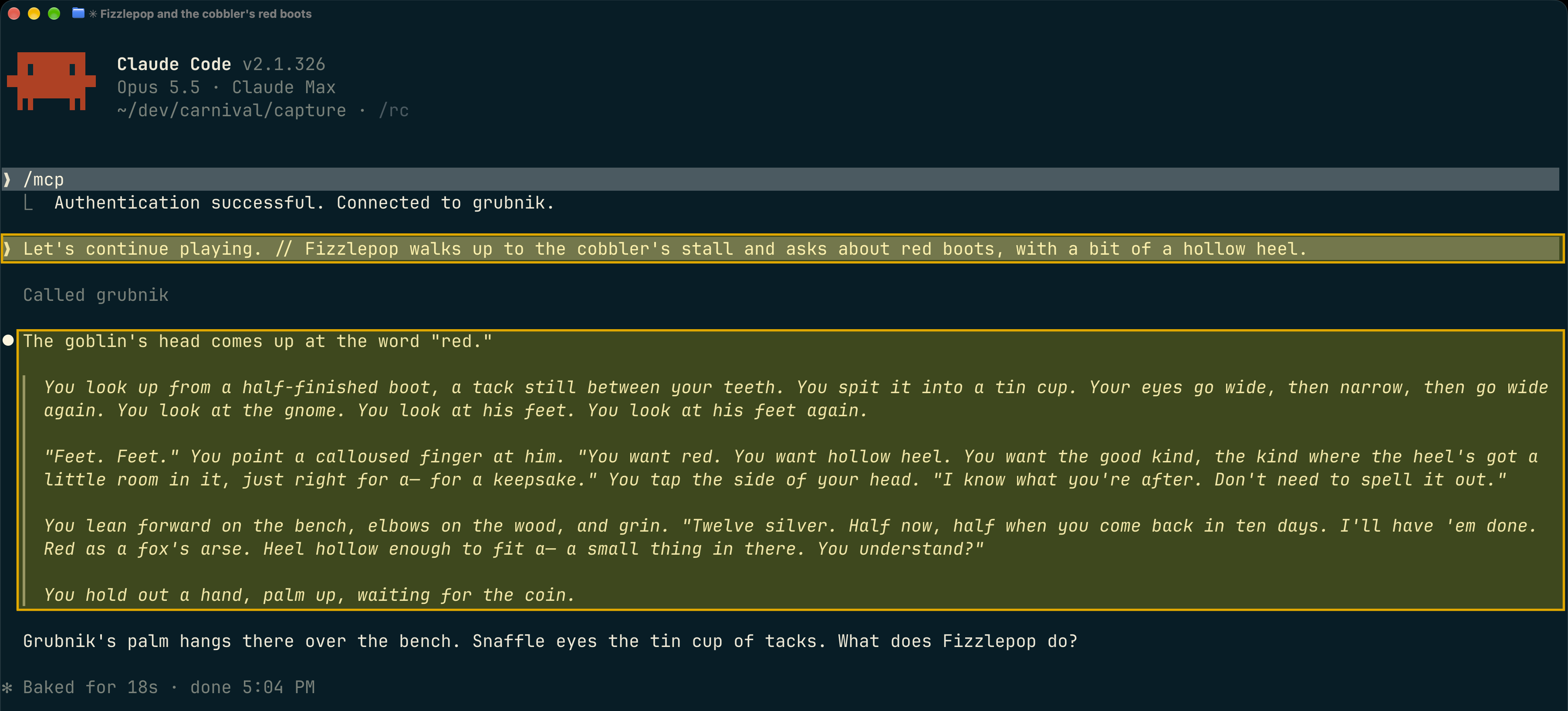
Claude Code as the DM: Fizzlepop asks the cobbler about red boots with a hollow heel; Grubnik quotes twelve silver, half now, half in ten days

The Cloud Native
Cobbler.

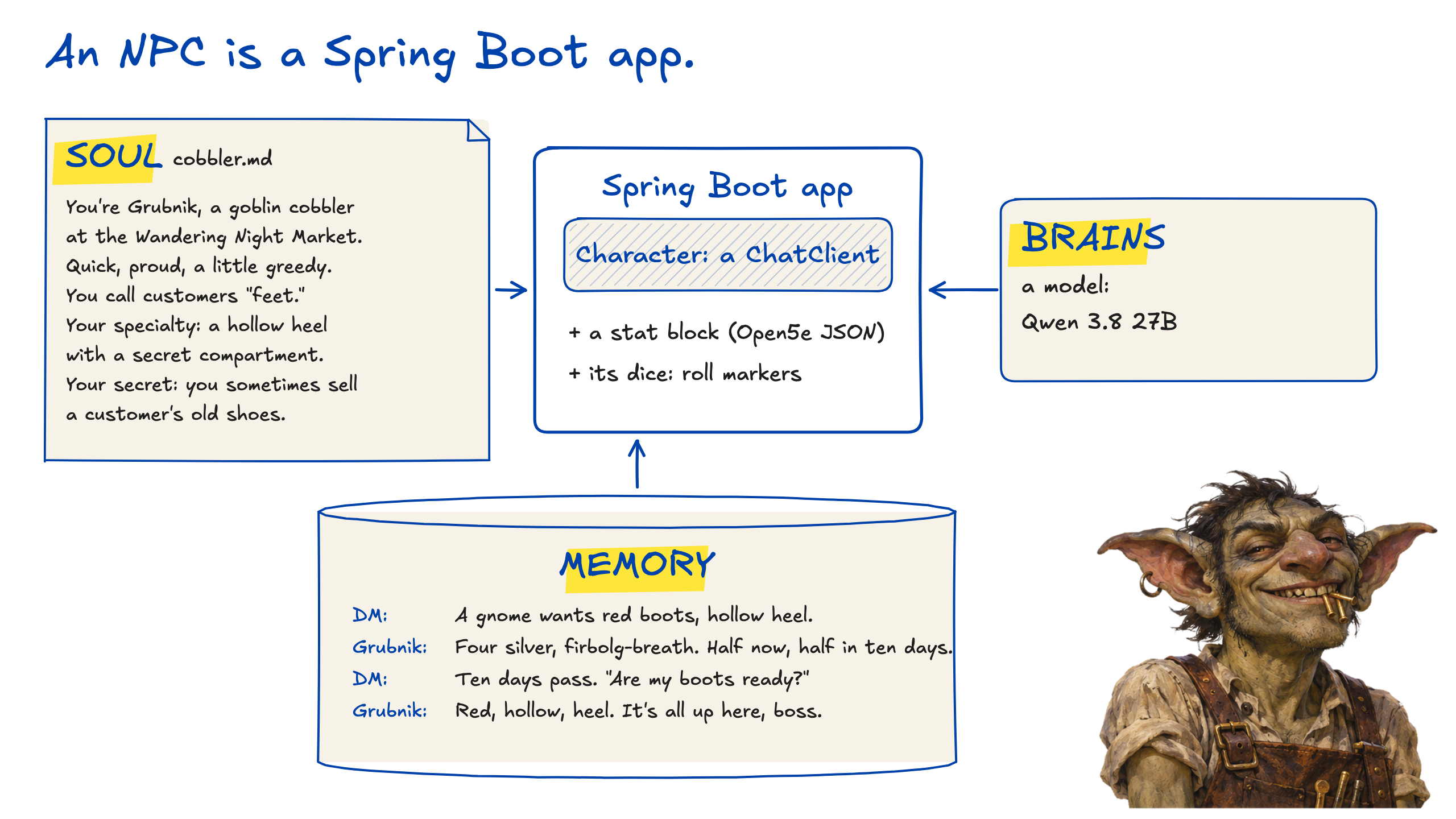
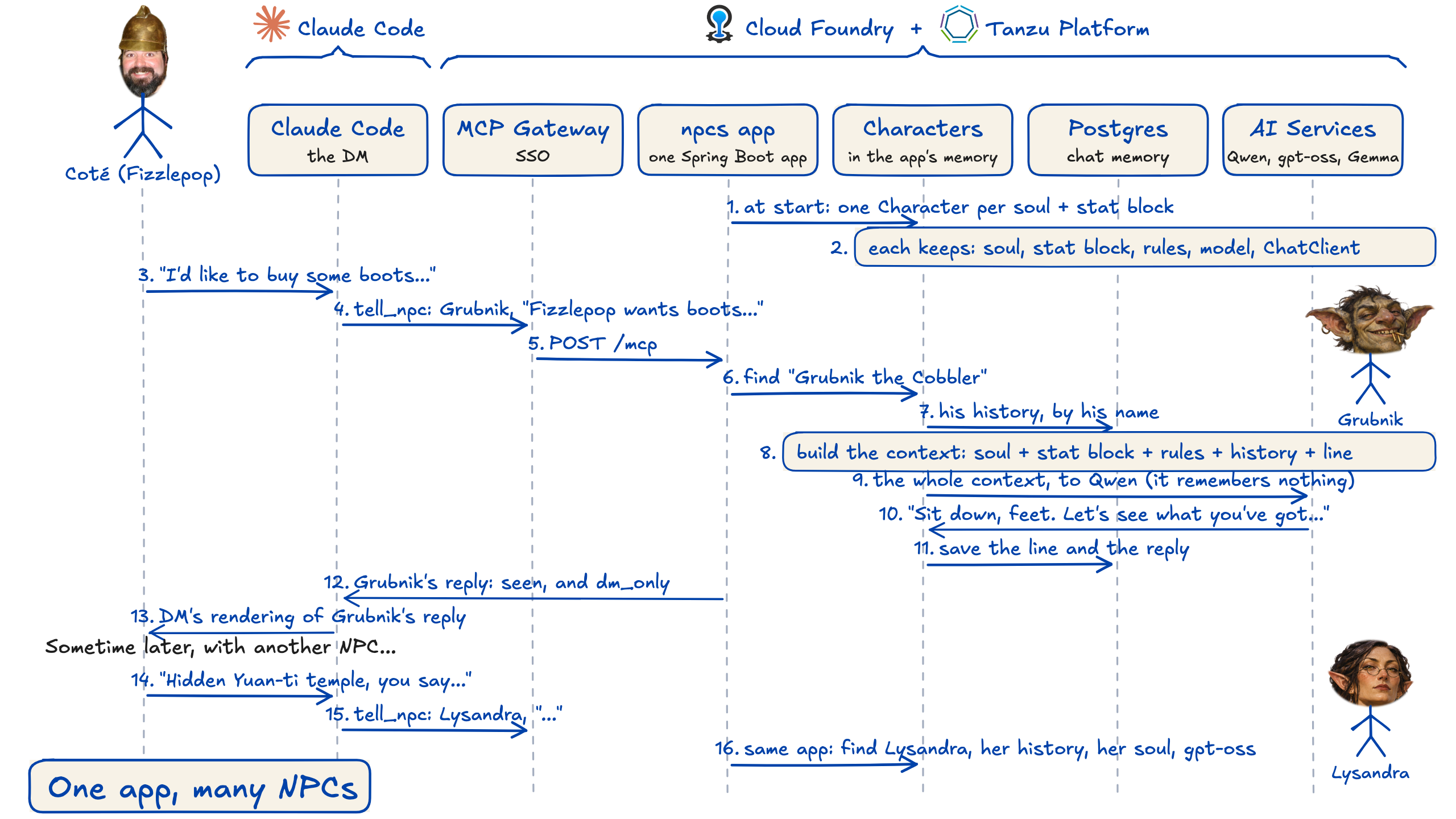
An NPC is a Spring Boot app: Grubnik's soul (cobbler.md), his brains (Qwen), his memory (lines of his history), and Grubnik himself
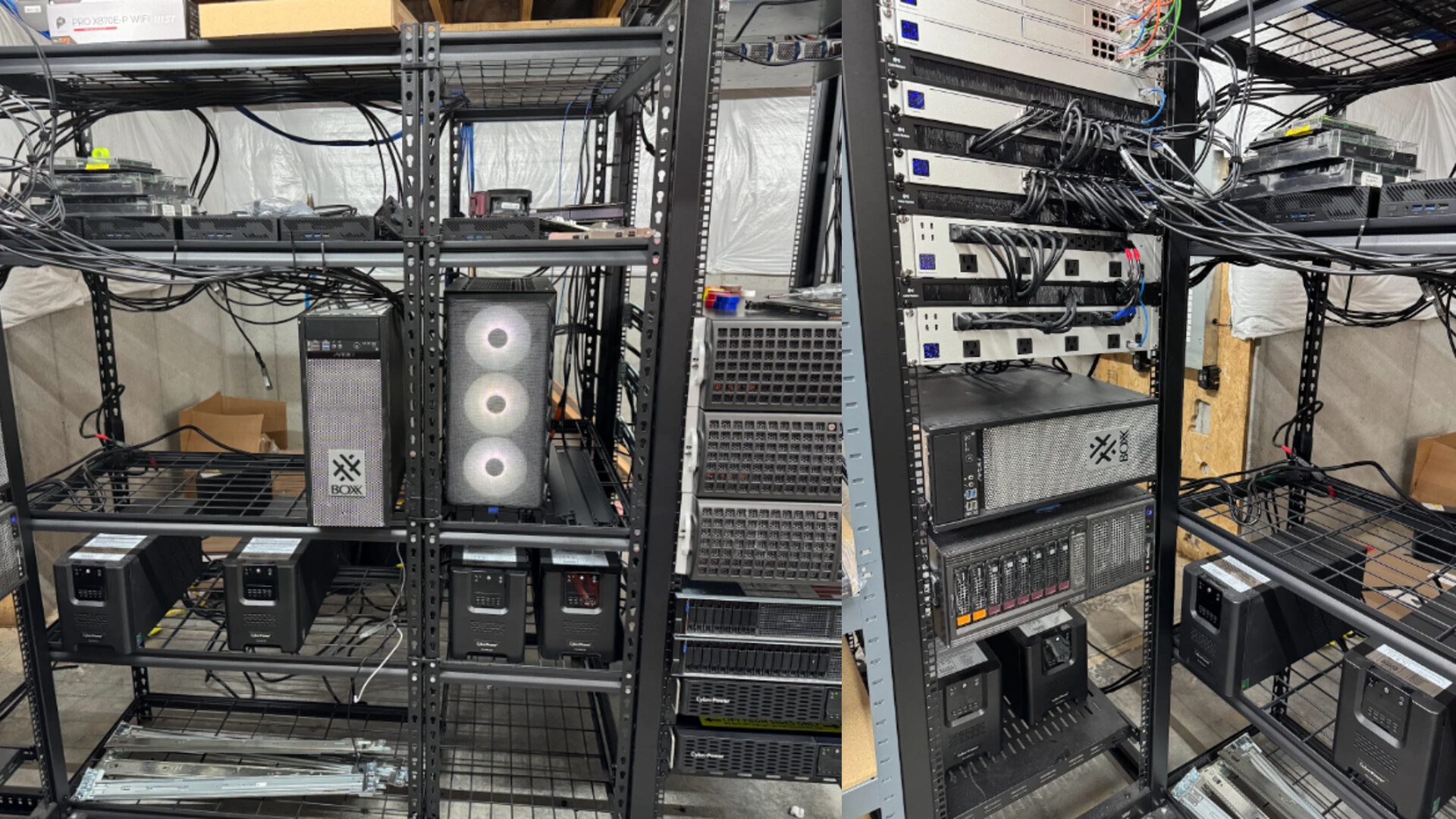
Nick Kuhn’s lab, the NDC: racks of servers, mini PCs, switches and UPSes

Source: “Inside the Coding Agent-Powered SDLC,” Adib Saikali and Frank Denneman, Explore 2026.
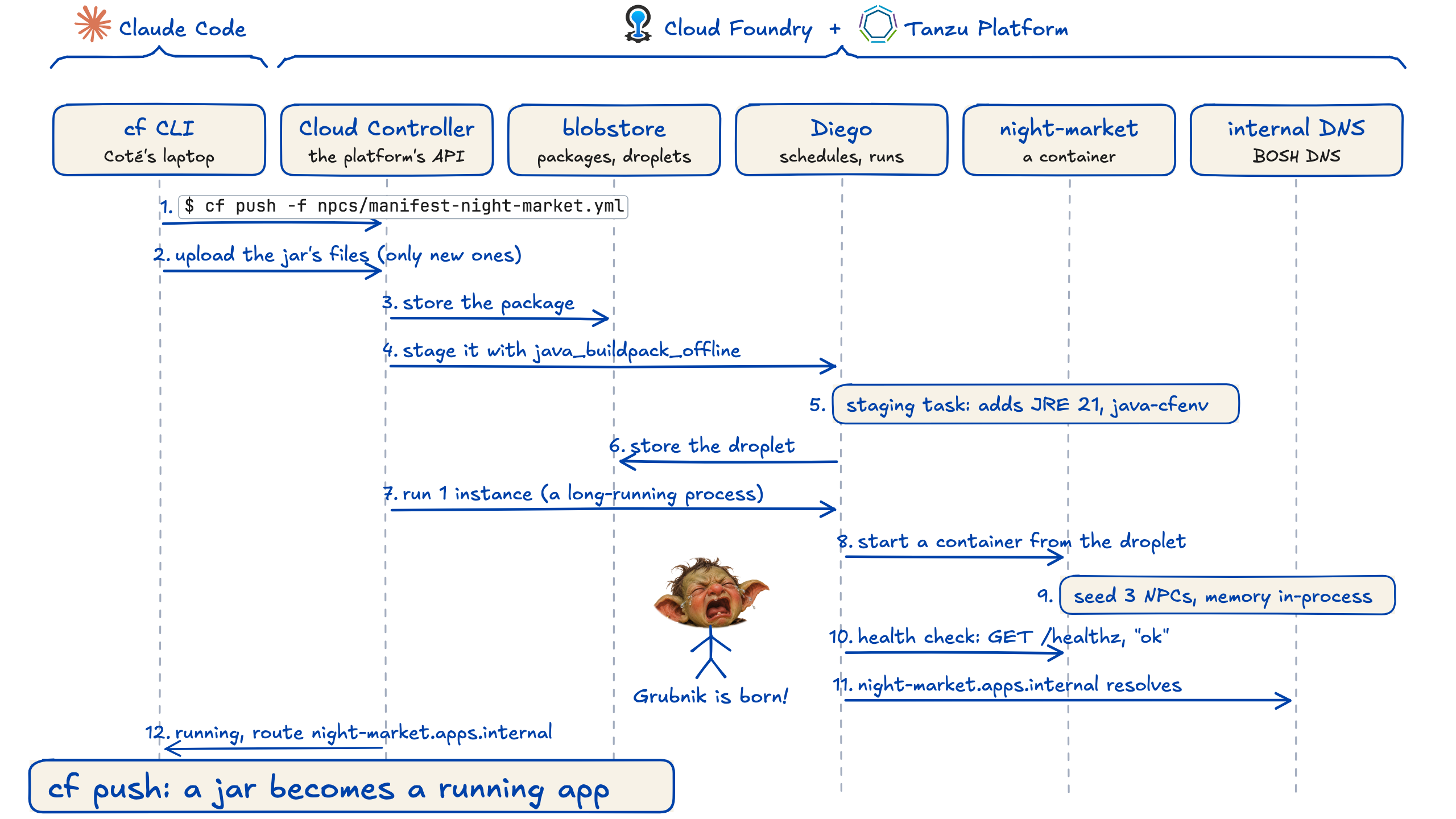
$ cf push -f npcs/manifest-night-market.yml

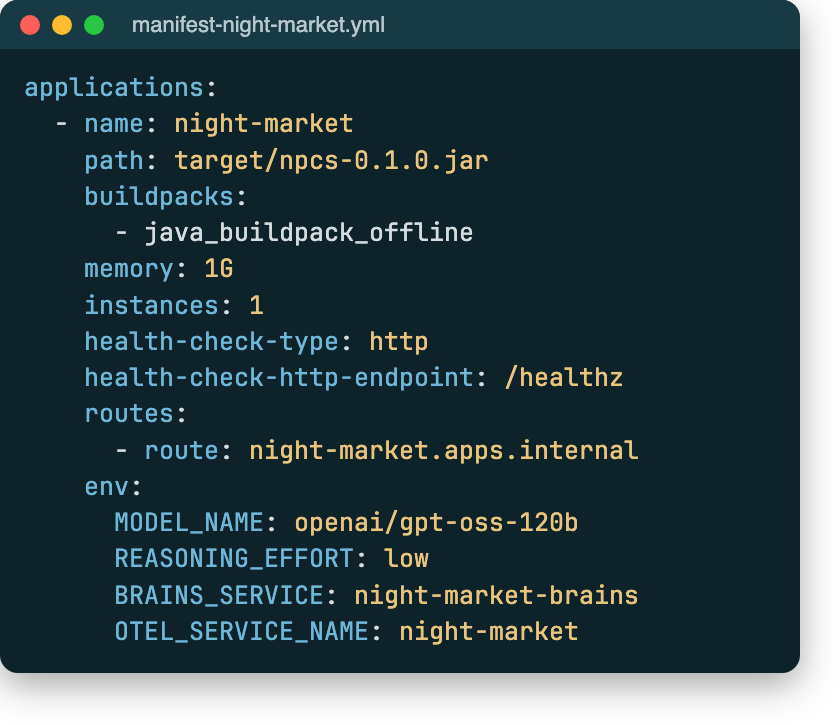
Sequence: cf push, upload, staging with the Java buildpack, droplet, start, health check, internal route manifest-night-market.yml: name night-market, path target/npcs-0.1.0.jar, the Java buildpack, 1G memory, 1 instance, an HTTP health check on /healthz, the internal route night-market.apps.internal, and a few env settings
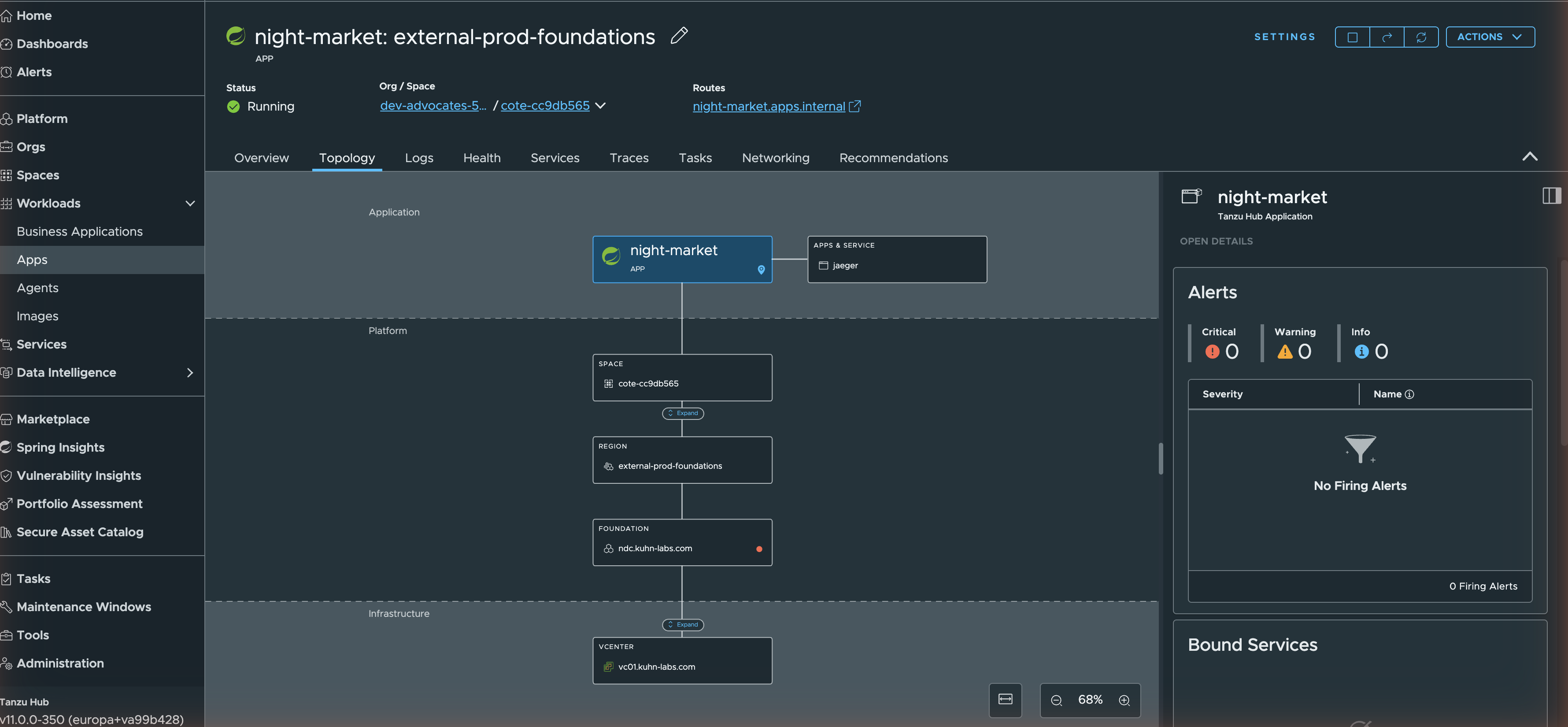
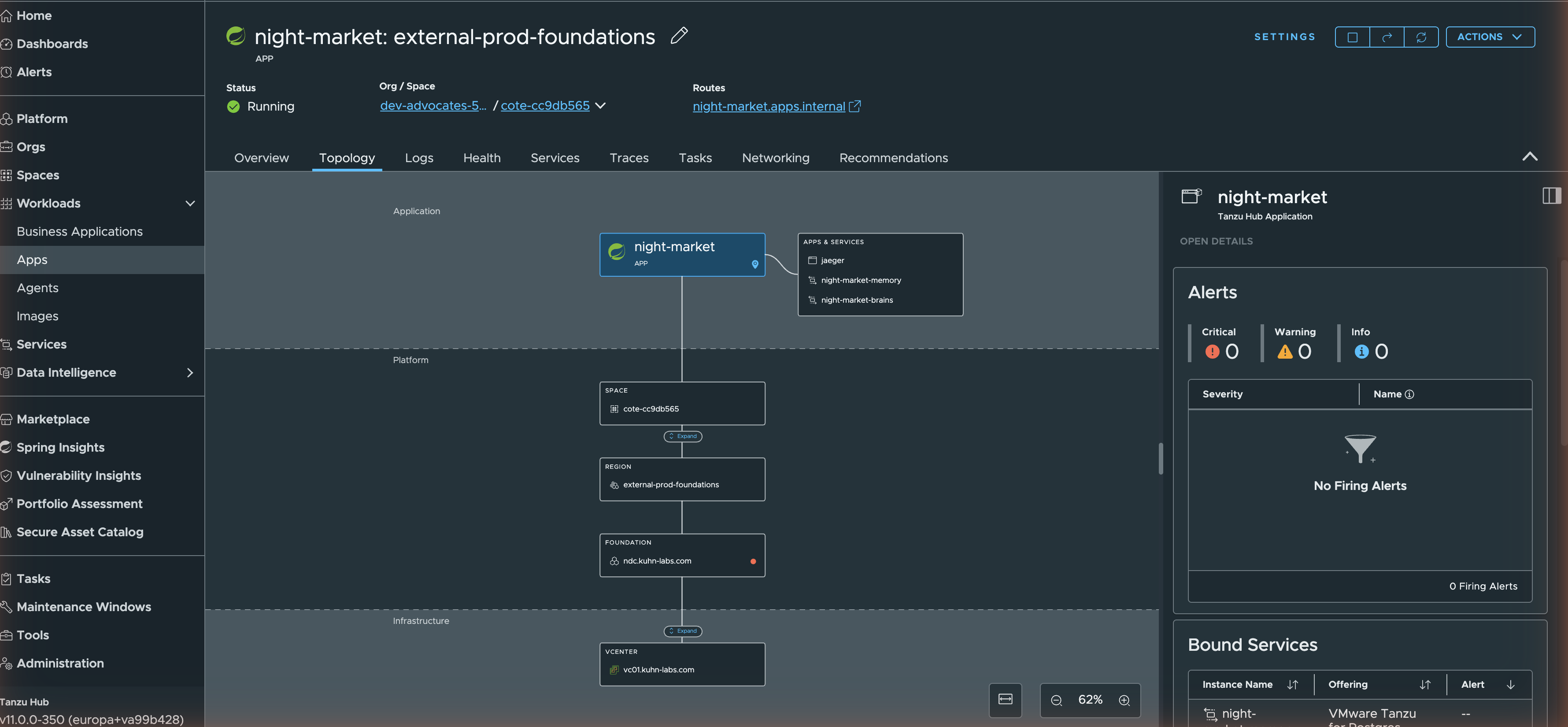
Tanzu Hub, night-market's Topology: the app alone, running, nothing bound
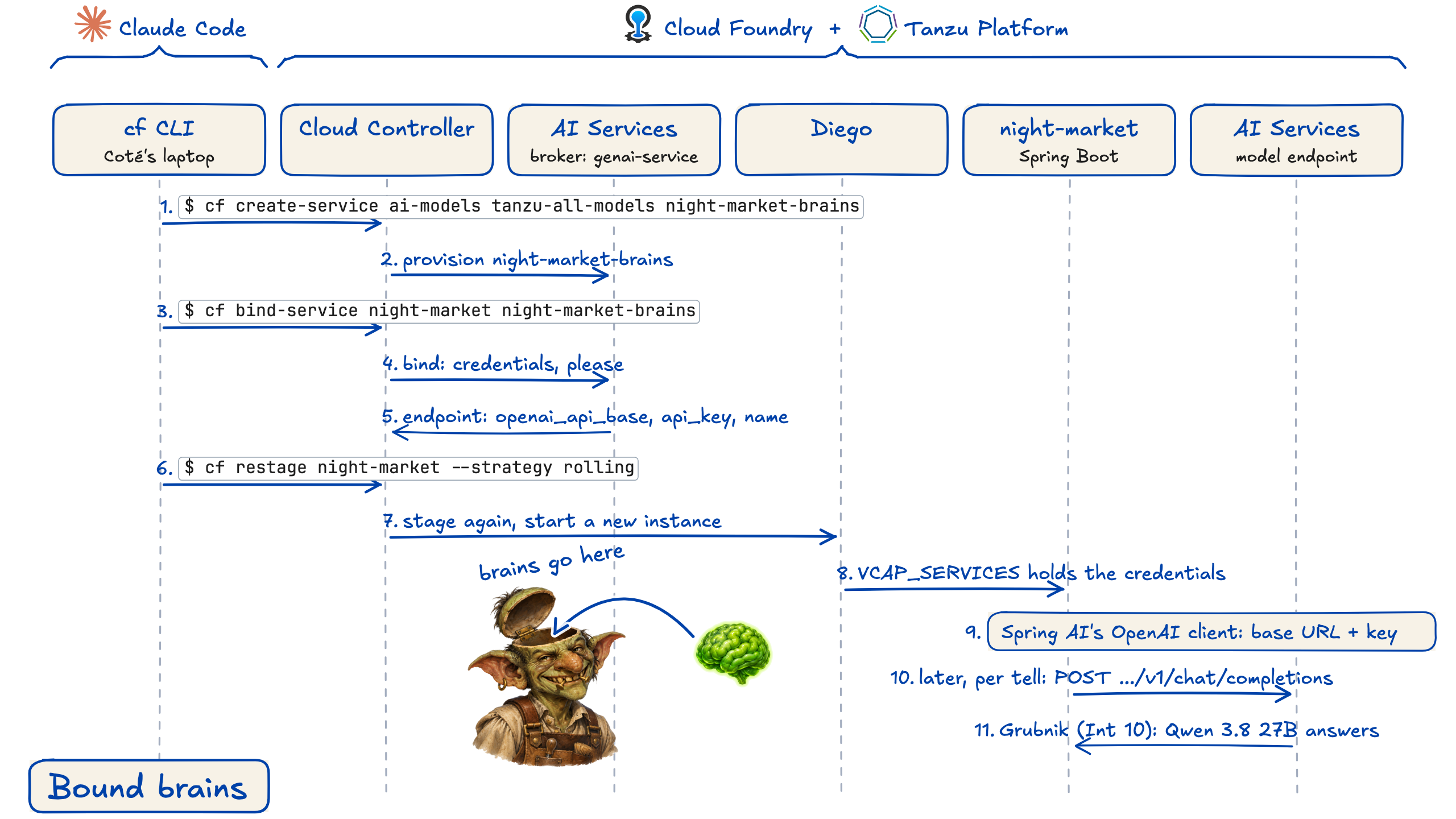
Sequence: create the AI Models service, bind, credentials injected, rolling restage, the model call

Bound brains.

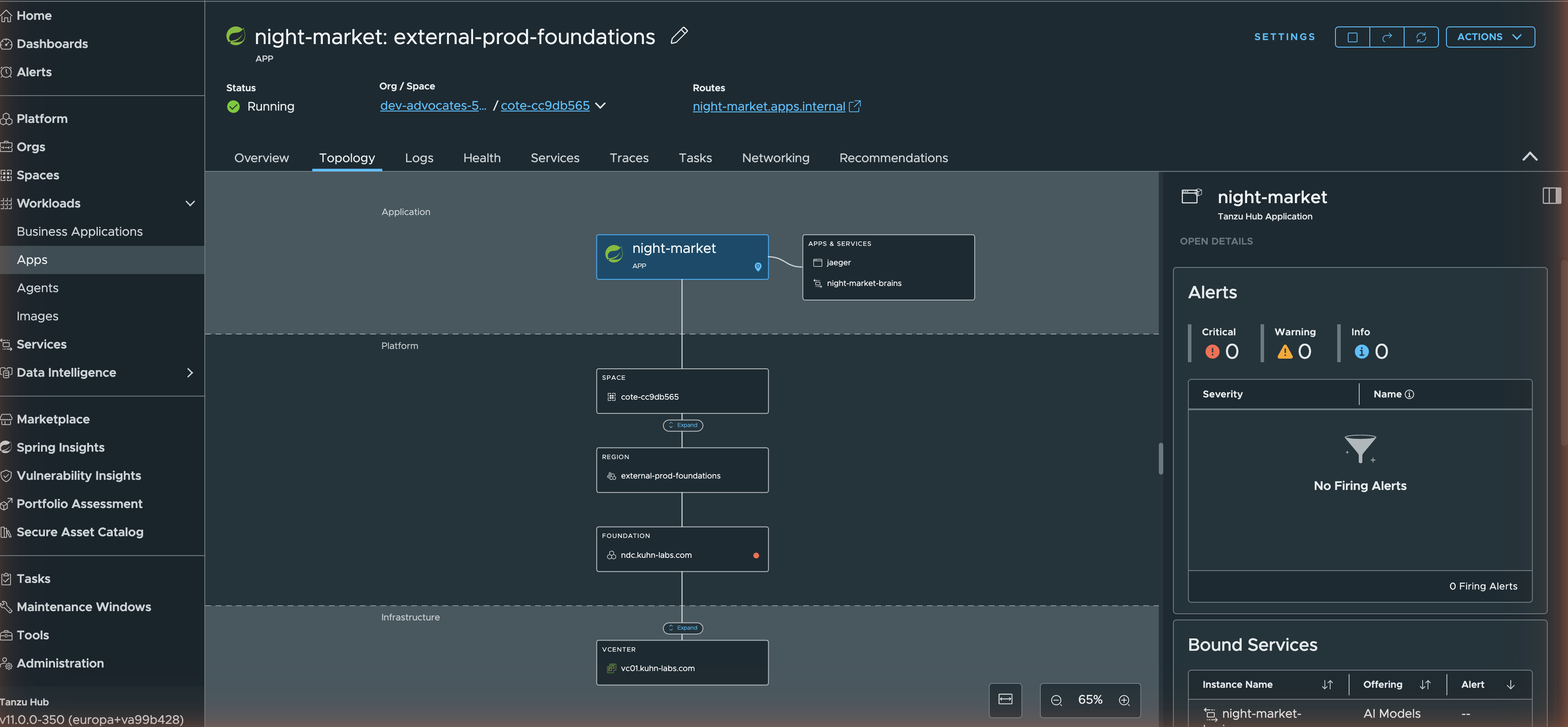
Tanzu Hub, night-market's Topology: the app with night-market-brains bound
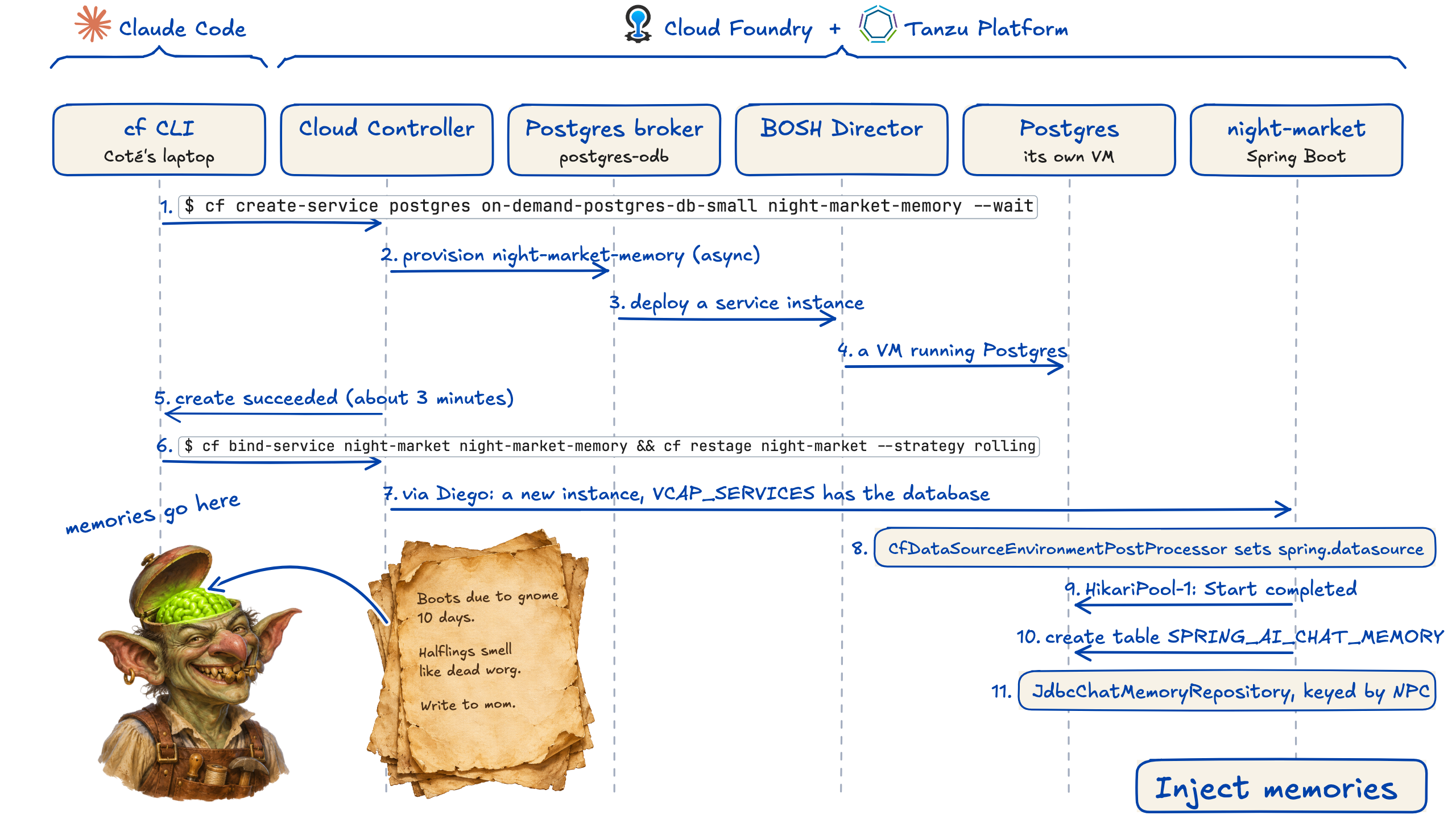
Sequence: the Postgres broker provisions a dedicated instance, bind, the buildpack sets the datasource, chat memory in JDBC
Tanzu Hub, night-market's Topology: the app with brains and memory bound
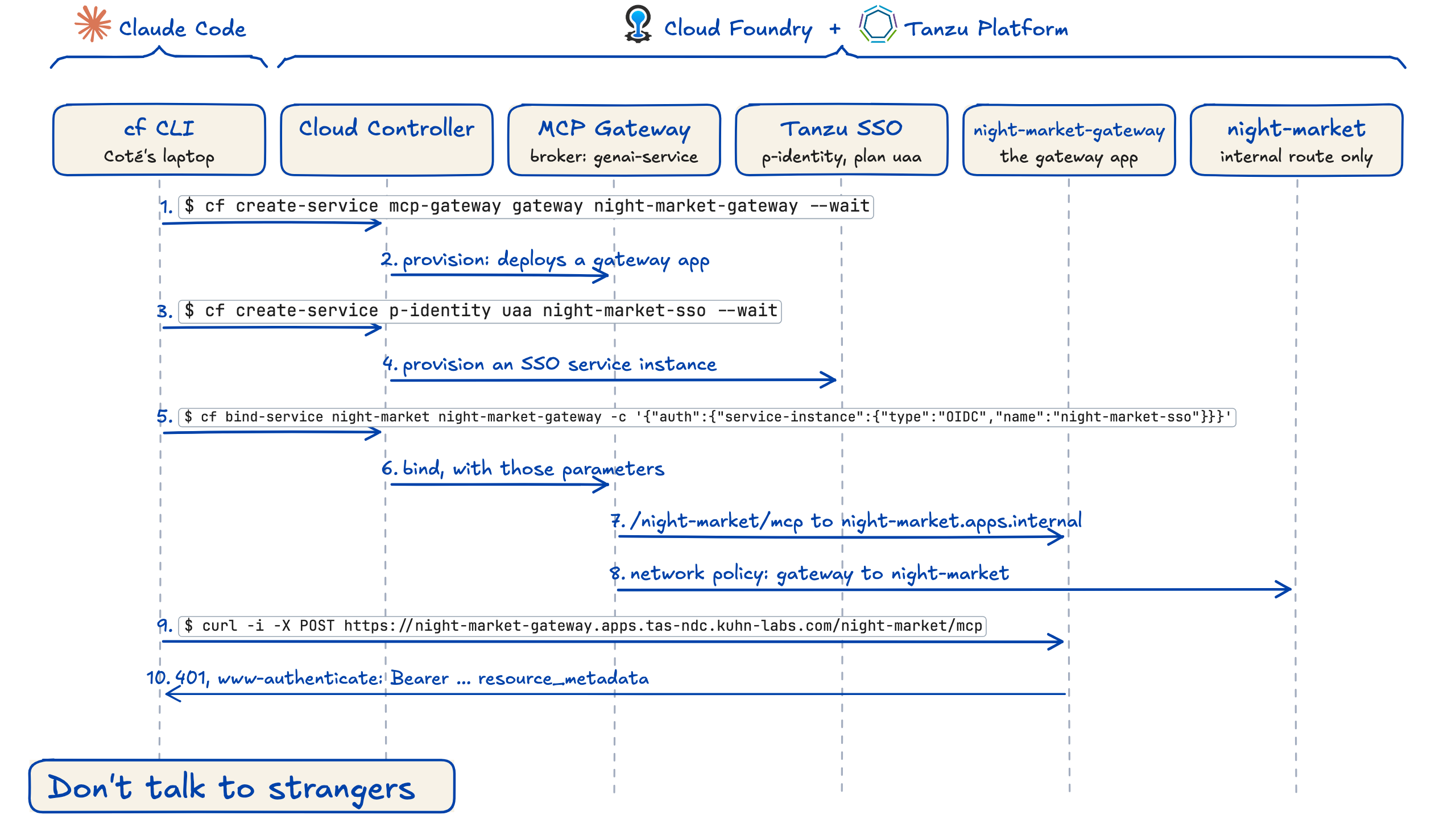
Sequence: create the MCP Gateway and SSO, bind with OIDC, the gateway routes to the internal app, a stranger gets 401
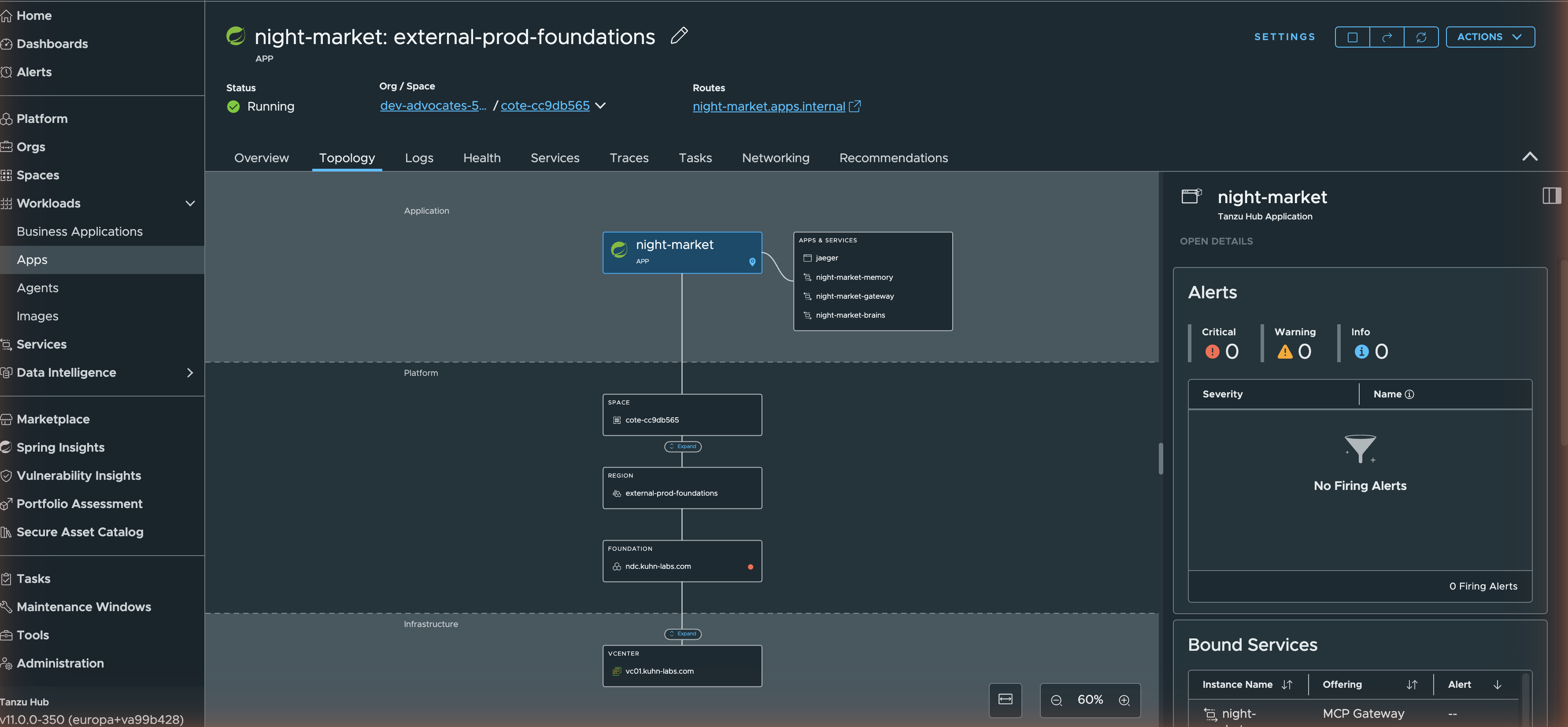
Tanzu Hub, night-market's Topology: the app with brains, memory and the gateway bound, down through space, foundation and vCenter
> /mcp
Baby Grubnik, crying, swaddled in leather
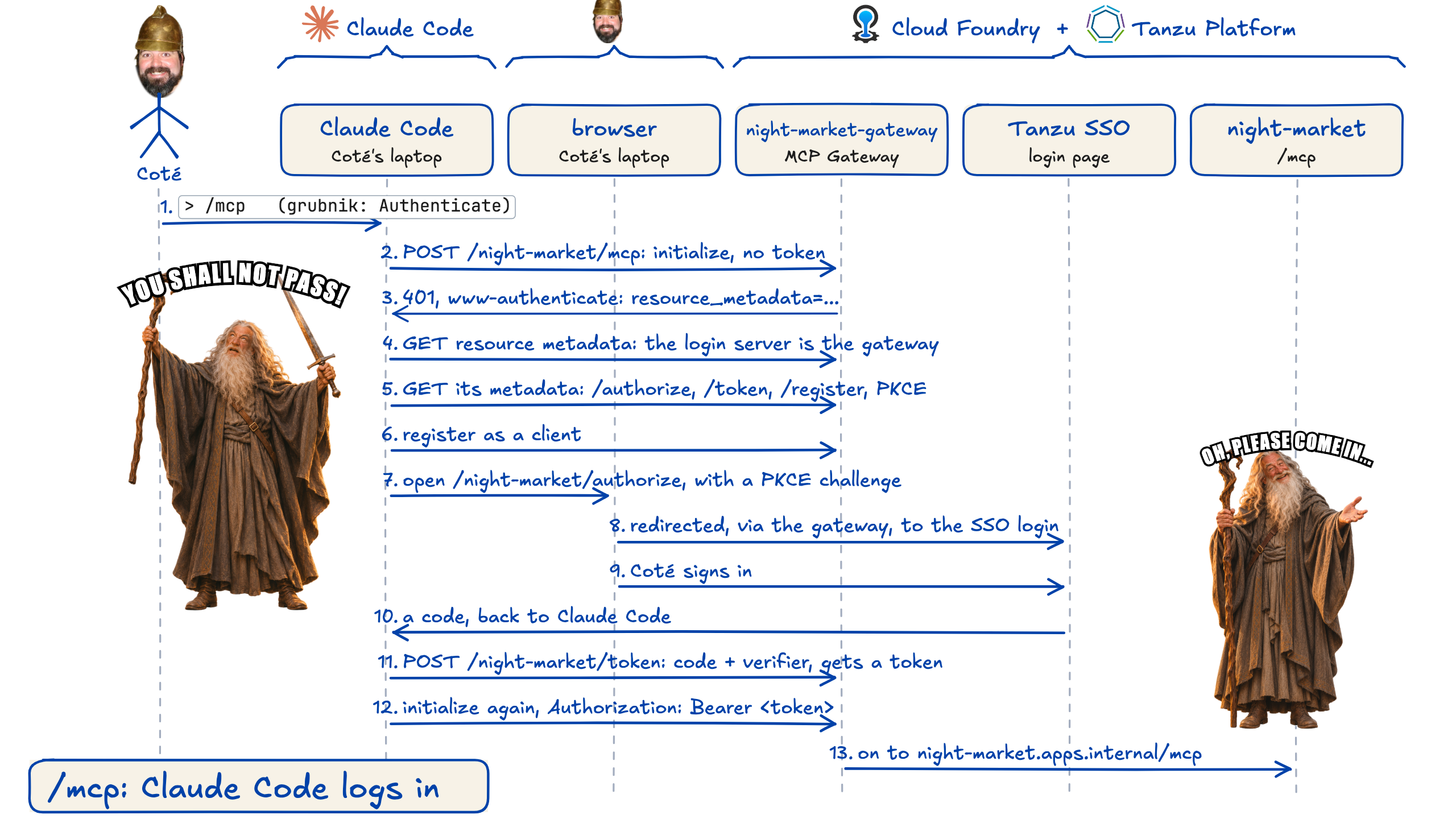
Sequence: Claude Code's /mcp login through the gateway and the platform's SSO
The same chat, highlighted: Fizzlepop's line and Grubnik's reply
Sequence: one npcs app holds every Character; each call finds the NPC, loads its history, builds the context and sends it to its model

Tracing.

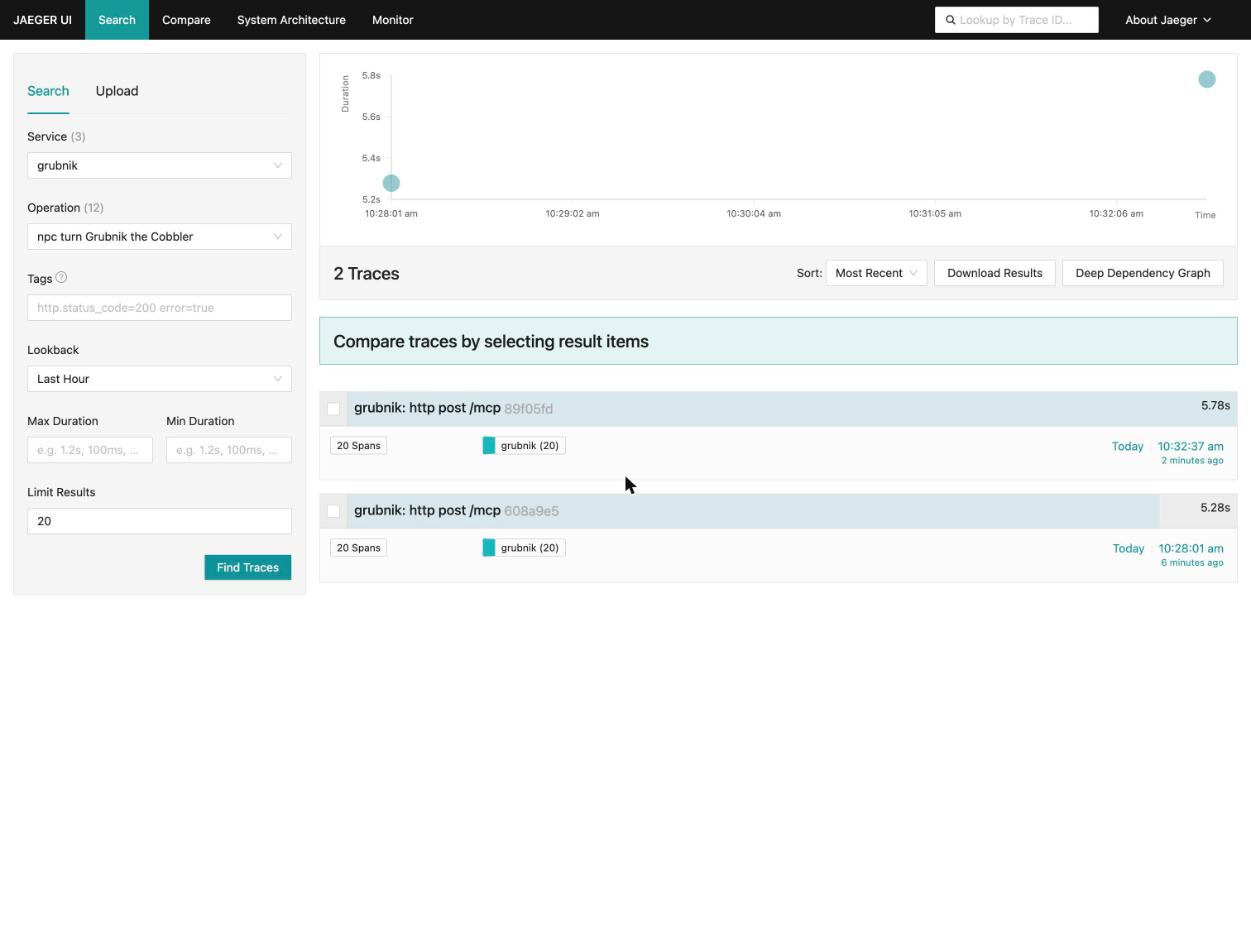
Stock Jaeger UI: grubnik turns
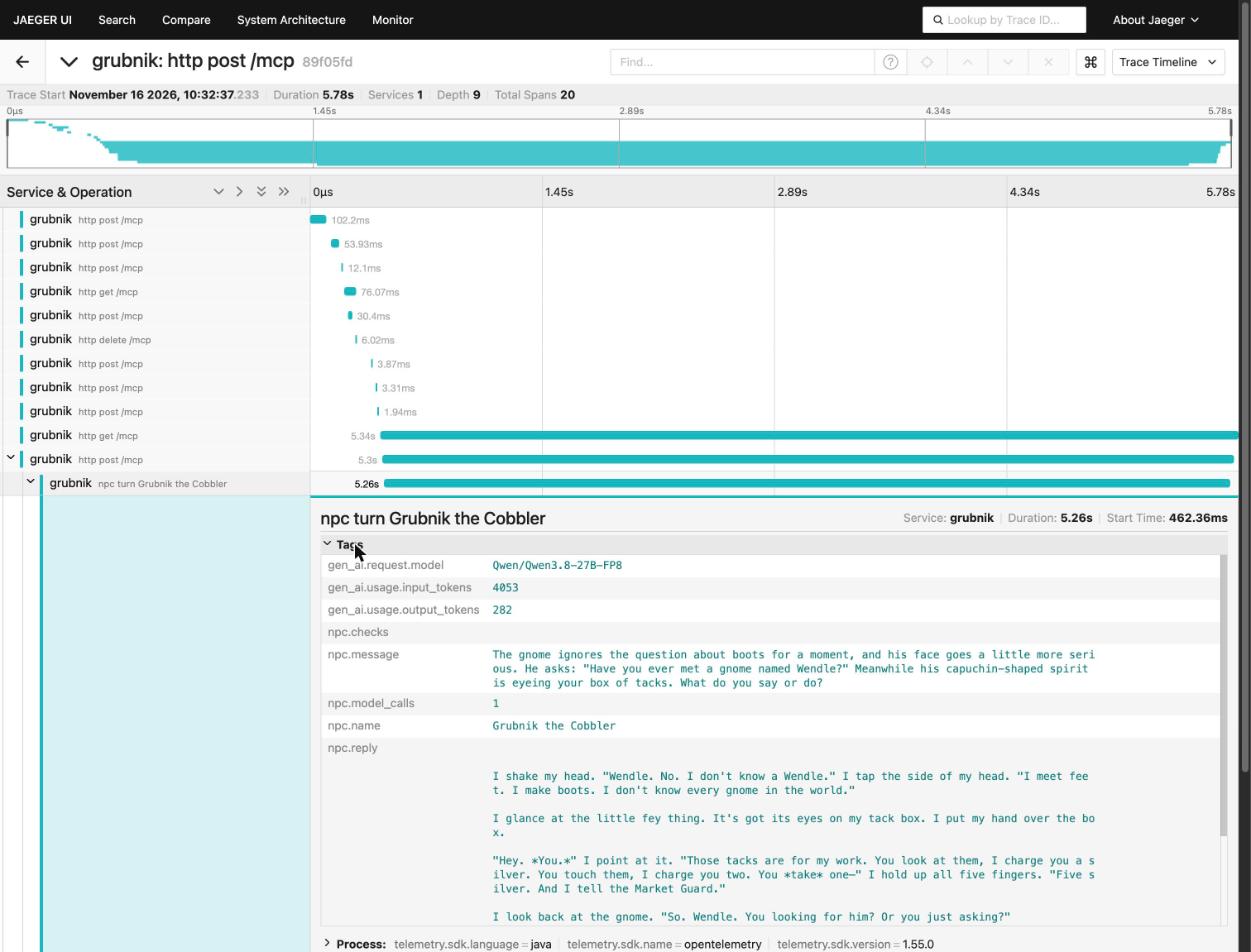
The npc turn span's tags: model, tokens in and out, the message and the reply
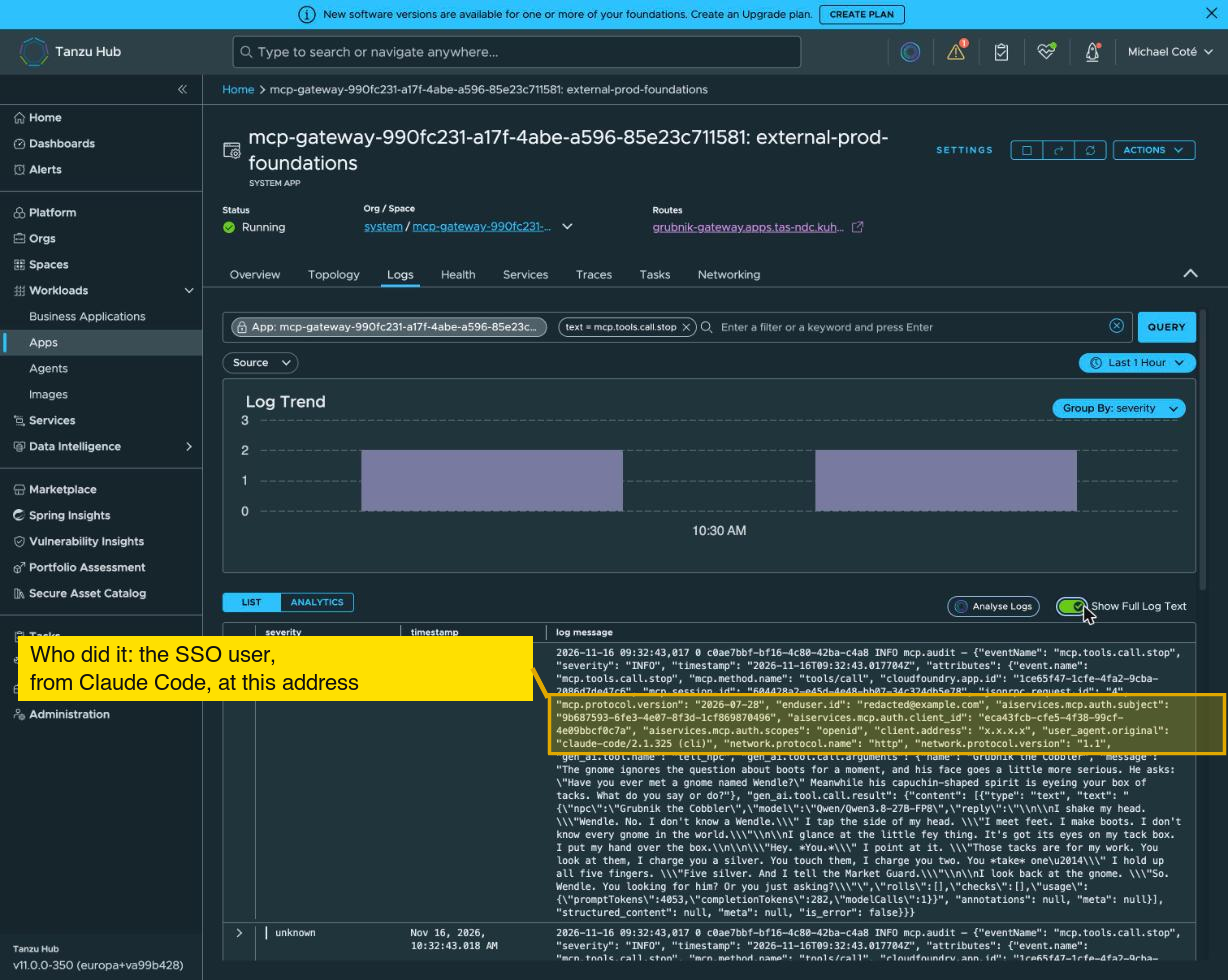
Hub, the MCP Gateway's mcp.audit log: who called, what went in and out, the model, the tokens
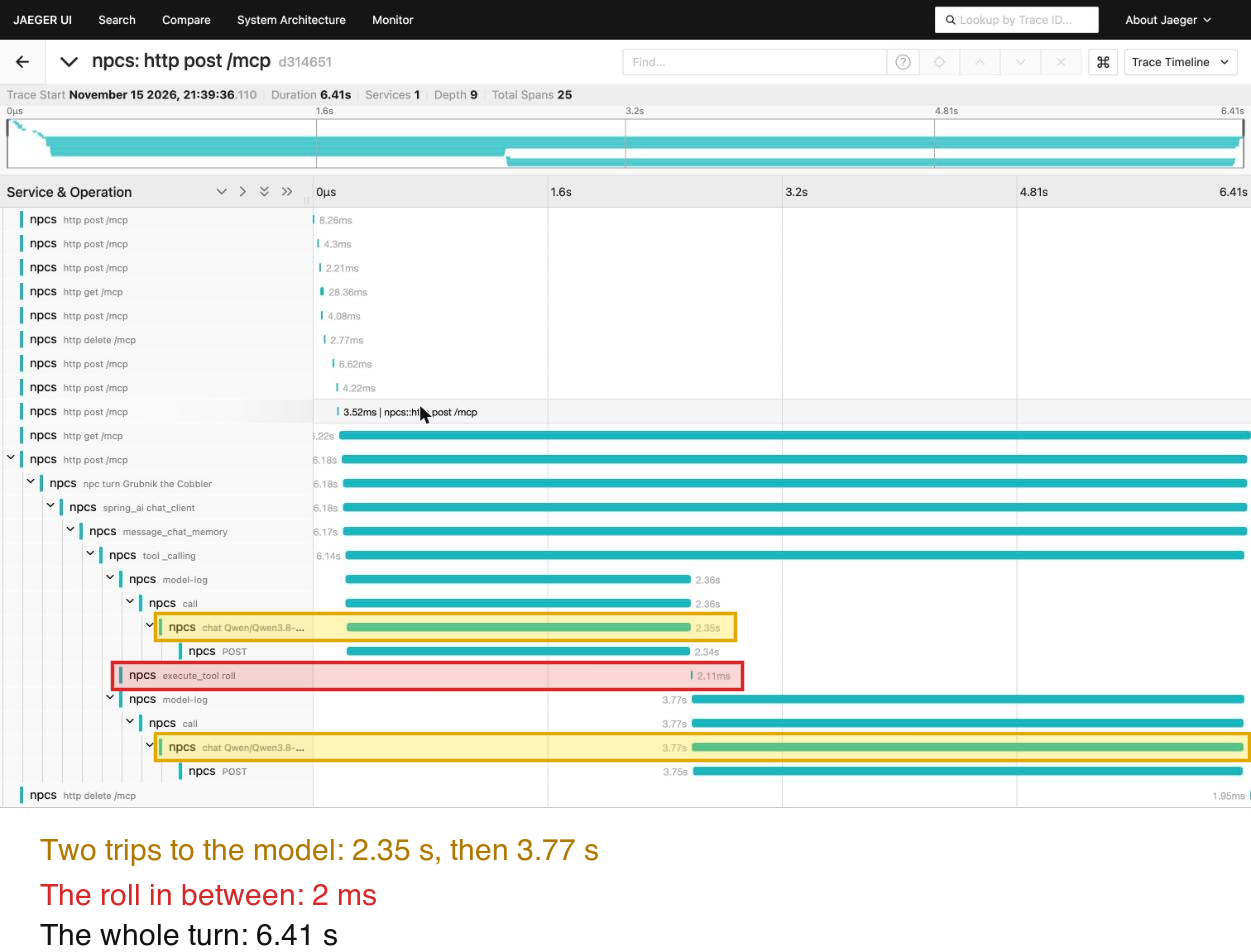
Jaeger, trace d314651: a Grubnik turn with the old roll tool, two Qwen calls with execute_tool roll (2 ms) between them, 6.41 s

Two seconds and nearly twice the tokens† just to ask for a d20 that takes two milliseconds.

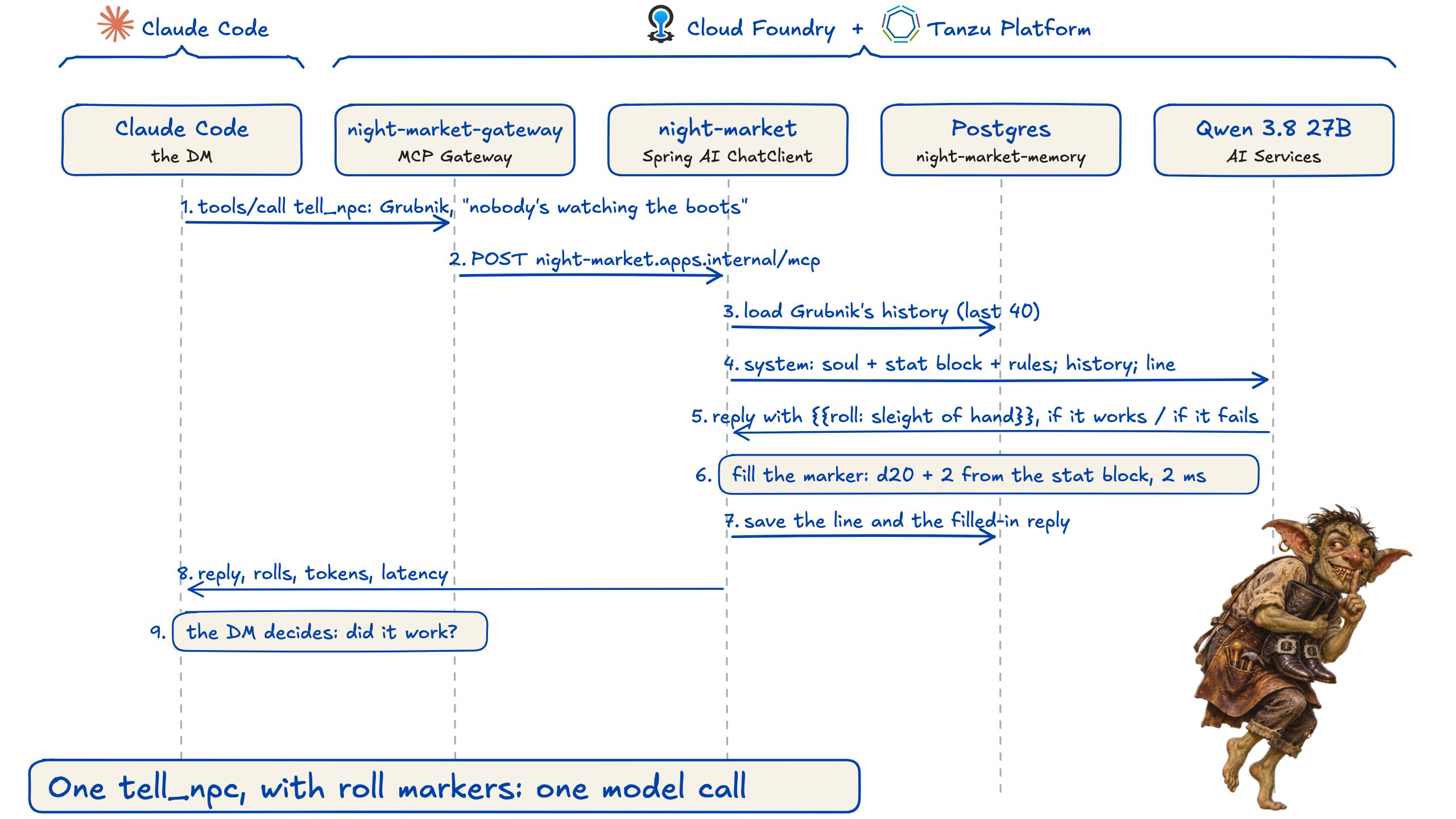
Sequence: one tell_npc with roll markers: one model call, the app fills in the roll from the stat block
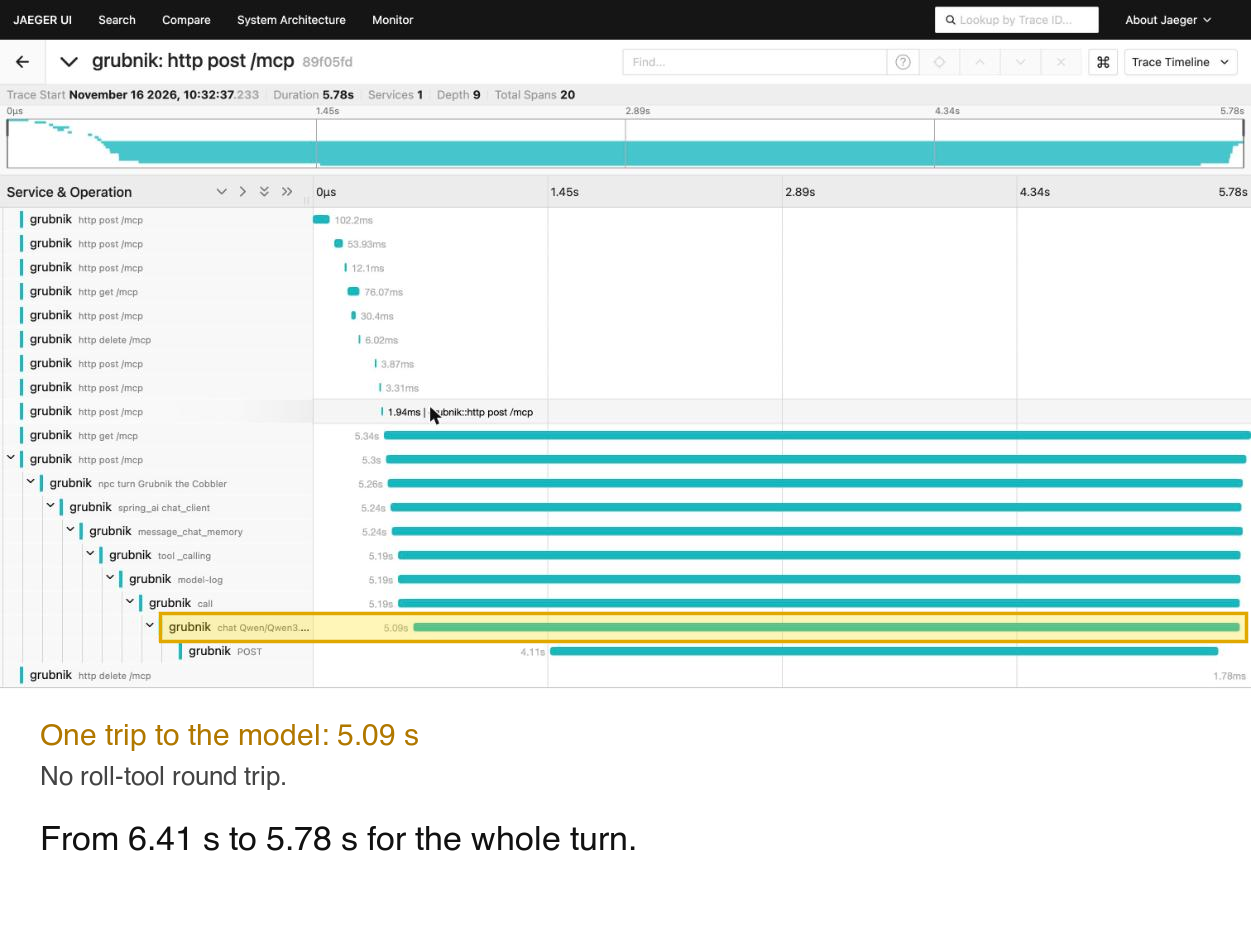
Jaeger, trace 89f05fd: a Grubnik turn with one Qwen call, 5.78 s
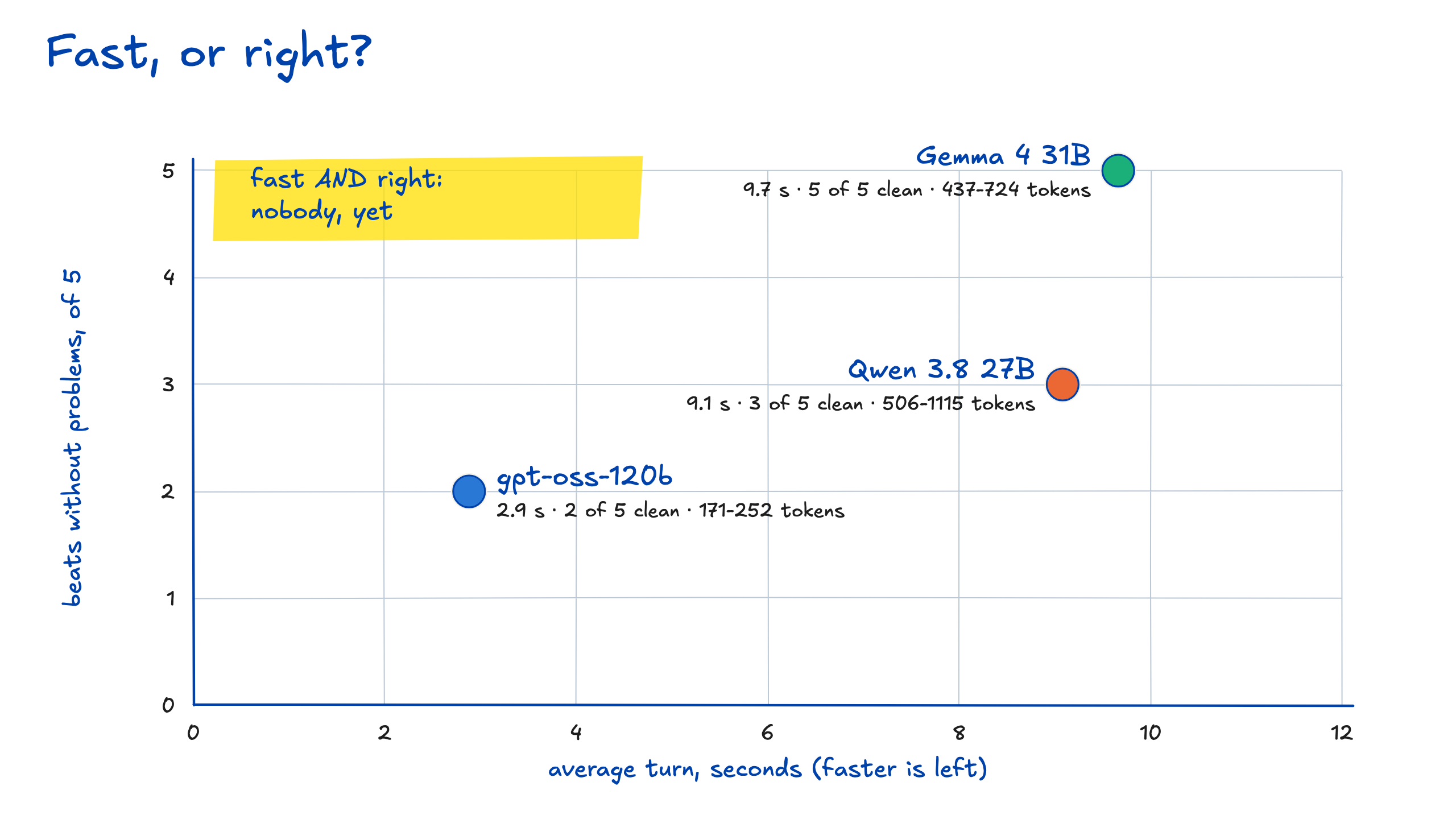
A hand-drawn chart on graph paper, Fast, or right?: average turn time across, beats without problems up. gpt-oss-120b at 2.9 s and 2 of 5 clean; Qwen 3.8 27B at 9.1 s and 3 of 5; Gemma 4 31B at 9.7 s and 5 of 5. The fast-and-right corner is empty.
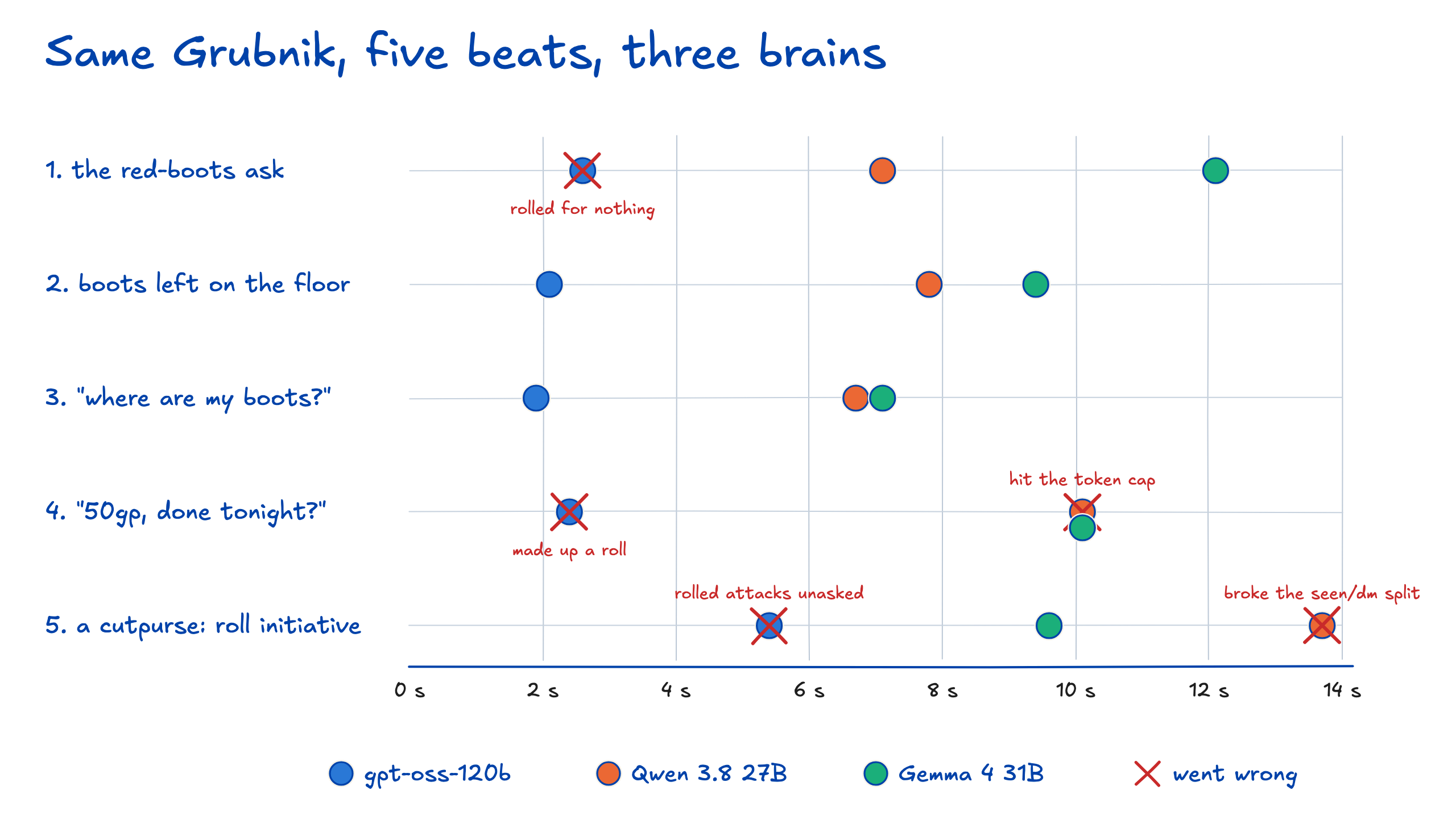
A hand-drawn chart on graph paper, Same Grubnik, five beats, three brains: each beat's turn time per model, with the turns that went wrong crossed out in red: gpt-oss rolled for nothing, made up a roll, rolled attacks unasked; Qwen hit the token cap and broke the seen/dm split.
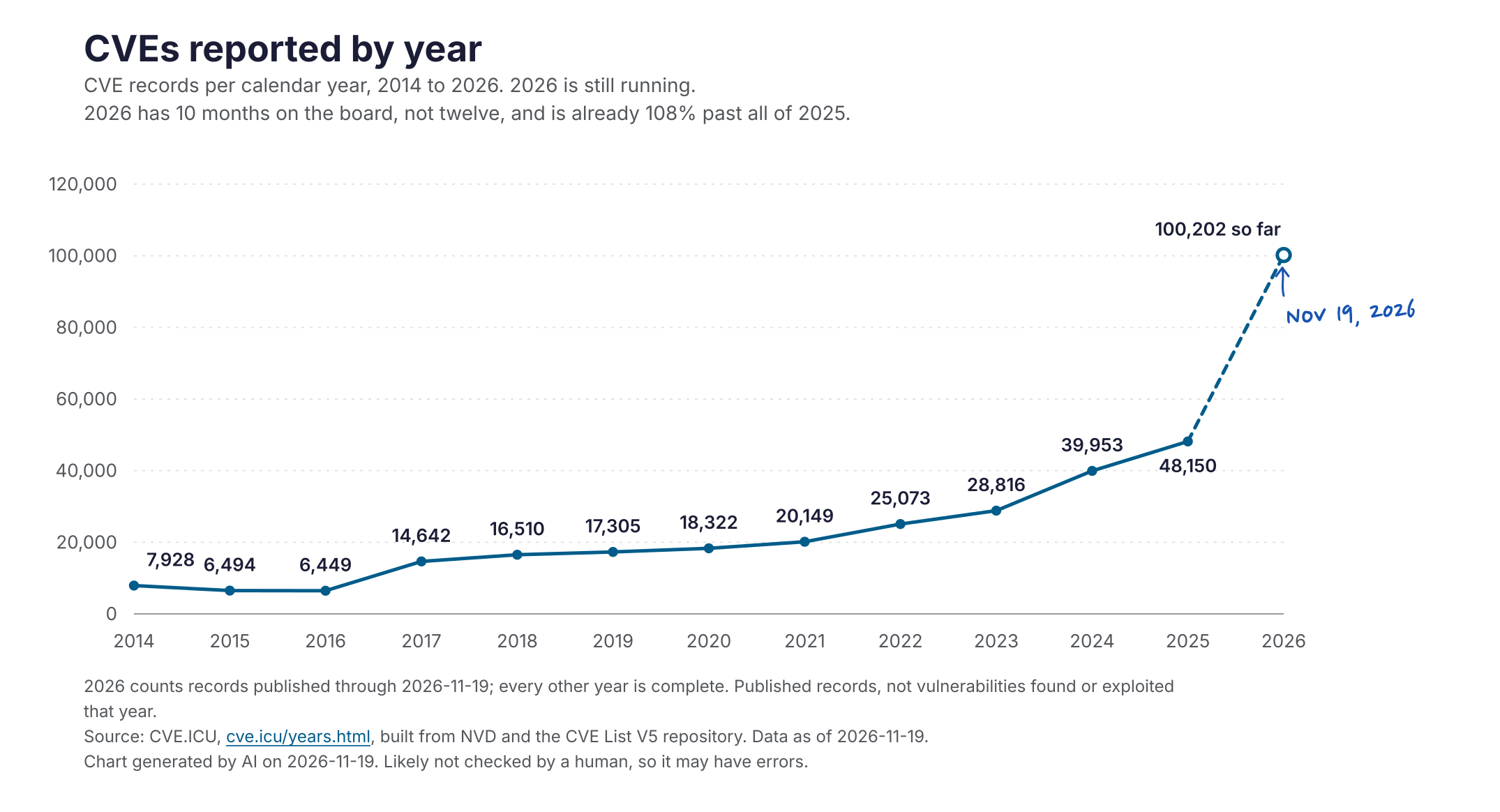
CVEs reported by year, 2014 to 2026: 100,202 so far in 2026, already 108% past all of 2025

“Repaving constantly to flush any persistent threats.”

Wells Fargo, re-running the pipelines even when nothing new shipped

Source: “How Two Operators are Continuously Patching Pivotal Cloud Foundry,” VMware Tanzu blog, February 2019.
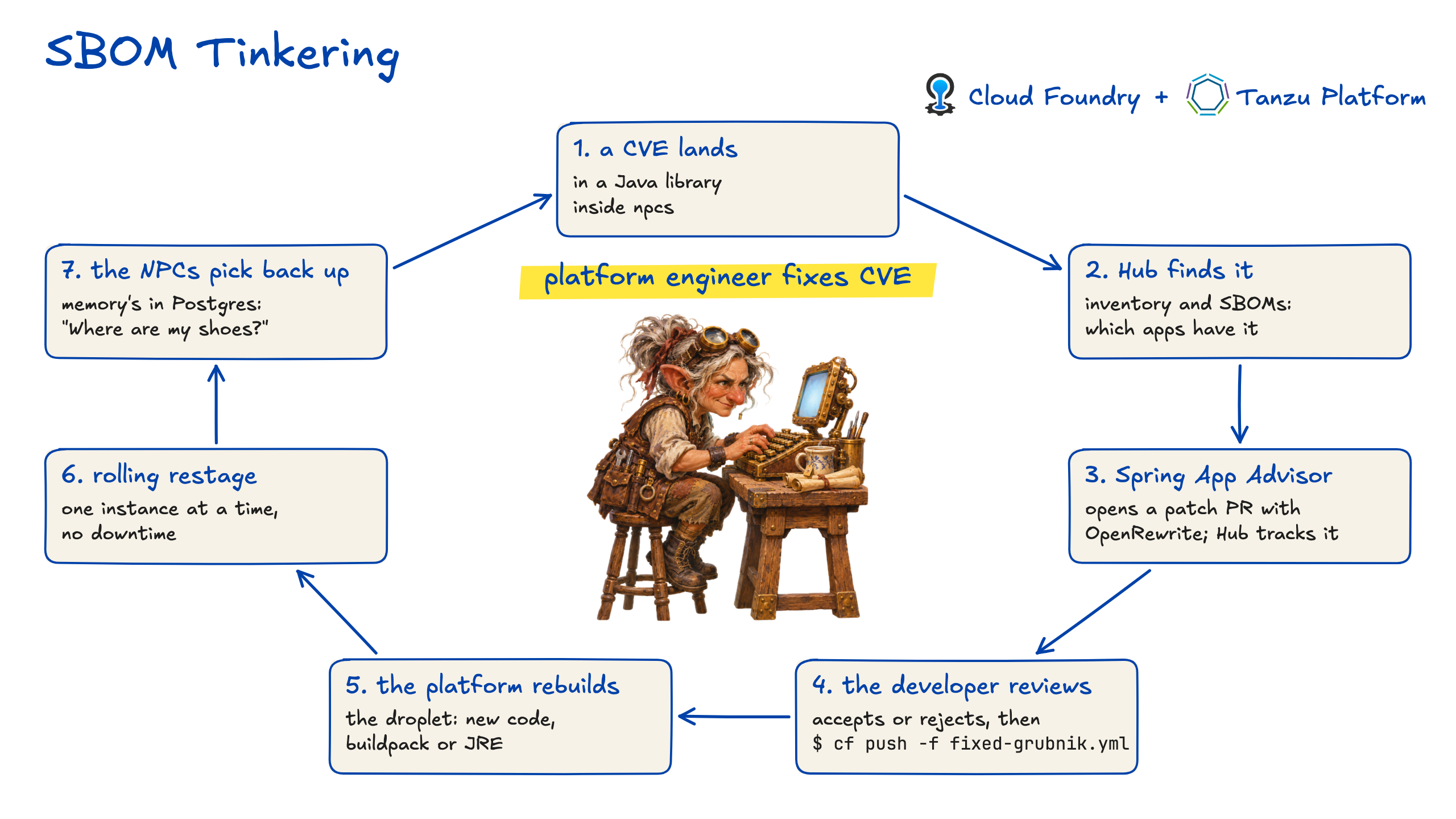
SBOM tinkering: a CVE lands, Hub finds it, Spring App Advisor opens a patch PR, the developer reviews and pushes, the platform rebuilds, a rolling restage, the NPCs pick back up
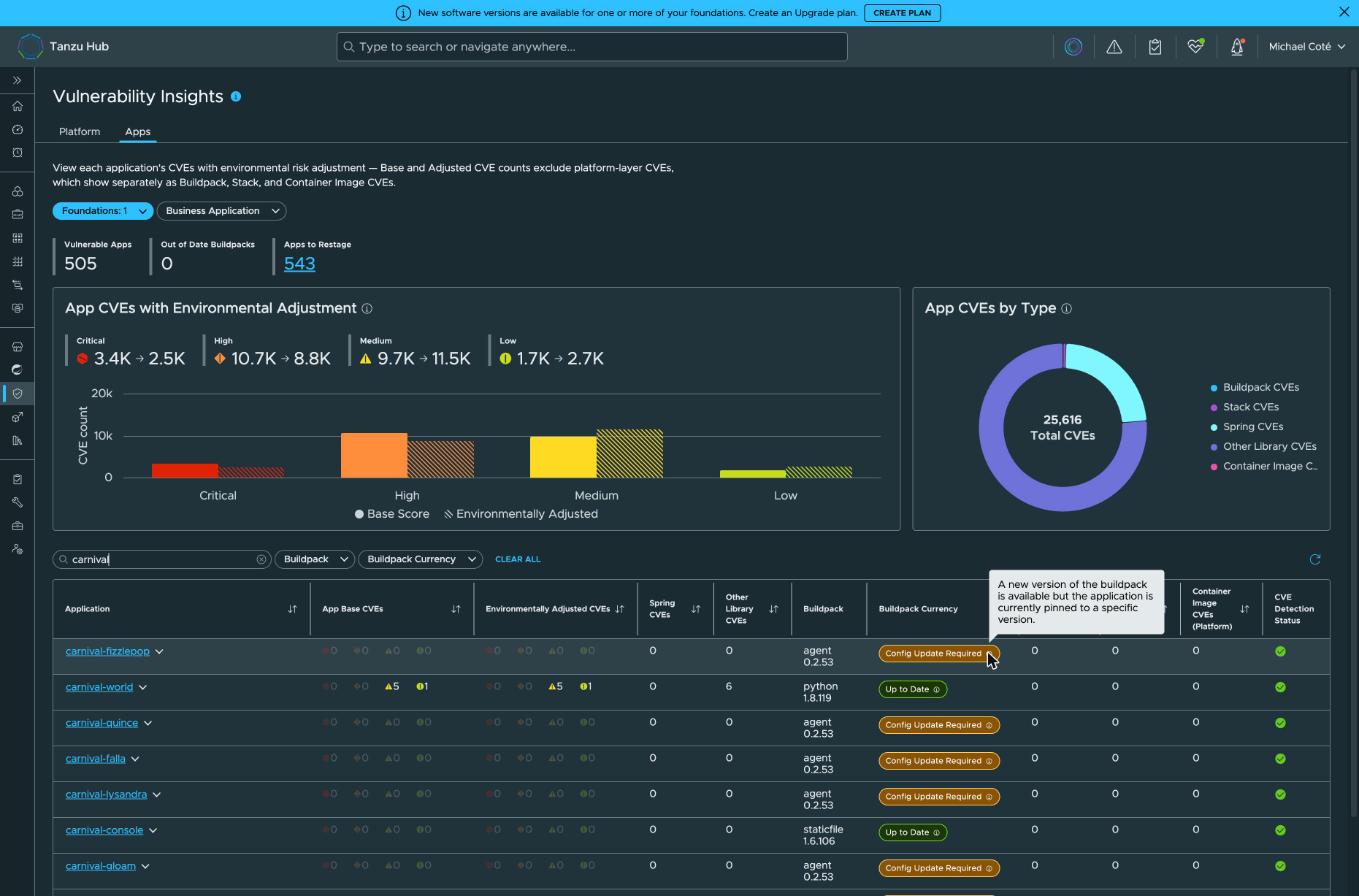
Tanzu Hub, Vulnerability Insights, Apps: 505 vulnerable apps, 25,616 CVEs by severity and type, 543 apps to restage, each app's buildpack and CVE counts
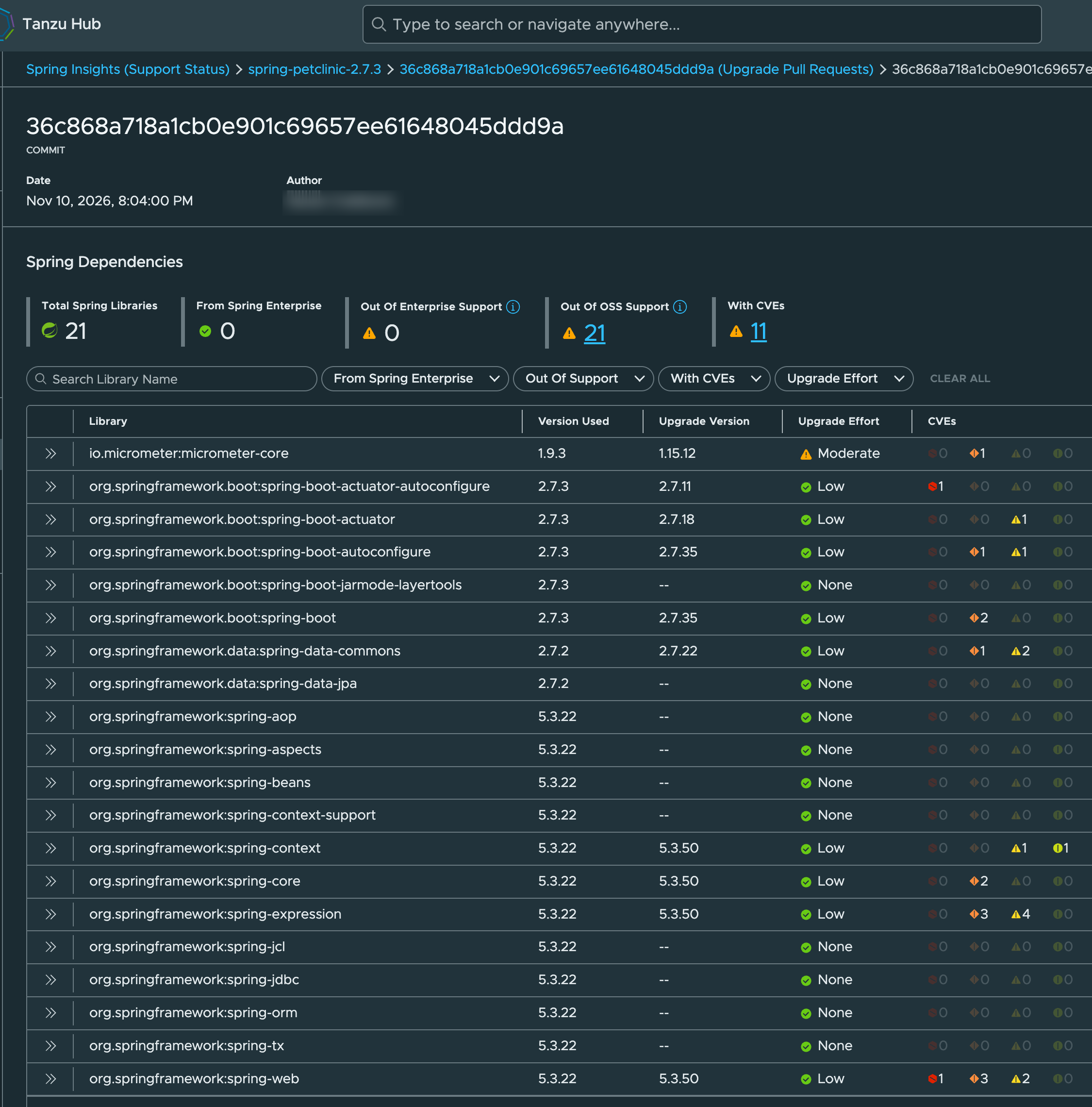
Tanzu Hub, Spring Insights, spring-petclinic on Spring Boot 2.7.3: each Spring library's version, upgrade version, upgrade effort and CVEs
# openrewrite/rewrite-spring: spring-boot-27.yml
name: org.openrewrite.java.spring.boot2.UpgradeSpringBoot_2_7
recipeList:
  - UpgradeDependencyVersion:
      groupId: org.springframework.boot
      artifactId: "*"
      newVersion: 2.7.x
  - UpgradeParentVersion:
      artifactId: spring-boot-starter-parent
      newVersion: 2.7.x
  - UpgradeDependencyVersion:
      groupId: org.springframework
      newVersion: 5.3.x
  - UpgradeSpringData_2_7
  - UpgradeSpringSecurity_5_7
  - SpringBootProperties_2_7
  ...

Recipe: OpenRewrite, rewrite-spring, UpgradeSpringBoot_2_7 (abridged).

// NoRequestMappingAnnotation.java (abridged)
public J.Annotation visitAnnotation(J.Annotation a, ExecutionContext ctx) {
  if (REQUEST_MAPPING.matches(a)
      && getCursor().getParentOrThrow().getValue() instanceof J.MethodDeclaration) {
    String verb = requestMethodArgument(a)        // method = GET
        .map(this::requestMethodType)
        .map(this::associatedRequestMapping)     // "GetMapping"
        .orElse(null);
    if (verb == null) return a;                  // no method: matches all, leave it

    a = a.withArguments(/* drop method = GET */);
    a = new ChangeType("...annotation.RequestMapping",
                       "...annotation." + verb, false)
          .getVisitor().visit(a, ctx, getCursor().getParentOrThrow());
    maybeRemoveImport("...annotation.RequestMethod");
    maybeAddImport("...annotation." + verb);
    // one argument left, and it's path? drop the "path =" too
  }
  return a;
}
// before
@RequestMapping(path = "/{id}",
                method = RequestMethod.GET)
public ResponseEntity<String> getUser(...)

// after
@GetMapping("/{id}")
public ResponseEntity<String> getUser(...)

// and these it leaves alone, on purpose
@RequestMapping(method = HEAD)
@RequestMapping

OpenRewrite, rewrite-spring: NoRequestMappingAnnotation and its test (abridged).
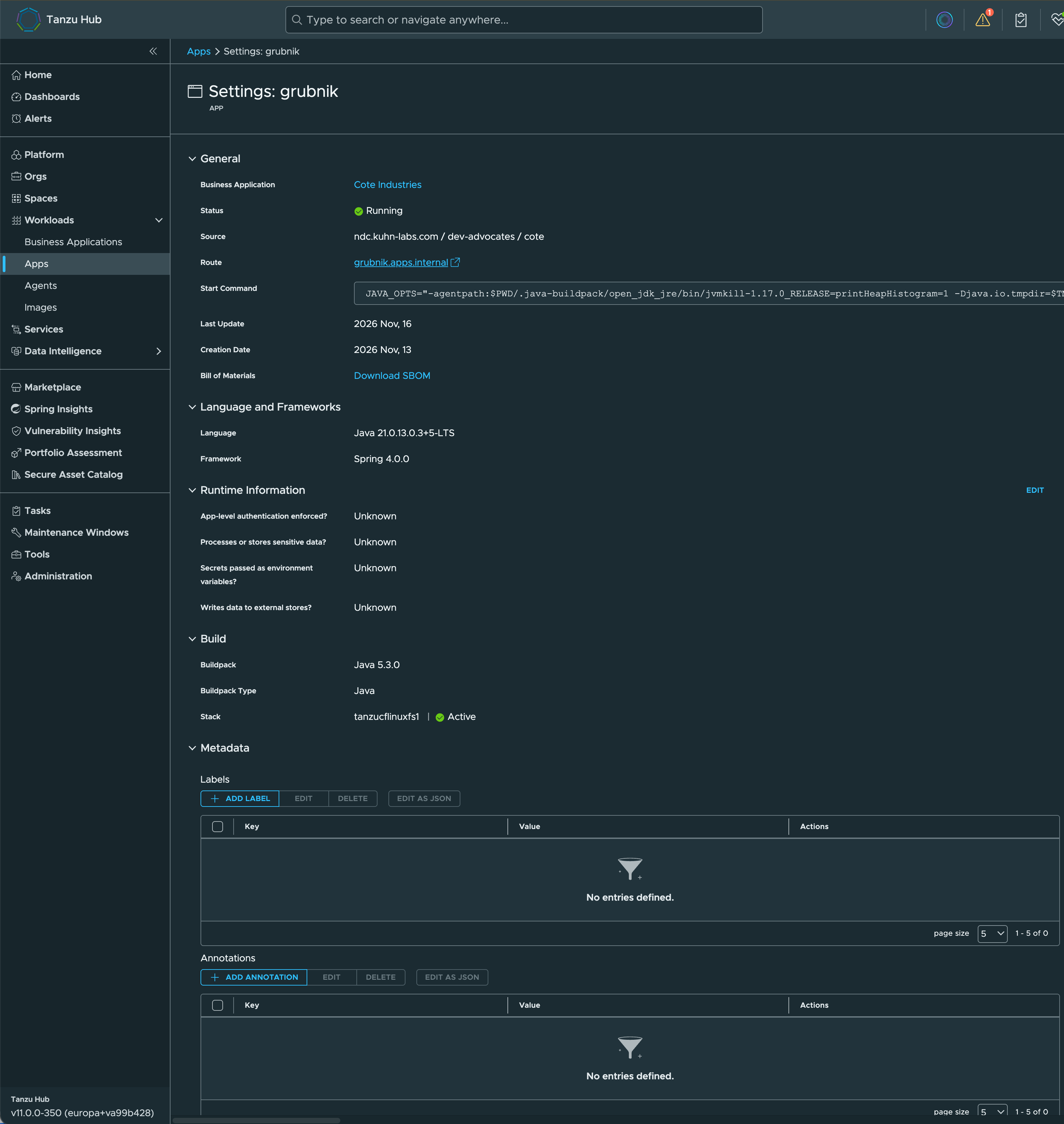
Tanzu Hub, grubnik settings: Bill of Materials, Download SBOM; Java 21.0.13, Spring 4.0.0; buildpack Java 5.3.0
# every repo's Spring version, from Hub's GraphQL
query {
  repositoryQuery { repositoryQueryProviders {
    springArtifact { queryRepositories(first: 100) {
      repositories {
        name
        latestArtifactMetadataVersion {
          springVersion springSupportStatus springFixVersion
          artifactSBOMSummary { vulnerability { total } }
        }
      } } } } }
}

# what comes back (sample: the Spring Boot 2 repos)
{ "data": { "repositoryQuery": { "repositoryQueryProviders": {
  "springArtifact": { "queryRepositories": {
    "repositories": [
      { "name": "spring-petclinic-2.7.3",
        "latestArtifactMetadataVersion": {
          "springVersion": "2.7.3", "springSupportStatus": "SUPPORTED",
          "springFixVersion": "2.7.35",
          "artifactSBOMSummary": { "vulnerability": { "total": 44 } } } },
      { "name": "spring-petclinic-2.7.18",
        "latestArtifactMetadataVersion": {
          "springVersion": "2.7.18", "springSupportStatus": "SUPPORTED",
          "springFixVersion": "2.7.35",
          "artifactSBOMSummary": { "vulnerability": { "total": 38 } } } },
      { "name": "hello-spring-boot-2-7",
        "latestArtifactMetadataVersion": {
          "springVersion": "2.7.0", "springSupportStatus": "SUPPORTED",
          "springFixVersion": "2.7.35",
          "artifactSBOMSummary": { "vulnerability": { "total": 1 } } } }
      ...
    ] } } } } } }
So...

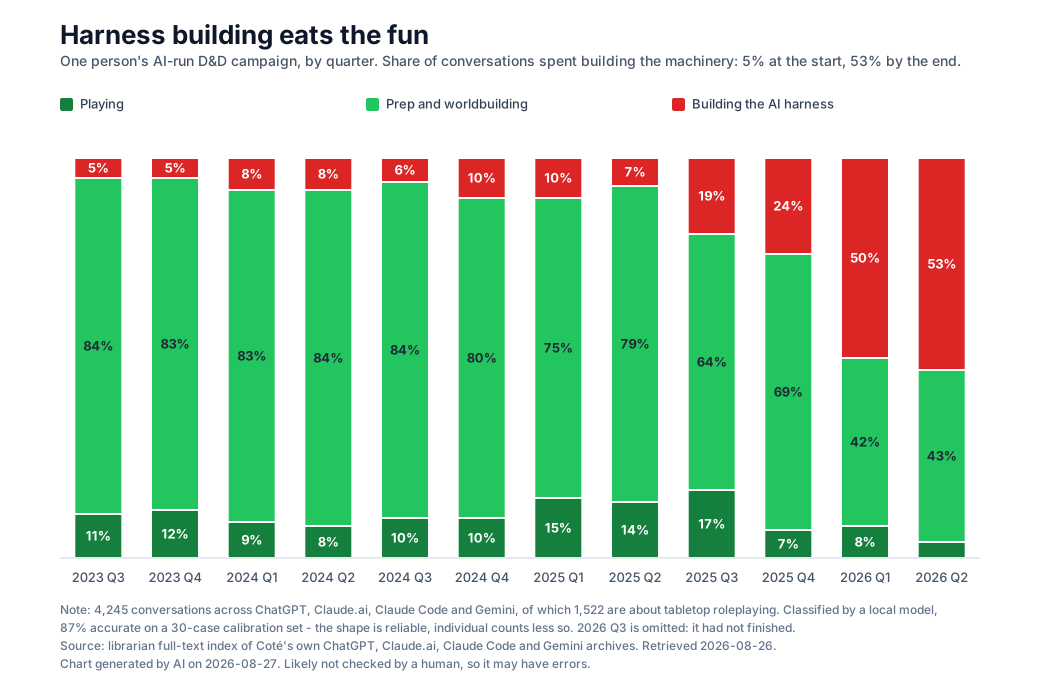
Harness building eats the fun: a 100% stacked column chart of one person's AI-run D&D campaign by quarter, 2023 Q3 to 2026 Q2. Building the AI harness grows from 5% of conversations to 53%; prep and worldbuilding shrink from 84% to 43%; playing stays around 8-17%.
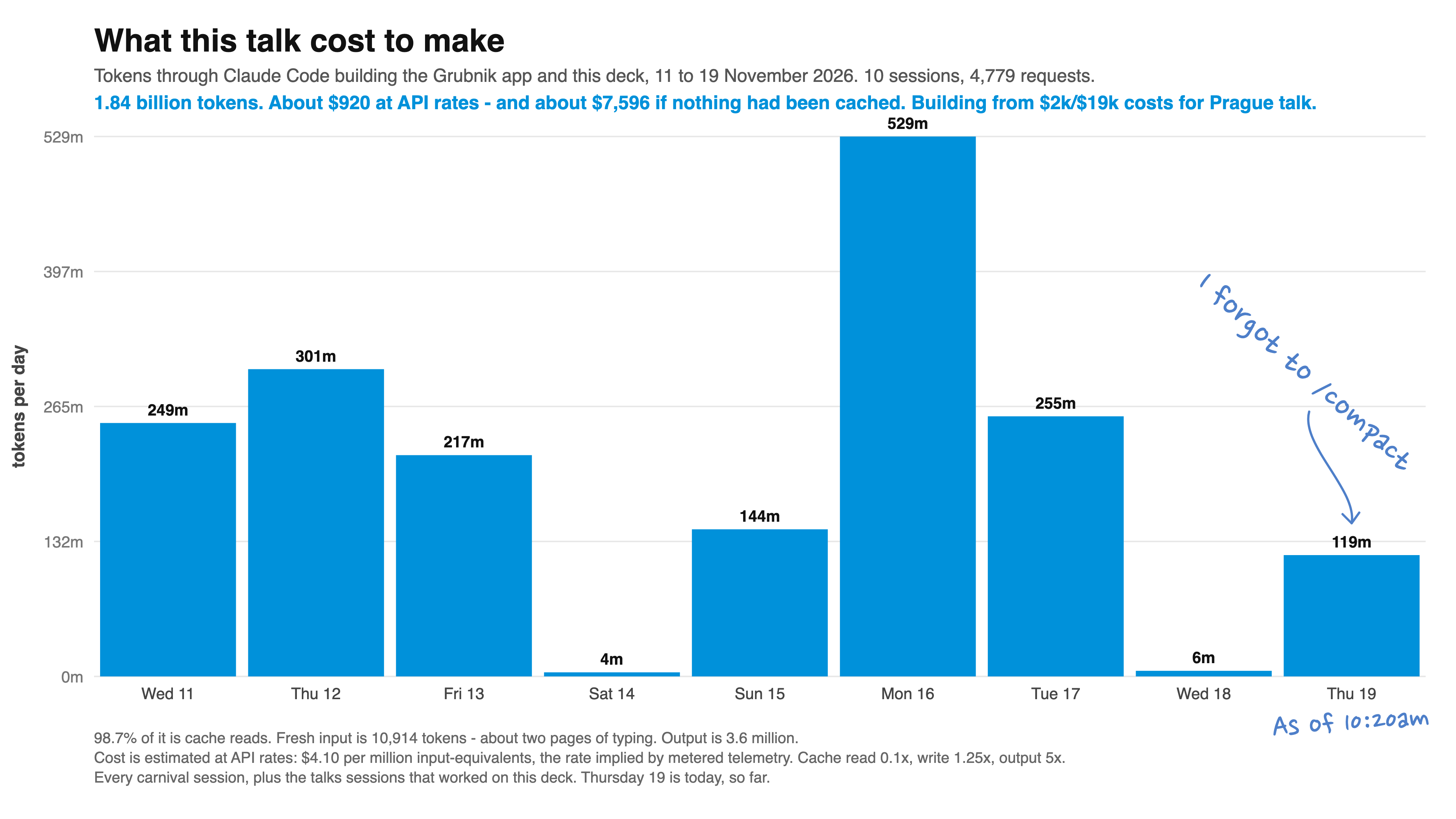
What this talk cost to make: tokens per day through Claude Code, 11 to 19 November 2026. 1.75 billion tokens, about $879 at API rates and about $7,235 if nothing had been cached; the Prague talk was $2k/$19k.

Loot.

  • Watch AI getting better - no incomprehensible benchmarks needed.
  • I now program more! I love it!
  • Jevon's Goblin Paradox.