Here comes the normies
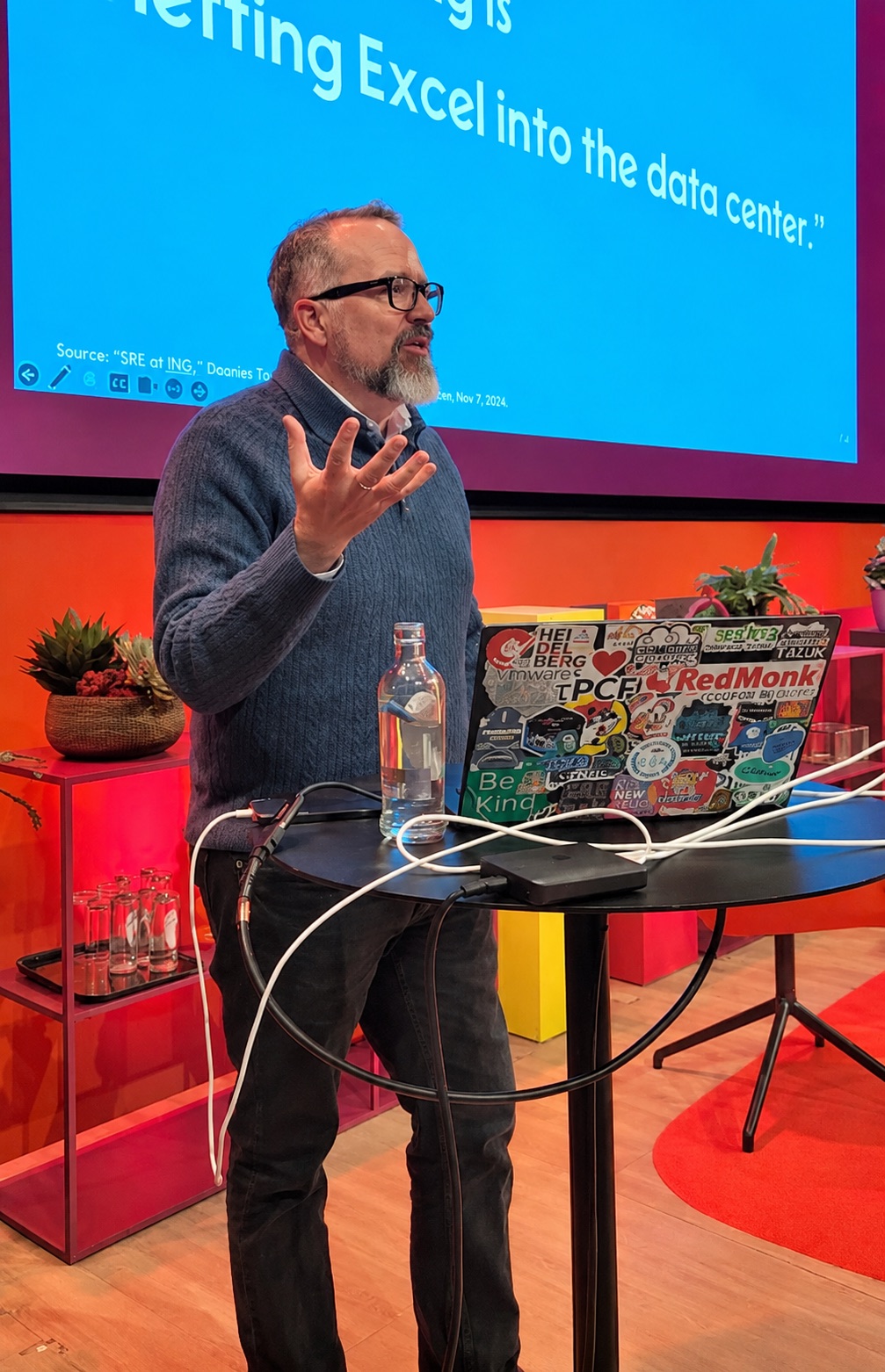
Given as "Here comes the normies - how DevOps can handle the flood of AI slop-apps" at SREday Amsterdam 2026 on .
Salespeople, analysts and HR teams are using AI coding tools to build their own small internal apps, and there are already thousands of them inside big companies. This talk looks at what those apps actually are, what a one-person "enterprise" ends up needing - credentials, governance, data policy, audit, a token budget - and why the answer is to shift that work down onto a platform rather than say no and start a new wave of shadow IT.
Slides
Abstract
There's a new wall to break down: the wall between normie/nerd wall. AI coding tools means we're starting to see knowledge workers writing applications. Salespeople, analysts, HR teams. Not "real" programmers - regular employees using Claude or Cowork to build small internal apps that replace the Excel-and-meeting business processes that used to take a week.
BBVA reports 4,000+ active employee-built GPTs, and Air France/KLM is saving over 200,000 hours a year on bot-driven internal automation. The pattern is showing up everywhere I look.
All those apps need to run somewhere, they need to be managed, they need rapid delivery cycles and feedback loops. Sounds like DevOps!
This talk goes over the new app patterns I'm seeing emerge, the platform-engineering work nobody planned for, and what the early movers have figured out about running it all.
Further Resources
- Protect your registries for AI use, and humans too with TrueSource Spring Enterprise by Broadcom and TrueSource Trusted Artifacts.
- TryTanzu.ai - need an AI platform? Why not TryTanzu.ai for a 90 day trial?
- "Inside the Coding Agent-Powered SDLC: Adapting Your Infrastructure," Adib Saikali and Frank Denneman, VMware Explore 2026, INVB1690LV. Where the lifecycle diagram comes from, and the argument that one developer now drives three to ten agents.
- "0 Code Agents: From AGENTS.md to Running App," Nick Kuhn, VMware Explore 2026, APPB1669LV. Make the compliant path the easiest path.
- "When everyone can build: The platform behind 1000 citizen-built apps," Boyan Dimitrov, CTO of SIXT, PlatformCon 2026, 19 minutes. A thousand solutions built by non-technical colleagues in about three months, against an expectation of ten to fifteen a month.
- "Conquering the Agentic AI Journey with a Private Cloud Platform," Stephen Elliott (IDC), Prashanth Shenoy and Shobhit Bhutani (Broadcom), 24 September 2026. "Treat every agent like it's a human" at 9:58, returned to at 21:50.
- IDC White Paper, sponsored by Broadcom, On-Premises AI Infrastructure Balances Innovation and Security, doc #US52747024, December 2024. Conducted July 2024, n = 411.
Transcript
The new workload
Well, hello. Thanks for coming to my talk, and for having me here. So, there's the name of it. What I want to go over is a new workload that, whether you call yourself an SRE person, a DevOps-y person, a platform engineer, operations, infrastructure, whoever keeps things up and running, is probably set to arrive. And if it doesn't, we'll probably all be in trouble, because it's our great hope for the future.
Developers are already flooding GitHub
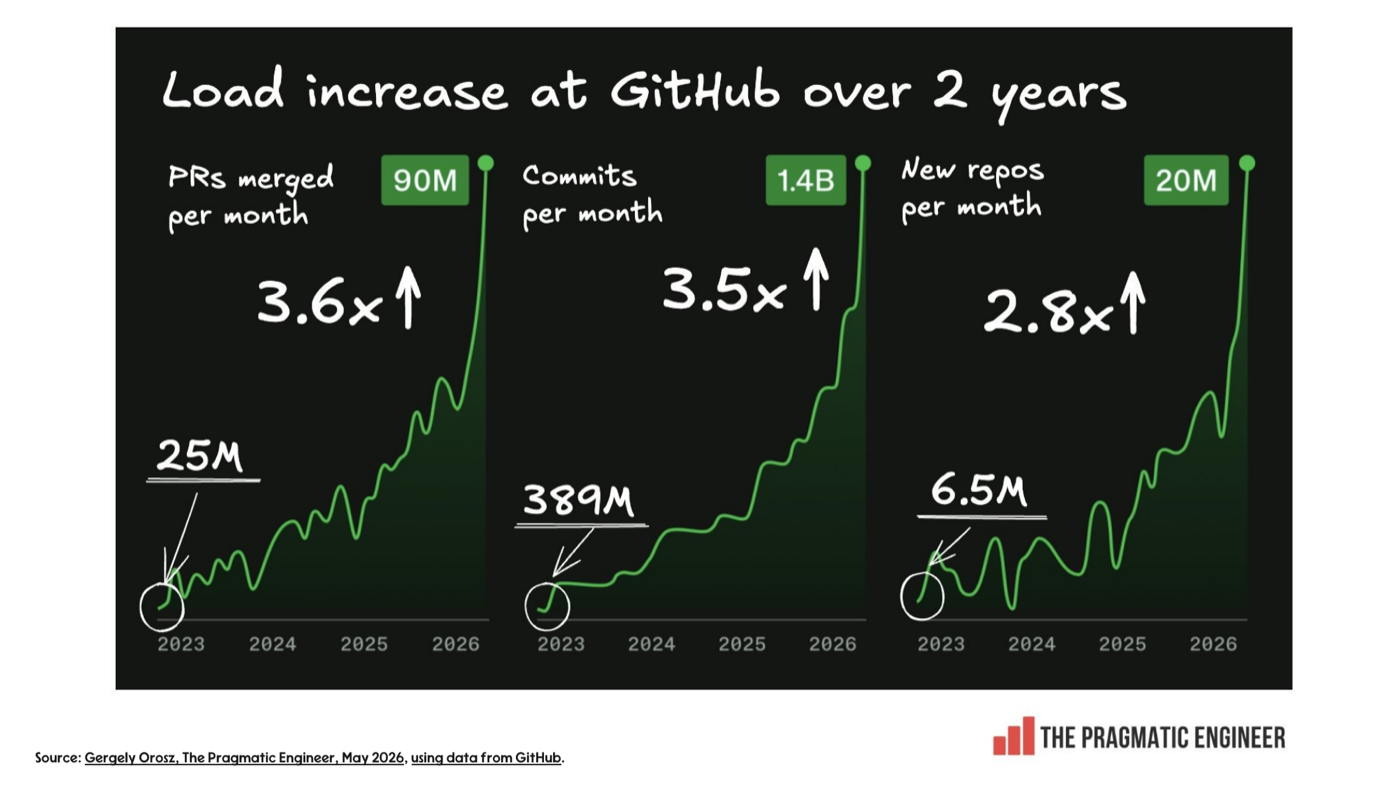
As has been talked about all day today, and this is my favorite way to represent it, developers are out there doing a lot of stuff with AI: lots of code generation, working on projects, some of them in that gray area of pirating famous video games and creative and productivity suites. Here's one way of looking at it. You can see there's been a huge rise in activity on GitHub: the PRs, the commits, just gigantic, tracked over the past few years. This is a bit like seeing the blood work of what's going on. I guess you could say maybe there are PRs of one character each, and that would explain it, but that's probably not what's going on.
Normie applications
So I think that workload, to use that archaic term, is very well covered. But there's another workload that's slowly trickling in, and it's represented by all sorts of applications. Someone was talking about tech debt today. You've got this great legacy application, this whole suite of legacy applications we've been dealing with for a while: Excel, or Word, or, if you're exotic, Keynote or Numbers on your Mac, or, if you're stricken with it, Google Slides or Google Sheets. These applications have nothing to do with programming. Well, there might be that one person in your organization who knows how to use VLOOKUP. But you have what I'd call normie applications. Which is to say: if we're the nerds, the neckbeards, the technical people doing things, then there's the rest of the world, normal, mainstream people that we're ideally supporting, who are just running things. And the issue becomes: what happens when they have workloads equal to what we're seeing with developers nowadays? How do you handle that from an operations perspective?
Letting Excel into the data center
This morning, in the opening, there was a great quote, a metaphor: vibe coding is letting Excel into the data center. And the point of this is, let's take that literally: letting Excel into the data center. When you connect it directly to the systems we have, you've got all the normies, as it were, going crazy with tokens. Imagine a world, whether you use Claude Code or Codex or whatever, where every single person in the organization is also using Claude Code. They just installed it, and now they're going to town with it, very busy using it. That becomes a situation where you wonder: how are we going to manage it? Most organizations have, what do they call it, desktop management. Are they going to be the ones who manage this? Are the people who manage the printers going to be in charge of it? It's probably going to be the people in this room. I don't mean to insult the printer people, they're fine, but the breadth of what you can do with a proper harness in place is a lot more than making sure you can connect to a printer, or that you have the approved things installed.
Converting PDFs to slides
As an example of things starting to go a little nutty, there's some news that Accenture has realized it's a terrible idea to have people using this powerful tool, which is either going to be the great evolution of civilization, its destruction, or just a big nothing burger, and all they're doing is converting PDFs to presentations. Which is kind of a questionable activity in the first place, when something could have just been an email, or nowadays two agents talking to each other to sort things out. It's understandable, right? Who wants to make a presentation? Not many people, apart from people who speak at this conference. But you've got all these documents and PDFs, and someone's asked you to make some slides, and you're going to go to some meeting and probably show one slide, and no one will pay attention to it. So you think, why would I bother? I'll have it convert a bunch of PDFs to slides. But this consumes a huge number of tokens. Recently, maybe last month, there was a leak that Accenture was limiting normies to $29 a month in AI, which I think is just about enough to open a PDF, if you look at the token count. So I'm not sure what they'll be doing with it now.
The numbers so far
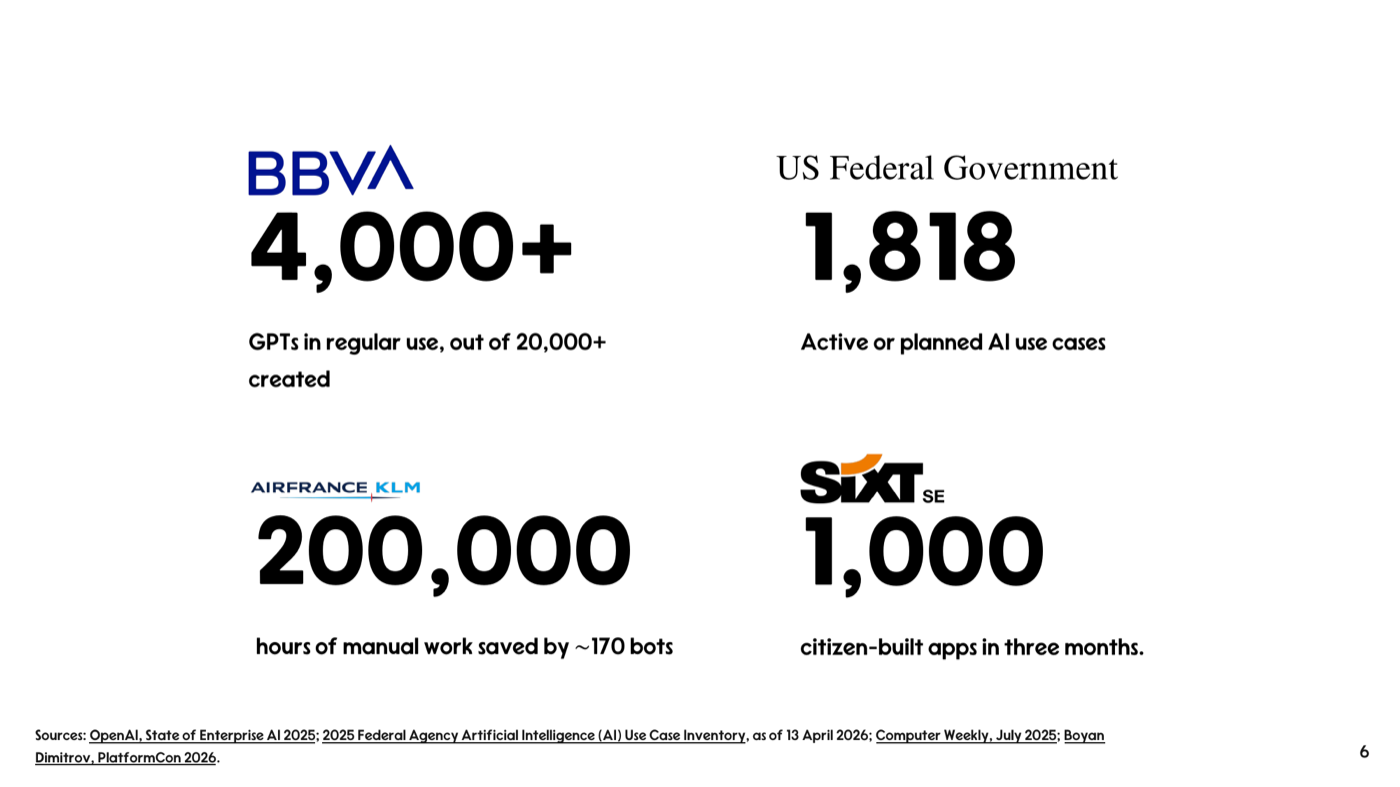
To add some numbers about what people are doing out there, here are a few I've collected over time. You can see the low thousands, and then even more thousands, of this sort of activity, some of it tracked by hours. One of the things I like to track is what normies are doing with AI: what use cases they have beyond programming. Because programming is thrilling, those of us who do it enjoy it, but it's a very small part of what actually goes on. Look at the SIXT presentation in particular, if you want to see how they thought through this whole situation and built things out. There's been a lot of uptake, more than might be expected, of using AI.
What people actually do with AI
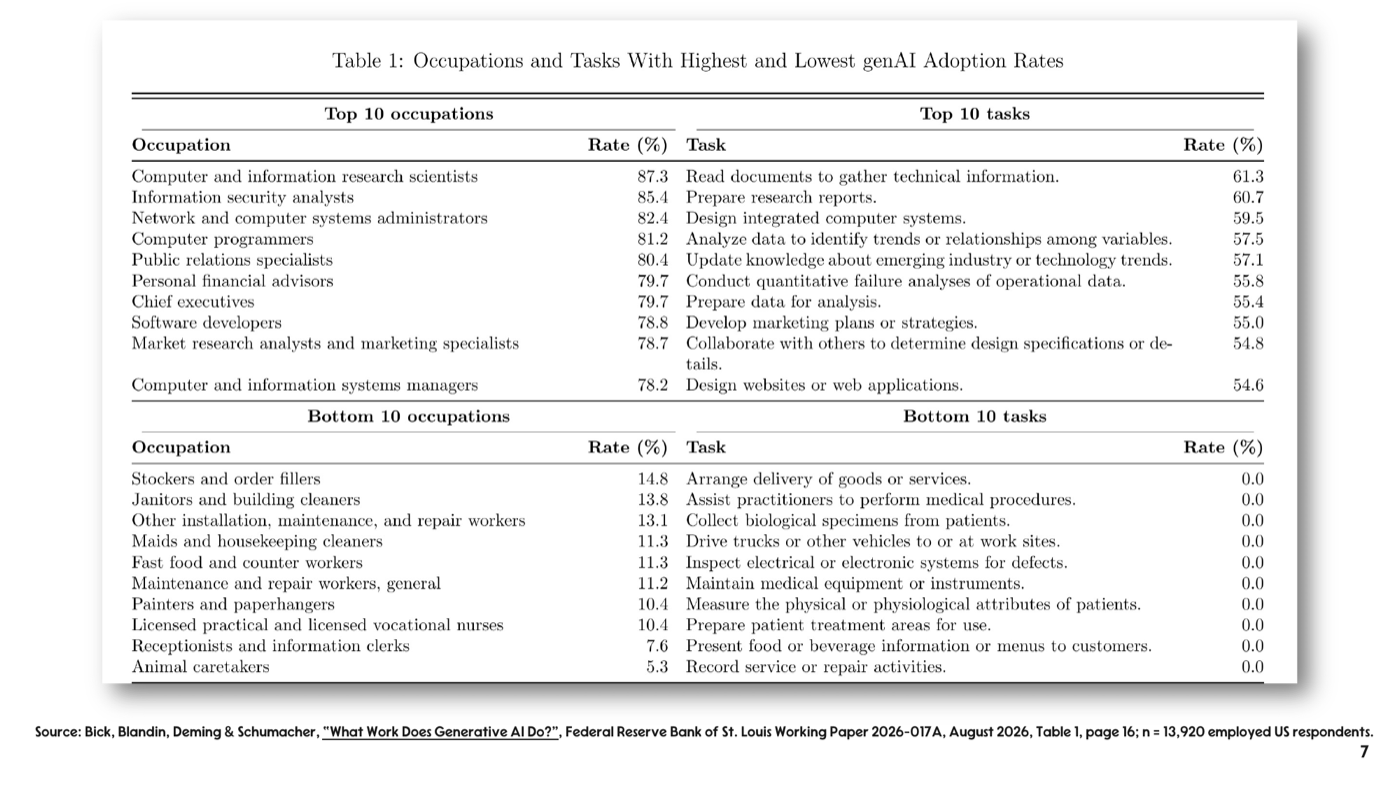
The next question that's always good is: what are people actually doing with it? This is from the US, from the Federal Reserve, not that an American would ever use that phrase, the bank. One of their studies asked what tasks people are doing with AI, what maps to the types of jobs that could be affected, and what the bottom tasks are. As you look at this: we're figuring out how to deal with programmers. You've got this pipeline, and it bottlenecks because you're delivering so much, and then it bottlenecks again until you figure out how to apply your magic AI stuff to deploying it, and then how to use AI on the bottleneck of operations, and on and on.
Me as the test case
So this is what will be in the pipe if all the normies come online. Whenever you think about an operations thing, it's good to figure out what the workloads are, and therefore how you help manage them and anticipate them. Beyond these charts, it's hard to go out and figure out what this stuff is. But then I realized I have a great test case here, which is myself. I don't really program anymore. I programmed a long time ago, but nowadays I make slides and sit in meetings, hopefully not too late. So I've been doing a lot of normie things that you'd do in a corporate setting, or a personal one. Combined with how people are actually doing this, I'll use that as a case study, and then get into what's good for the platforms, the services and the way of managing this kind of normie workload. So that's actually me up there.
Who's talking
I'm Michael Coté; everyone calls me Coté. I've worked at Pivotal, which was acquired by VMware and then by Broadcom, so Pivotal, VMware Tanzu, by Broadcom, for about 11 years now. I've been lucky to spend the whole time studying how large organizations use software, and get better at software, to run their organizations. Before that I was an industry analyst, at a place called RedMonk and another called 451 Research. I'm originally from Austin, Texas, and if you're from Austin and in tech, you serve a compulsory two-year term at Dell. So I worked there for exactly two years. I worked with a bunch of business people, normies. If you ever get a chance to work with business people, I highly recommend it, for a very fixed period of time. You'll learn all about Excel, thinking about numbers, business strategies, synergies, all that MBA stuff, and it's great. Just set yourself a two-year limit, otherwise you'll go insane. But it's very educational. And I do a bunch of podcasts and other nonsense, if you're really interested in engaging with my brand.
What I've had the robot do
So let's look at me as a case study of what I do, and I'll convert it to what you'd do in a corporate setting. But of course, true to the point of normies doing AI stuff, I didn't actually do this. I just asked my little Claude friend to catalog it. I've been doing this for maybe two years or so, and as you go through it, it's the obvious things you'd want to do, here and there. One of my podcast co-hosts put it this way: once you put your fingers on the keyboard to do something, stop doing it, and ask the robot to do it instead. Which I try to do, in a nice, stable way that's not too insane.
Mapping it to work
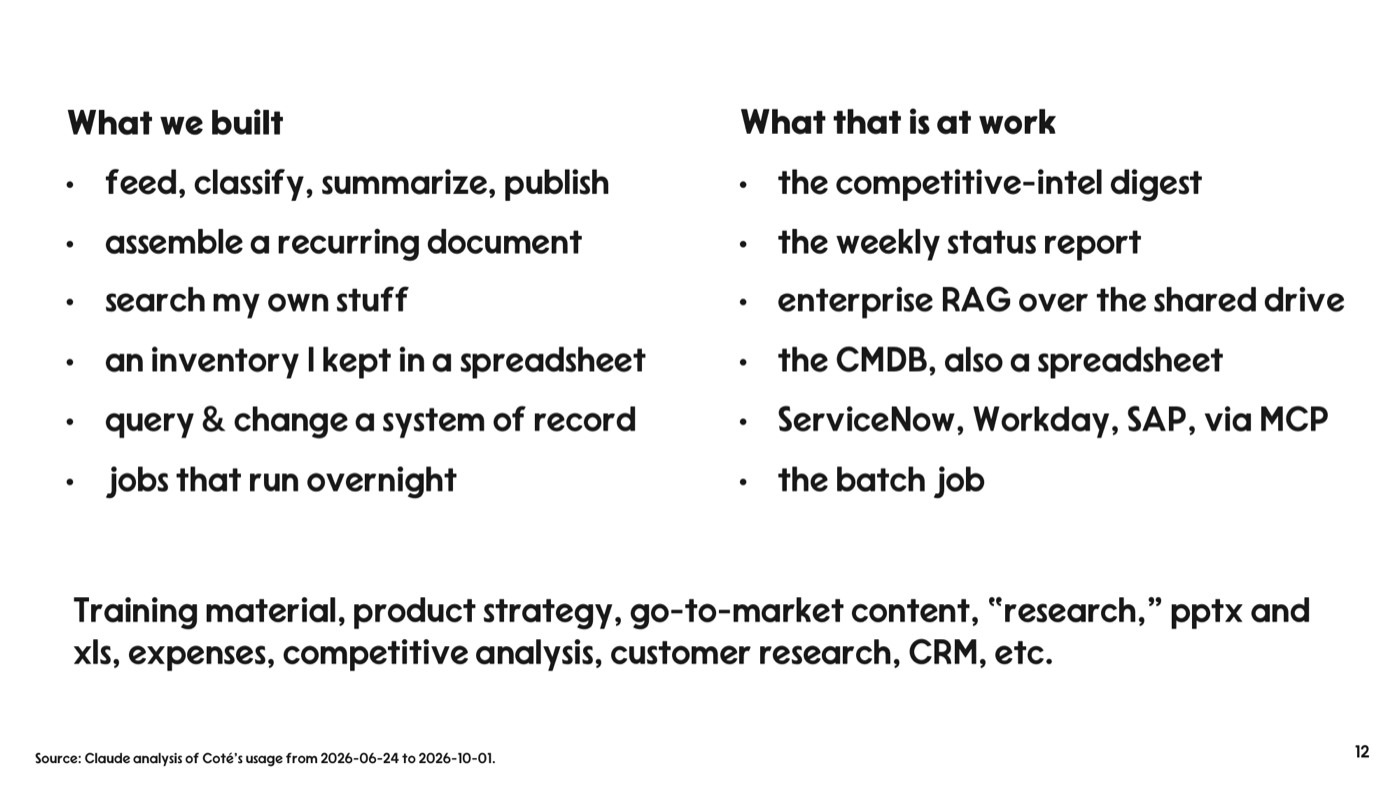
If you think about those types of activities broadly, and map them to their enterprise category, you start to get a sense of what a normie would do if they had a harness. I read a lot of news, so every night I have something go through all my RSS feeds and everything else and write briefs for me, which is great. One of the major activities in the normal world, outside IT, is taking a huge amount of information and synthesizing it into, as they'd say, something actionable: understanding the competitive landscape, following new developments in your market that you might take advantage of. I guess a fancy word for that is analytics, or analysis. Once you figure out how to do it, it's fantastic. I think of all those MBAs I used to work with; they'd love this. So much of their time goes into finding a bunch of stuff and compressing it into a slide, which is what they've got to do. You go on through the list and you can see how easily it maps to the activities we do in a business sense.
Some of these might not be things you'd do in your personal life. I've worked on training material; thinking about how we do things in the field; engaging with customers you're trying to sell your goods and services to, figuring out what they're interested in, how to sell to them, the messages you have; your CRM systems. And one of the most, I think you'd agree the word is fun, things you can do with AI is file your expenses. It's glorious. If you're sick of filing expenses, you can, if you'll pardon the phrase, file the shit out of these expenses and really go to town on them, and the AI is happy to do it for you. I wouldn't recommend it, but you could also imagine, if you're driving Chrome, this is the time of year when you take your ethics and compliance and safety classes. That might be a fun thing to teach your AI about: have it take the ethics and compliance class and give you a readout of what you should be doing at the end. Just imagine all these activities, with all the AI harnessery we use available to everyone in your organization.
Building the harness eats the fun
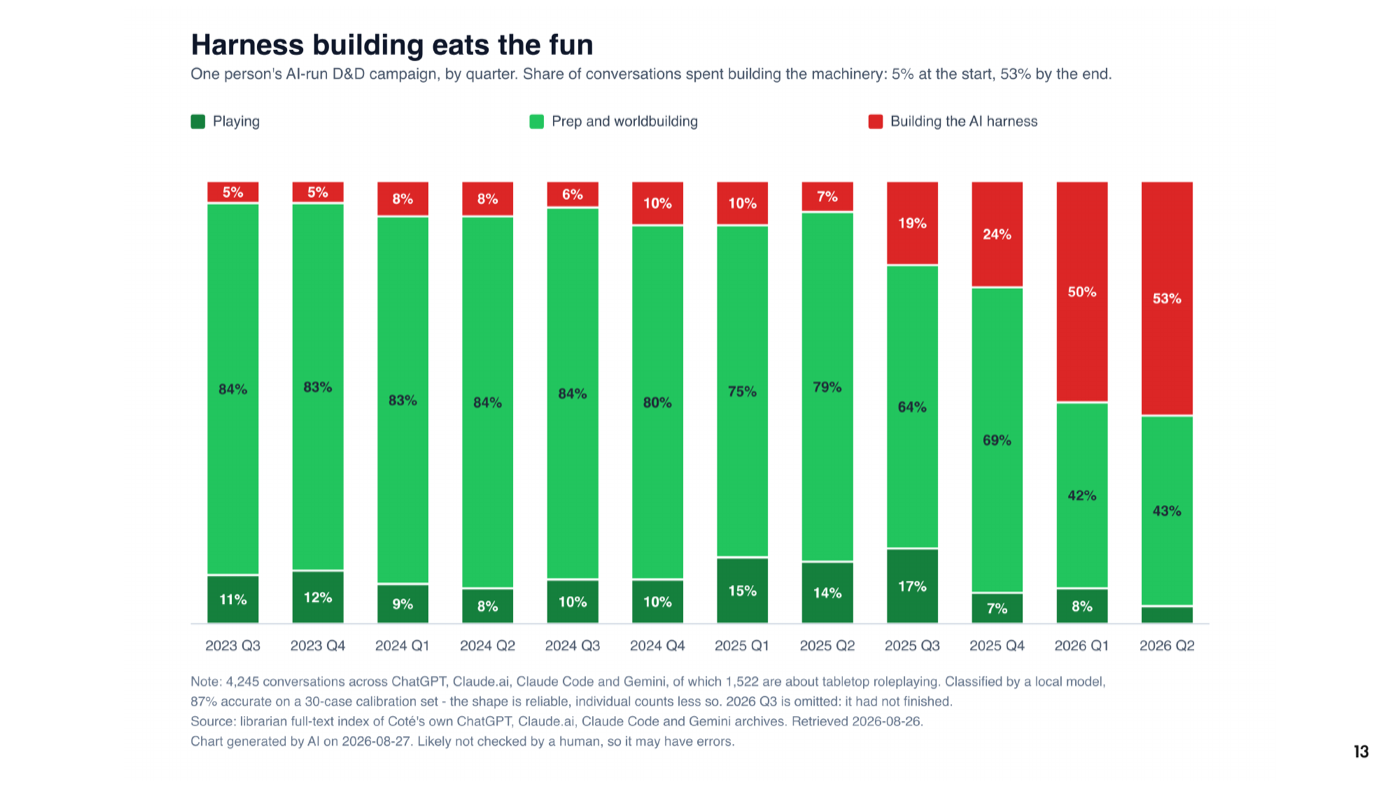
The first thing you encounter is a very typical technology problem: building your own platform, building your own harnesses, specializing them. Over the years I've spent a lot of time figuring out how to play Dungeons & Dragons with AI, from the era when the only interface to AI was copy and paste, all the way to now. What I've tracked here: the green is the good stuff, the actual playing. Over the years, as the harness gives me more power, I spend more and more time building the harness and less and less time playing. You can imagine the normies doing the same thing. They'll spend time customizing things, making their charts look really awesome, figuring out how to get things summarized, and then, "Yeah, but I need the chart." We see this in our own work. If you get stuck building a platform instead of, as I always highly recommend, buying one, you spend a lot of time building the platform, and then: "All right, I'm supposed to be running a bank." You kind of lose track of that. So how do we build that into what people are using, so they don't have to build it themselves?
The one-person enterprise
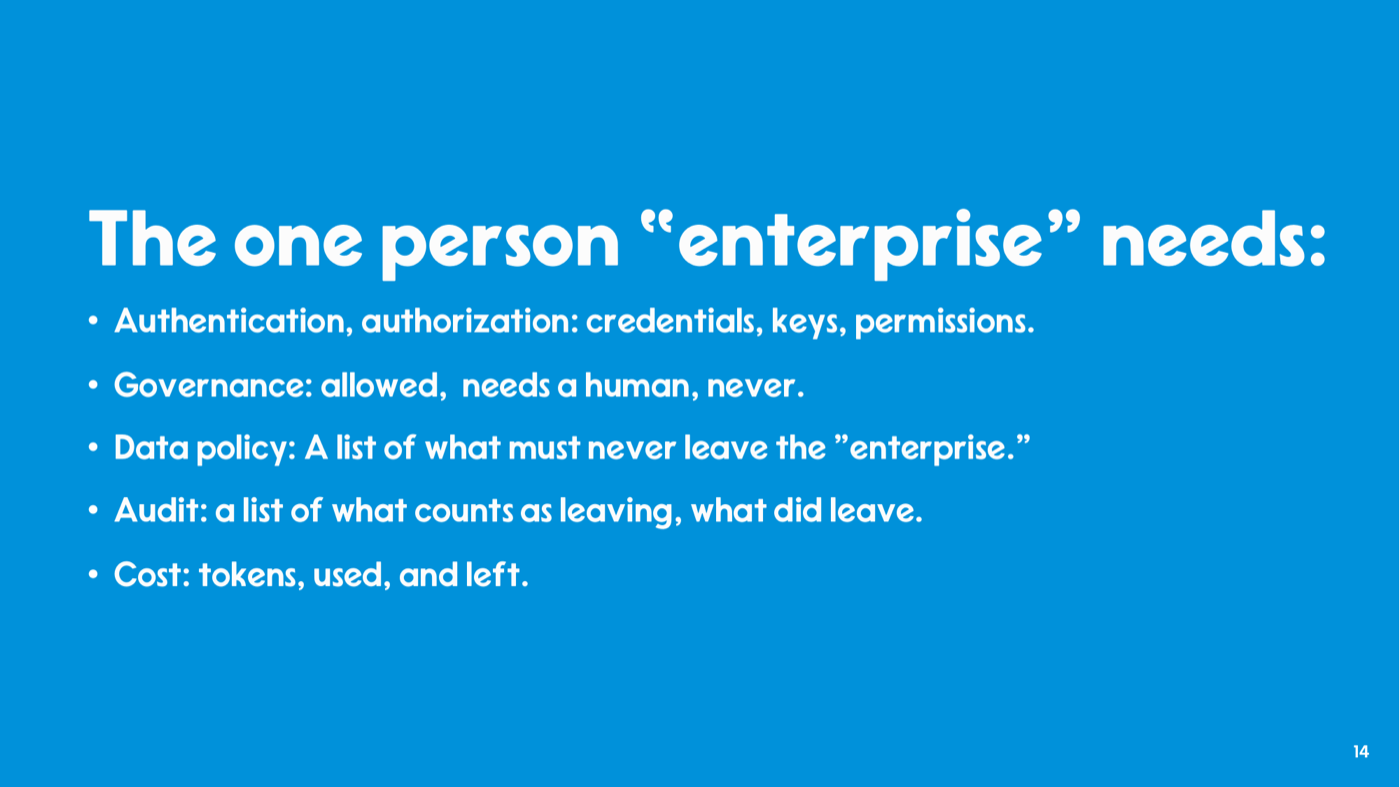
If I start analyzing this, here's the one-person enterprise. This is just basic software, but these are the things you particularly need when you're building things up with AI in a business context. You'll need a bunch of authentication and authorization, logging into stuff, because you can't do anything if you can't log in. You want to govern, you want to audit, you want to track what's happening so you can unwind things and see what's going on. You want a data handling policy: do you want it to know your finances, your health situation? So you start setting up governance for how data is separated, who has access to what, maybe what the retention policy is. Do you want to save your chat transcripts or have them deleted? Think about all the different data sources and tasks you have in an enterprise. These will come up in the same way.
What it costs
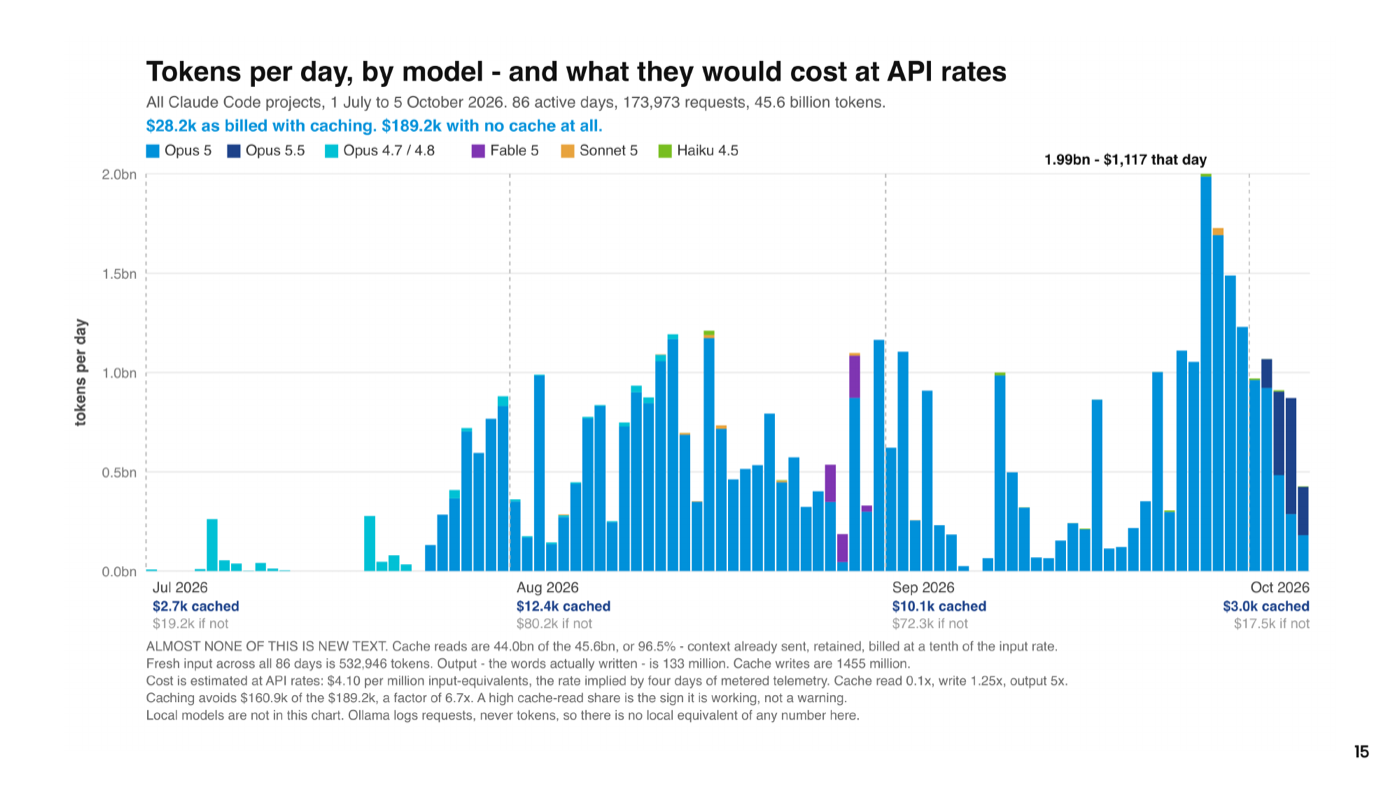
Of course, cost is the other thing you want to manage, the thing everyone cares about. As an example of the cost I've had: I'm lucky, I have those subsidized consumer plans, which are, I don't know, two hundred dollars a month, so I don't actually pay this amount. But as far as I know, if you're doing this in an enterprise context, you're not really allowed to use those. So you can see, over the period I've been using this, how the money adds up. Again, I'm not really programming. Programming is done for me, but I'm not programming an application; I'm doing slides and fighting goblins and stuff like that. And the token consumption is nevertheless real.
A $2,500 presentation
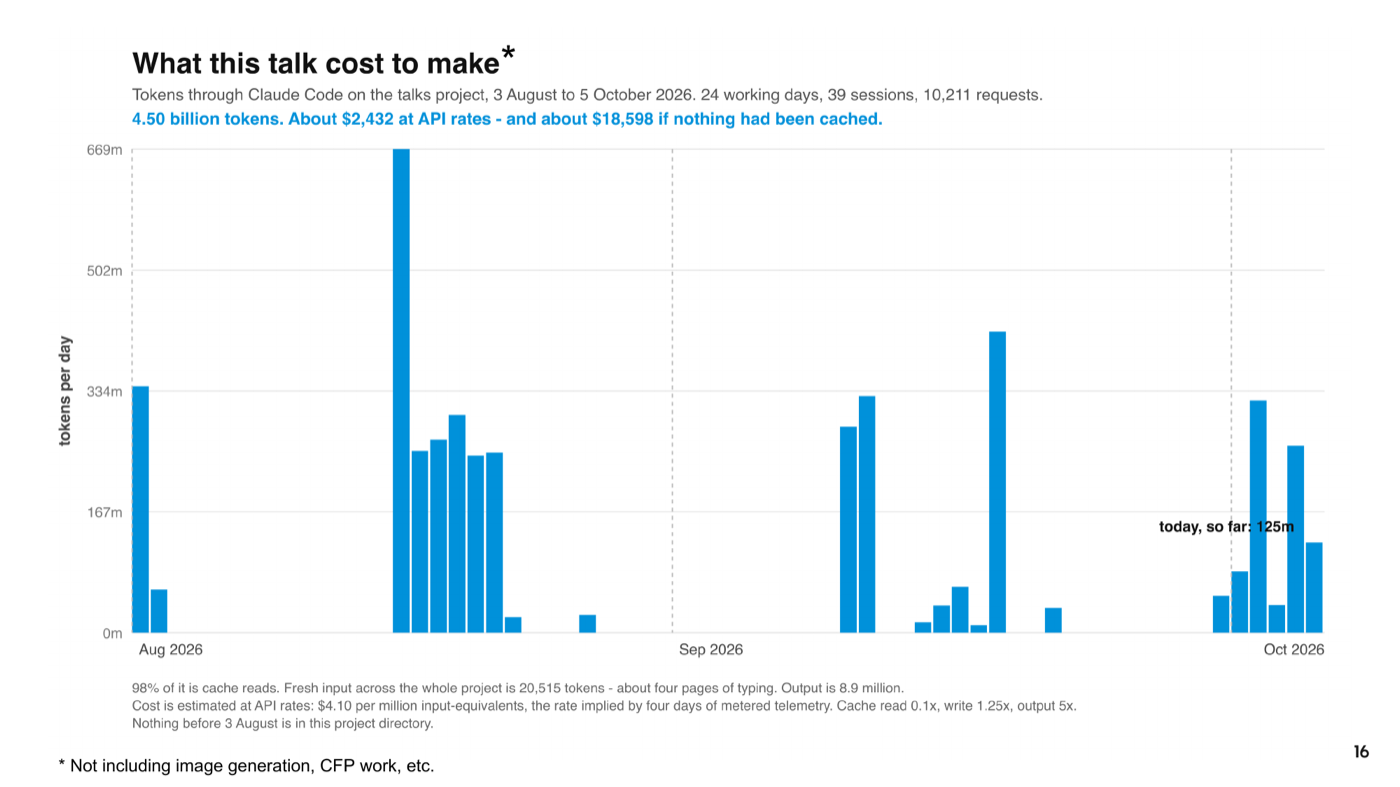
To really narrow it down, here are the tokens it took to make this presentation. If we include caching, this is about a $2,500 presentation. You're welcome, for the non-existent tokens. Thank you for it.
Now multiply by thousands
So that's me, one person doing this: the kinds of workloads I have, the things I need. But the -s in normies is the point. What if there are thousands of these people? They all have a harness, they've all got these tasks, each of them doing all that work. And not only that. If you remember back, ironically it's less fun to play Dungeons & Dragons with an AI when you can build whatever you want, because you end up building, not even world-building, just building tools. It's like spending all my time crafting the dice instead of actually playing. Imagine that spread across all these people, with all those concerns, and you've got a real opportunity, or a problem, if you will.
Enterprise requirements for AI
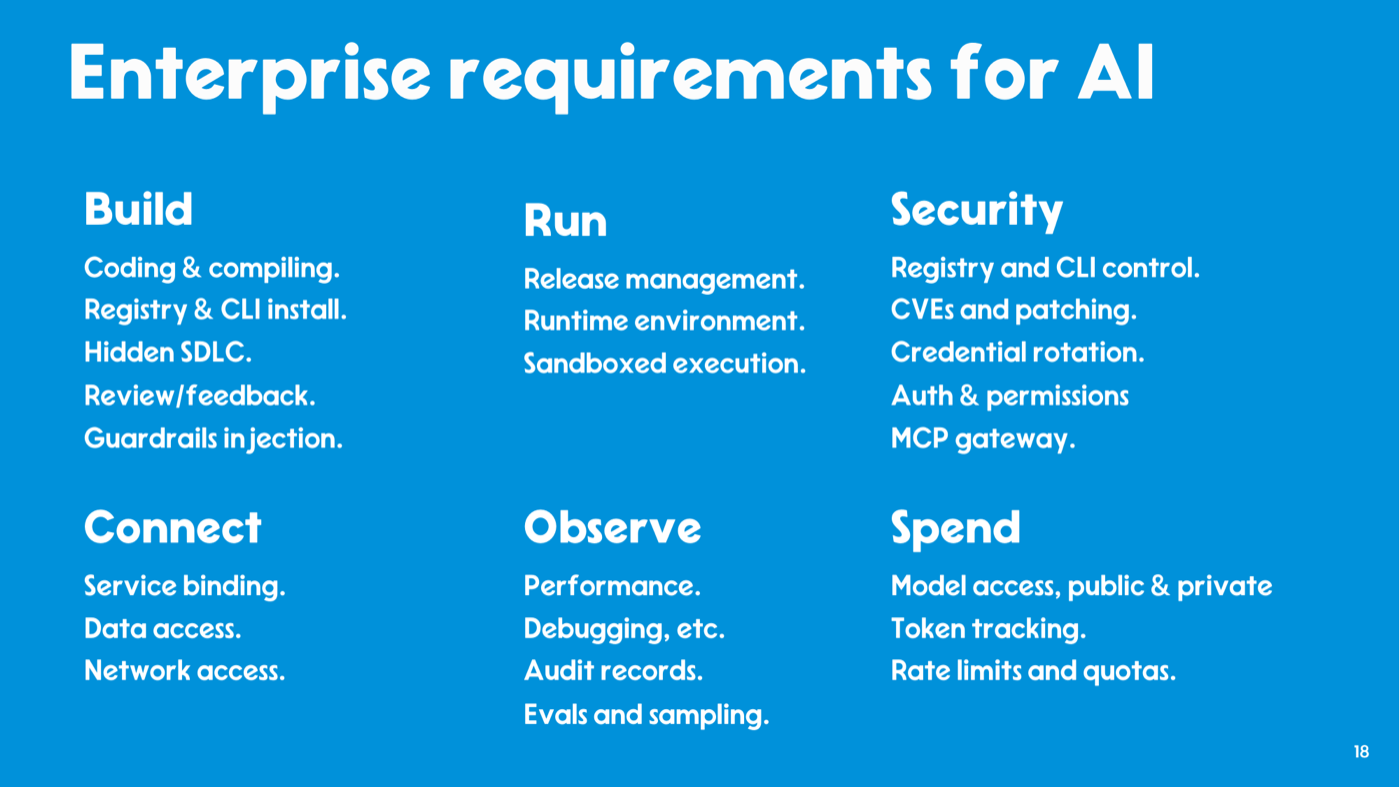
So what are the requirements of what we need to build out for this kind of workload? A lot of this has been talked about today, especially the software development lifecycle, the SDLC, how you manage the flow of software through an organization, again from the developer perspective. You have a team of people who, depending on whether you treasure them or not, know what they're doing, are responsible about it, are intentional about writing their software. They tend to need this set of things. And then you need all your, as we used to say, day-two operations things to run it, to control the spin. If you're writing your own software and running it, this is the set of things you need.
The developer flow
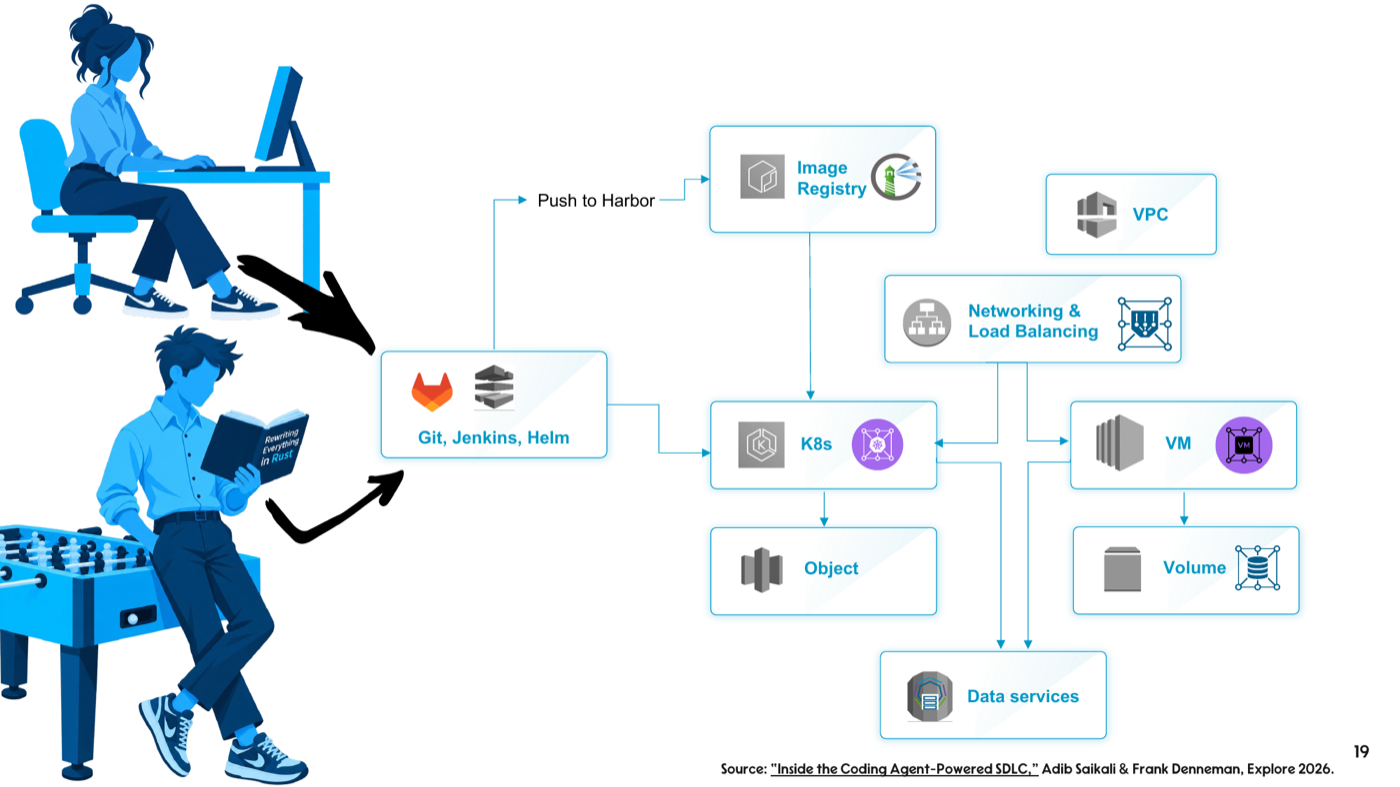
If we look at the core flow we've had so far, broadly the operations world, especially specialized down to SRE and platform engineering: you have an application. If you don't have an application, you're not really needed. You're just there with a blinking cursor and no application. Yay. So eventually there's an application, you hope. You've got developers, and depending on your setup, they write their code and stick it into the pipeline. You're probably using Kubernetes, because everyone says we've got to be using that thing. You've probably got systems set up to manage your configurations, put things in your registry, spread it all out, do your infrastructure, all nicely automated. You've got developers going through that flow, and as has been talked about, you can figure out how to make that work in the AI world.
Then the normie shows up
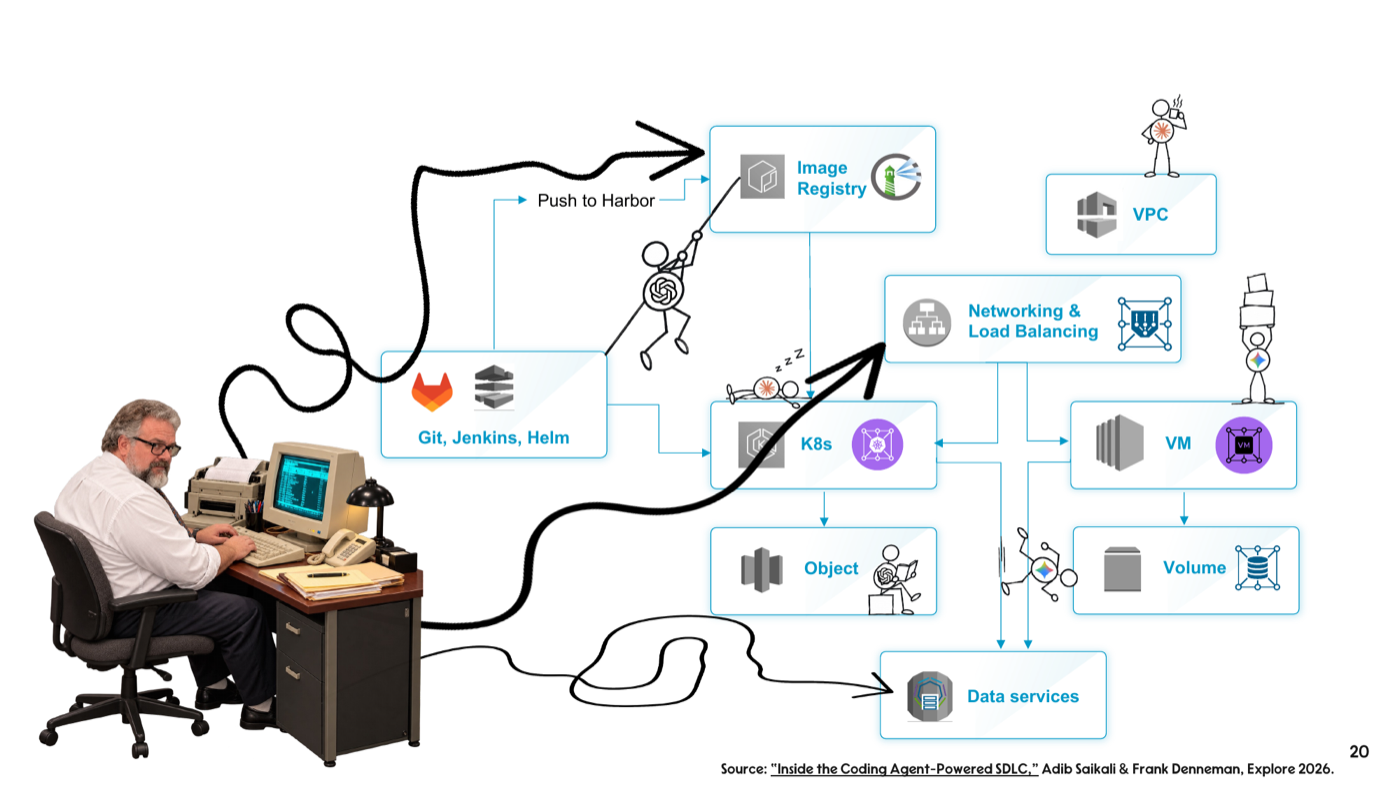
But then consider the normie. The normie doesn't know anything about what an SDLC is. They don't know the policies you should follow. They don't have the best practices a developer or operations person just knows. Apparently some developers don't know this either, but you don't put a password or a key in plain text somewhere. A normie would say, "I've got to do my work. What do you want?" So think about how they'll encounter a system like that. Even though I say I'm not programming, programming is being done on behalf of these people whenever they say, "I'd like to make a full slide out of this CRM dump." And what you'll see, as you can see in your own use, is that the AI also doesn't really care about the SDLC. It cares about getting the job done. It will totally ignore any beautiful system you've set up and go directly to what it wants. As we know, AI is really good at "I need to get into a registry, I need to get over here and set this up." You tell it you want something done, and it says, "I got it, boss," and goes off and does it. Whereas a developer took that ethics training I mentioned, and has some kind of morals and common sense, so they know what to avoid. Not so much the robots. They're all over the place. That's a very basic thing to think about: this is the workload coming at you, and this is the way it thinks.
Give it a happy path
So we can use a basic principle of platform engineering: let's think about how to force things to use our platform. Instead of relying on the AI to figure out how to do everything, why don't we figure it out for it, give it a nice happy path, and tell it about it. That's what we've seen for a long time with platforms: instead of relying on developers, and now these thrilling normies, to know how to use a platform, you try to funnel everything down to a very standard way of deploying things.
Locked down, Cloud Foundry style
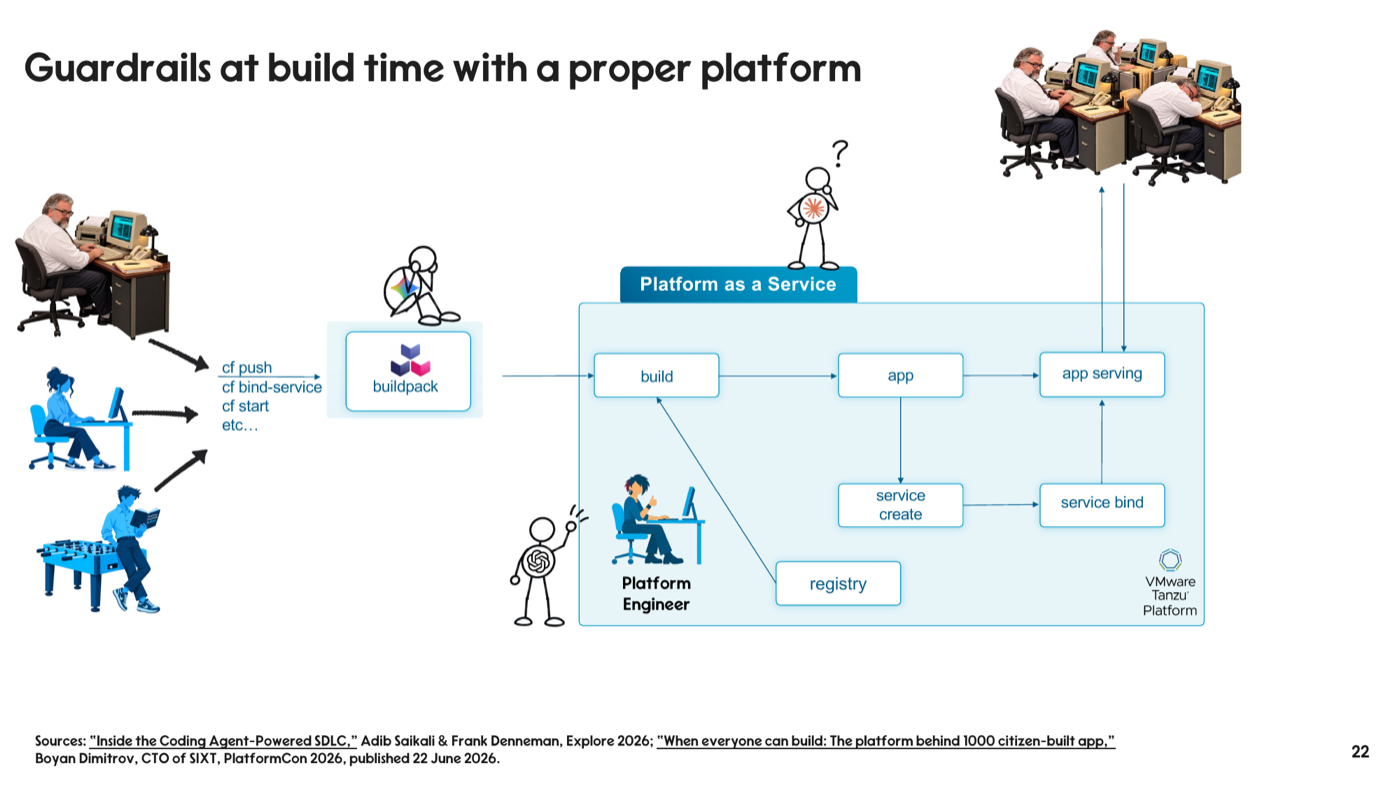
Like I said, I'm from the Pivotal, VMware Tanzu world, so I happen to think the way the Cloud Foundry world does this is the best way of doing things. It's a very strict way of packaging up an application and handing it to the platform to handle. You can't really run around in there doing things; it's extremely locked down. And that's the mindset I think we need, to some extent with humans, but definitely with agents.
Consume, don't provision
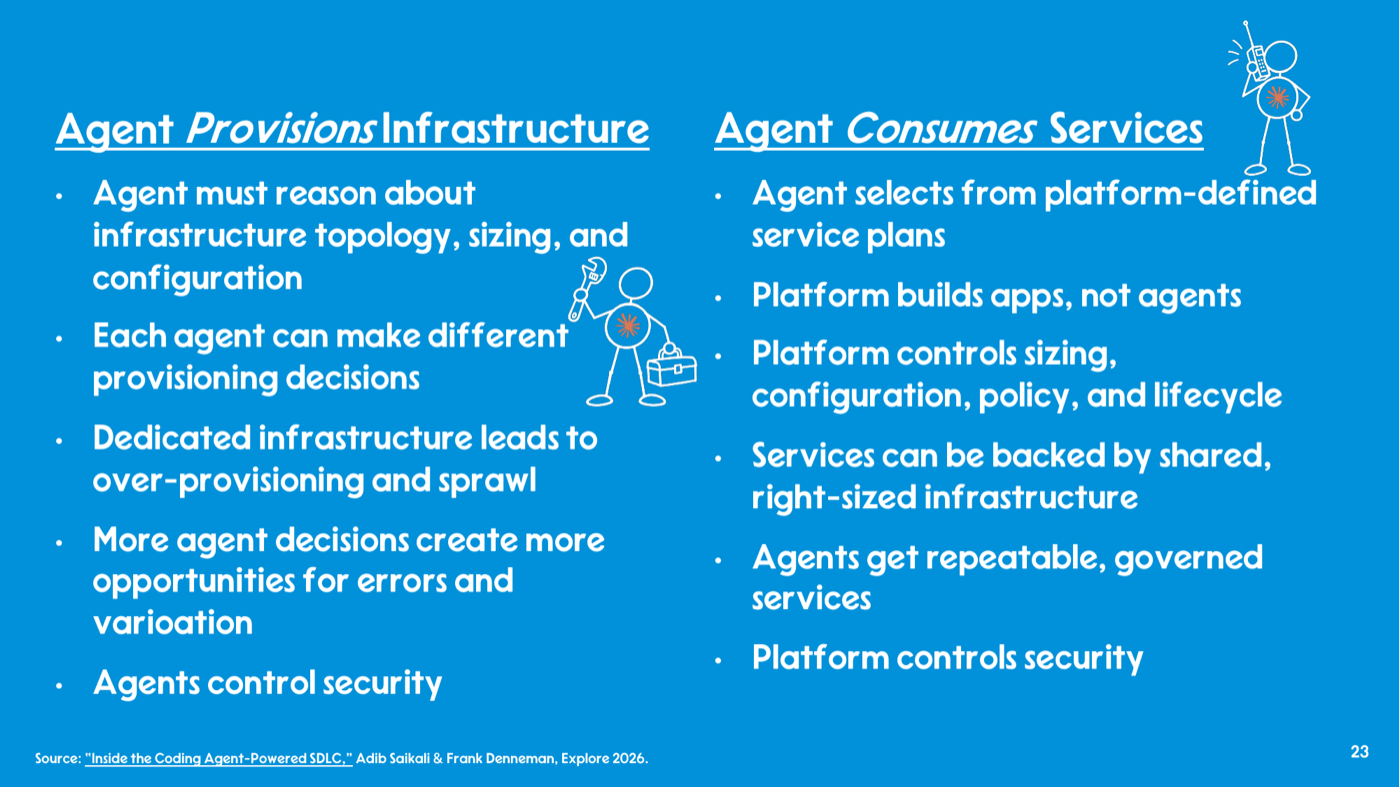
There are always lots of clever phrases for this kind of thing, but instead of saying that the normie, and therefore their agent, does the work of provisioning things and managing them, you want it consuming services, being declarative: "I'd like access to a database," instead of "here's the database, I'll give myself access to it through whatever means I can." So you think about setting these up. I wouldn't even call them golden paths; maybe golden portals, an overused word nowadays; golden ways of doing things, the path you want things to go through, so you have one way of doing it and you manage how things go through there. That's one of the most important things. We can't expect to deal with this workload the way we'd send a developer off with "here's how you do all this, you know Kubernetes, make a Helm chart, configure things the Kubernetes way." I think you'll find the agents might do that, and the normie might get frustrated and say, "I don't know what all this nonsense is, just make me a slide," and the agent says, "All right, boss," and goes off and makes a slide, regardless of what the policy is.
Treat the agent like a human
So the other good mindset is: don't think about it as handling a developer, or a normal workload. Think about treating the agent as a human. How would you allow a human to install their applications, set up access to the databases they need, and, if they're making little departmental applications, deploy them somewhere, and control all of that policy? To that end, it's almost a locking down of the platform you have: not open access to everything, but a very tightly controlled layer on top.
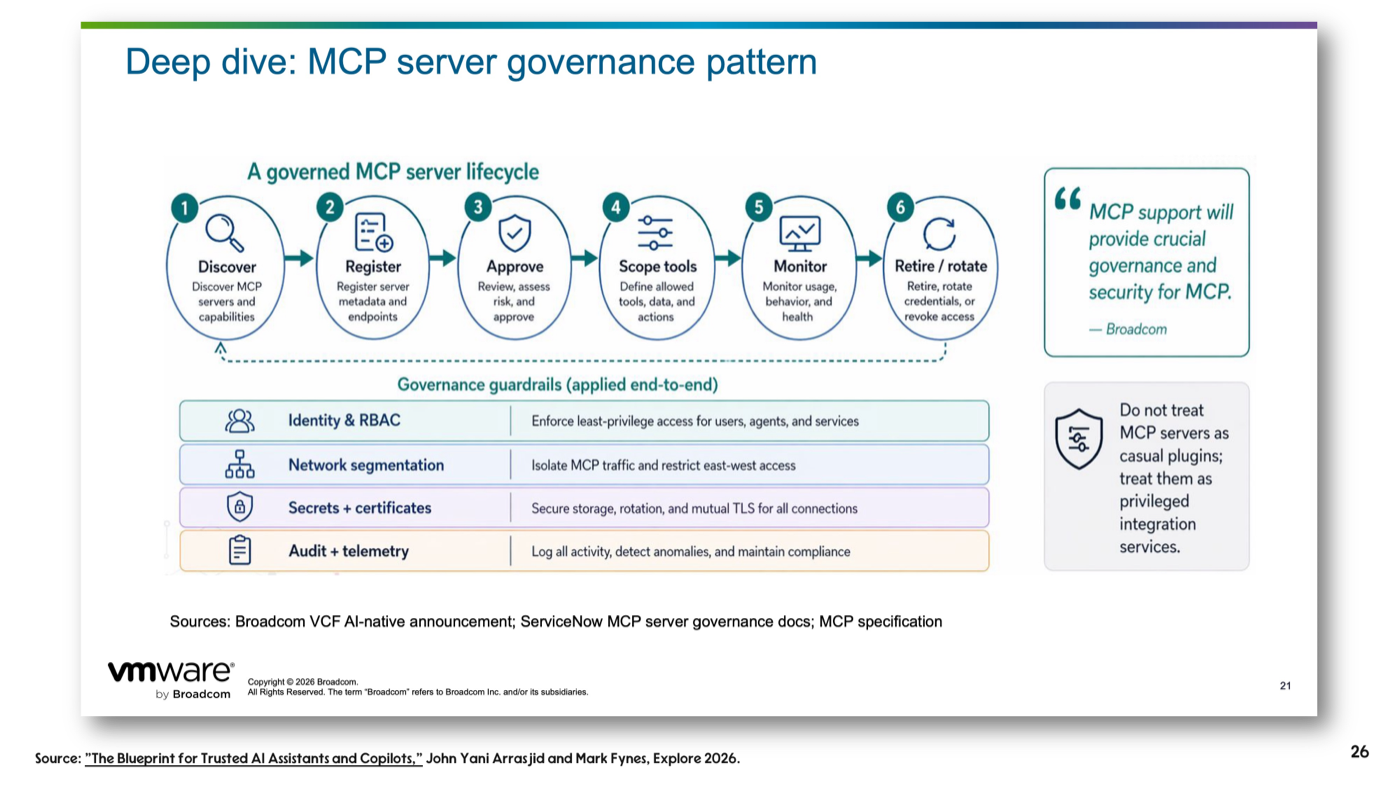
MCP gateways as control points
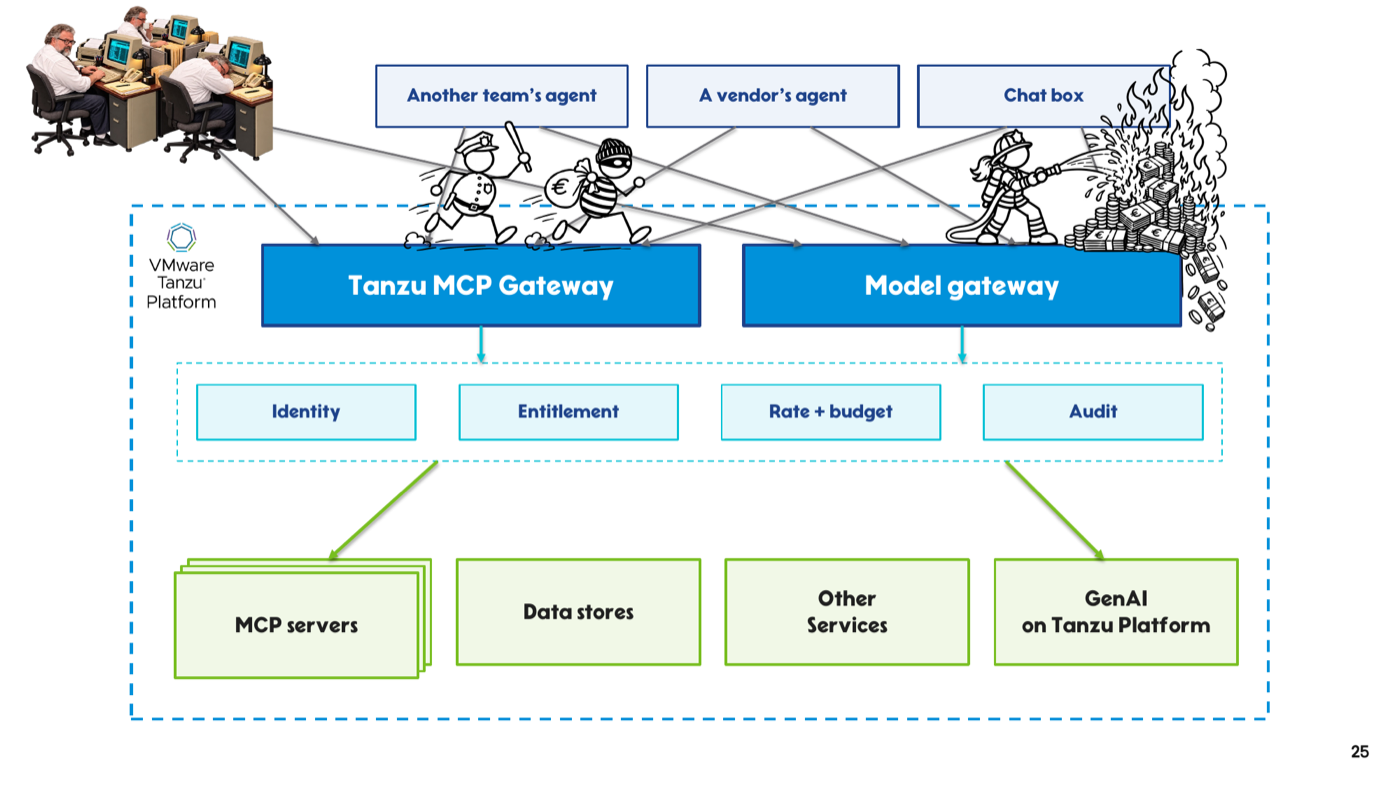
A couple of good examples. I happen to think the Model Context Protocol, an MCP server, is like, why don't you just give me a command line or an API, and then we don't have to worry about all this nonsense. But it is a good example of a control point. At Broadcom, we use the MCP gateway we have, and all the developers, never mind the normies, have to funnel through this gateway, so there's very maximal control over everything, whether it's GitHub or Jira, all the MCP access we have. This gateway is good for developers, but it's going to become especially good, along with all sorts of gateways, for normies accessing things.
Model gateways
Similarly, you can have a model gateway there. One interesting use case: do you really need [unclear; probably "the most expensive model for this"]? The gateway could underhandedly swap something cheaper in for you instead, because slides are really easy to make with AI. So think about these basic things, proxies, gateways, whatever you want to call them, and how you can start funneling all those normie workloads into them.
The CVE surge
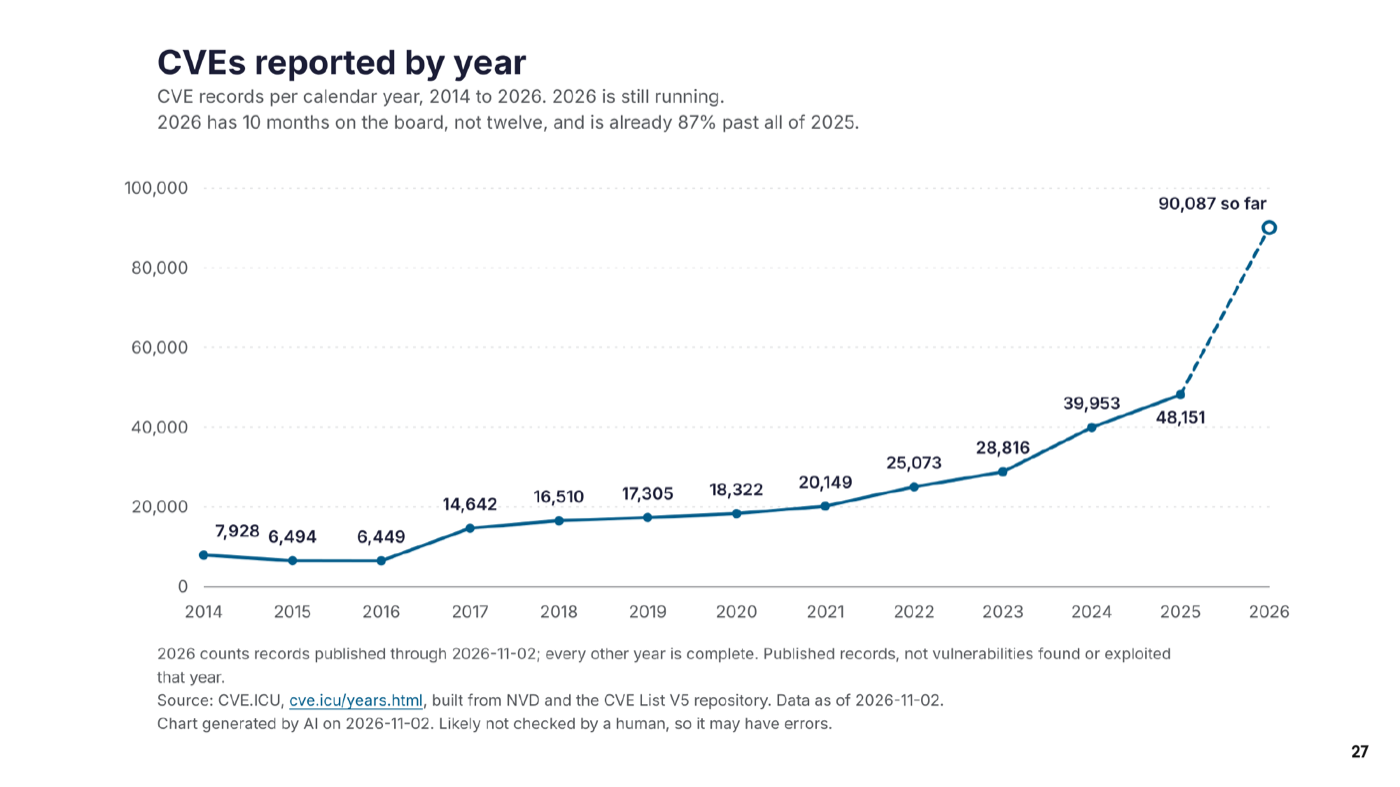
The next thing to pay attention to is, of course, what everyone's freaking out about nowadays. Similar to all the pull requests and everything going on, you see a huge surge in security issues. I think this morning, here at ING, it was six times as many patches as before, and even that is out of hand and difficult to deal with. Not all of these are civilization-ending, critical, high-priority things, but there seem to be one or two of those a month. How does this affect developers, your normal workflow, your SDLC? We've got practices and ways of doing things; people are as responsible as they can be, more or less.
Agents fetch whatever they need
But bring our normie back in here. Again, the normie doesn't know what an SDLC is. "Oh, I'm supposed to configure it to use this thing over here, or that?" And if you observe the way all your agents work: if the agent needs something, it just goes out onto the internet, gets whatever it needs from wherever it can find it, and installs it. Which is not great. You rely on the professionalism of the developers, of the people using it, to know that's a bad idea. But you can imagine, if you don't get ahead of it, the agent saying, because that's how it talks, I guess, "Okay, what I'm going to do is install Homebrew, and then install whatever I need," or "I'm going to pull this container," and it starts assembling things on behalf of the normie, who's thrilled: he gets his slide as soon as he needs it. But that's a terrible way of doing things. It's much better, in a professional capacity, to have your own little enclave of what you're doing.
The free beer era is over
I think this is a broader point about the open source world. Everyone's freaking out about security stuff, rightly so, and it brings up a responsibility thing we've probably been talking about for 30 years. You've got your free open source. It was great that we got it: it's a lot more affordable, it's fun, it's easy to get. But it does seem like the era of free beer is probably over for enterprises. It might be nice to think about how you're supporting the open source community, and, if you're overwhelmed by all these patches, to think about essentially buying into a system that helps you with that. There are all sorts of options out there.
What to do about it
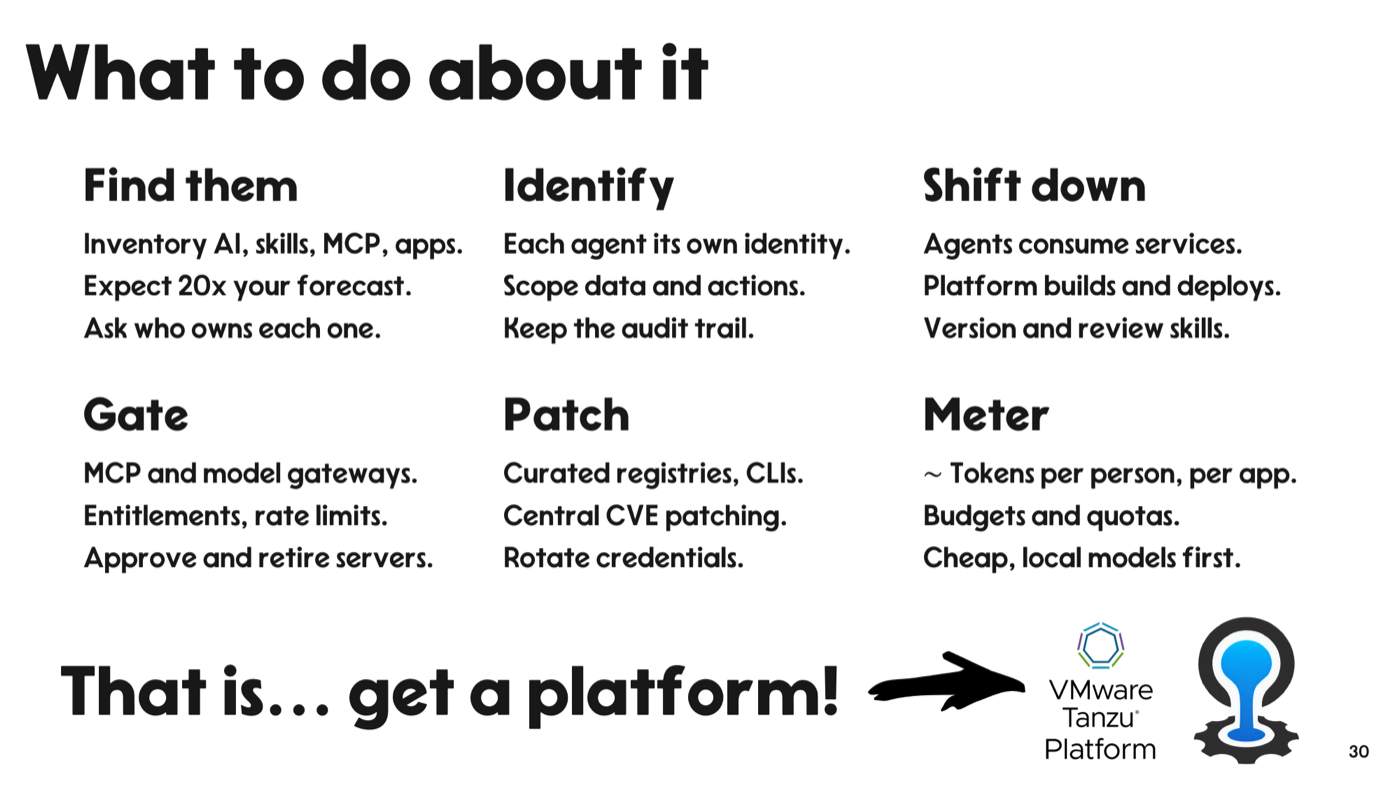
So, to sum it all up, here's a good way to start thinking about this and preparing for it. I'll put it this way: if this workload isn't coming, we're all kind of in trouble, because we need this workload to justify the sheer, huge amount of money in the AI world. Programming with it is cool, but it's not going to support everything. Eventually we've got to bring all these normies over, so it's good to start preparing for them. As always, the first step is to understand what the workload is, which hopefully you understand a bit better now. Start inventorying what they do. Think about how you can have enough control over what they have to configure; set up the registries and the proxies and everything out there. And of course I think the best step is to get a platform that has all of this built in, or enough of it, as it evolves. There are great options out there, if you're interested in that kind of thing.
Thanks
So hopefully you have some notion of how to get ready for our little friend down there. Thanks for being here. You can get the slides from the talk, where you can click on the links, if you're interested in more delightful technical content. Enjoy the last talk, and hanging out for a bit. Thank you.